Showing posts with label Empire Builder. Show all posts

Friday, April 6, 2012

Photo of the Week: 4/6/2012

Last spring, you may remember that the entire Midwest seemed to be flooded.  While the Forsyth Sub and the Glendive area did experience some flooding, it was minor compared to what was experienced in other areas, such as Minot, ND.  Various washouts kept things moving slowly on the Forsyth Sub.  I was still in training, and I decided to take advantage of all the time off we were getting between trips.  I decided to visit my grandparents, who live in a Long Island suburb of New York.  Being a last minute trip, flights could not be found for even a slightly reasonable price, so I decided to take Amtrak.  When I arrived at the depot in Williston, ND, the ticket agent began to explain that there would likely be delays because of the flooding, and then started a surprisingly elaborate description of how all the water was effecting the railroad.  I stopped her and explained that I was employed by the BNSF, and I understood exactly why Amtrak would be delayed.  She looked relieved that I was not complaining to her!  A few minutes later the Empire Builder pulled into the station, and I boarded.  The next morning, we had a service stop in St. Paul, MN, and I decided to step off the train and take a look around.  I had been there before on a few occasions, but they were all after dark.  This was my first daylight visit.

What I found in St. Paul was a former Milwaukee Road Skytop lounge car, coupled to a full length dome car.  I knew they were there, but had never gotten a good look at them, so I took the opportunity!  The Skytop cars have always intrigued me, because they are so unique, and an icon of the Hiawatha trains that the Milwaukee Road once ran across the country, between Chicago and Tacoma, WA.  These care are available for charter, and one day I'd like to do just that!  Here they are, with another private car, idling at the St. Paul depot.  The Empire Builder was behind me.


I think some preparations were being made to move the car, because there were some people working on and around it, and it was connected to power.  I do not know what the plan was for it though.  I do regret that I did not ask one of those people if I could see the interior of the car.  I keep telling myself that someday I will get to charter and ride these cars, although that day may be a while in the future still!

We would love to see your pictures!  If you have any pictures you would like featured on Photo of the Week, please email it to us with your name, a brief description of the photo, and of course, the photo itself, in 800 x 600 or larger resolution.  We will let you know if your photo is chosen, and you will receive full credit for your submission.

Thursday, September 8, 2011

History of the Empire Builder

On Tuesday, we talked about Amtrak's Empire Builder. Today, we are going to talk about how that train came to be, which takes us back to the late 1800's, long before anyone had ever thought of Amtrak. The Great Northern Railway was created by tycoon James J. Hill from the St. Paul and Pacific Railway, and several other railroads he owned at the time. The railroad was headquartered in St. Paul, and James Hill had a dream of connecting that city with the Pacific Ocean. His dream was realized on January 6, 1893, in Scenic, WA, when the countries northernmost transcontinental railroad was completed.

James J. Hill, circa 1890.
Image from Wikipedia.
James Hill became known for keeping the work on the railroad going, even against obstacles. His goal was the shortest, straightest, and flattest route possible to the Pacific Ocean. He had no interest in developing Rocky Mountain scenery, he just wanted to develop a railroad to the Pacific. He did a lot of the route planning himself, and even rode the proposed routes on horseback. If an area the railroad was expanding to did not have enough industry, Hill would buy out a company and bring the industry in, just to generate rail traffic and produce business for the line. He let nothing stop him, and he refused Federal money, and only accepted a few land grants. The Great Northern was the only transcontinental railroad built without any Federal financial support. Because of Hill's attitude and ruthless expansion, he became known as the Empire Builder. Hill died in 1916, and never saw the launch of the train named for him, the Empire Builder.

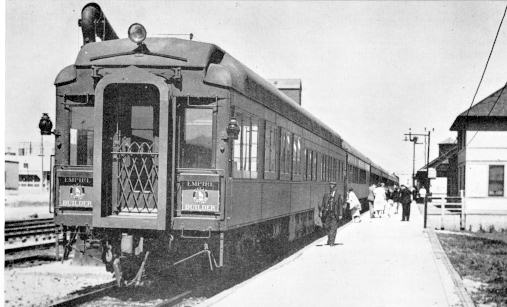
The Empire Builder Solarium observation car, idles in
Shelby, MT. Photo from www.gngoat.com.
On June 11, 1929, the Great Northern decided to launch a new premier train, and they chose to name it the Empire Builder, in honor of James Hill. The train displaced the Oriental Limited as their premier train, and it operated between Chicago and Portland and Seattle, using Chicago, Burlington, and Quincy trackage between Chicago and Minneapolis. The train was a 14 car train, pulled by a 4-8-4 steam locomotive. For World War 2, the service was altered to accommodate the higher demand for the railroad. After the war, in 1947, the train was re-equipped for the first time.

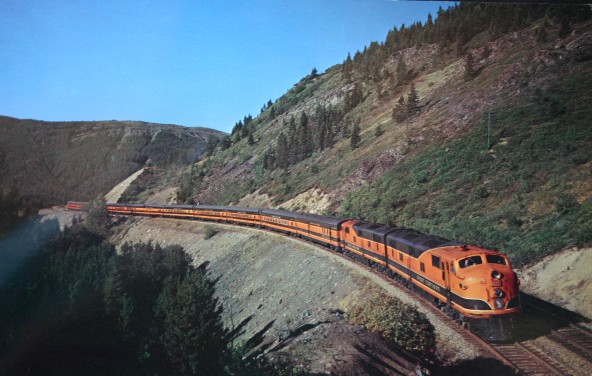
The 1947 Empire Builder, near Glacier
Park, MT. Photo from www.gngoat.org
In 1947, the Great Northern gave a new look to the Empire Builder. It was re-equipped with new, streamlined passenger cars, and the steam locomotive was replaced with a pair of shiny new diesel locomotives. This is when unveiled its famous orange and green paint scheme, which became a trademark of the Great Northern. The diesels and cars were all painted to match, and they really stood out in the new Empire Builder paint scheme. The new diesels were streamlined to match the new passenger cars. Diesel was still new. Premier trains got diesels first, and the steam locomotives kept pulling the less well known trains and the freight trains. In addition to being new power, diesels were a status symbol for the railroads.

The Empire Builder, after the 1955 addition of the dome
care. Photo from www.greatnorthernempire.net.
In 1951, the Empire Builder was re-equipped once again. A new set of diesels was assigned to the train, and in 1955, dome cars were added to the passenger cars. The Empire Builder boasted more seats under domes than any other train. Several coach dome cars were added, and one full length dome car was added for the First Class passengers. The train featured food service in three cars, including the dining car, the full length dome, and the coffee lounge car, better known as the Ranch car. The Ranch car featured a western themed decor, with a variety of options for dining, from light snacks to entire meals. There was bar seating, table seating, and lounge seating. The full service dining car served three meals per day, all cooked to order. In the full length dome, First Class passengers could order food and drinks while enjoying the view of the scenery under a large, glass dome. Attendants were happy to deliver food to any sleeping car accommodations or coach seats as well.


Drawing of the interior if the Ranch car, taken from a Great Northern
publication entitled, "The Ranch."
The entire train had a western theme in the artwork. Many of the cars were decorated with northwestern Indian artwork. Some, like the Ranch car, had a western, ranch theme. With the hide seats and wooden partitions, the ranch car was supposed to make passengers experience the areas of North Dakota and Montana that they were travelling through, and looking at outside the windows. The dome cars gave passengers some spectacular views as they traveled along the Mississippi River, through the Rocky Mountains, over Stevens Pass, and through the Columbia River Gorge.

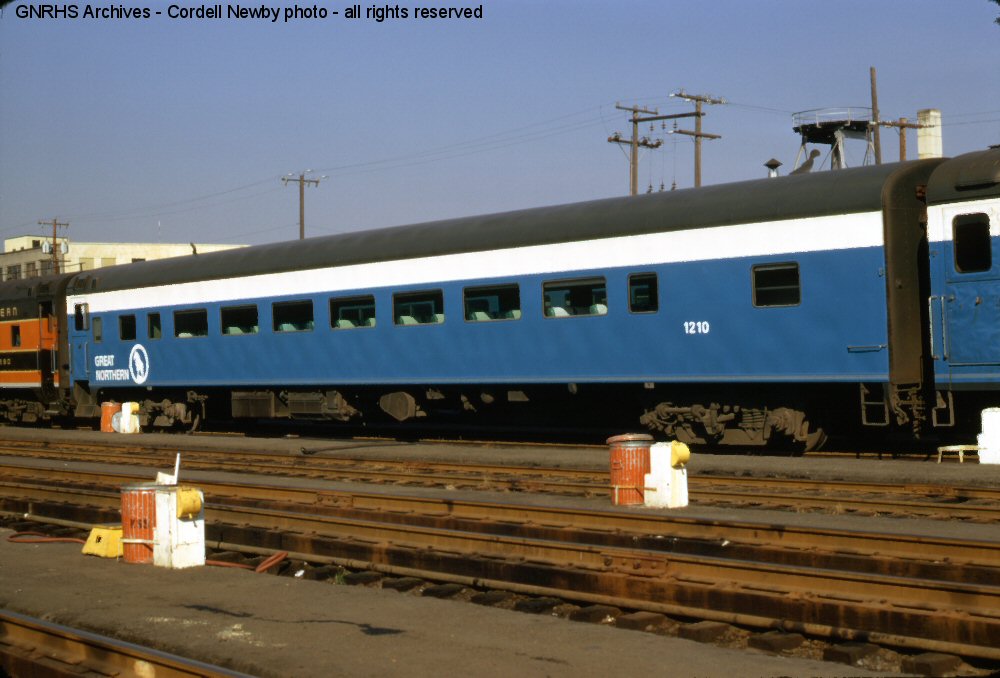
An Empire Builder coach in the "Big Sky Blue" paint
scheme. Photo from GN Historical Society archives.
Train travel during this time was often viewed differently than it is today. Many people have heard the phrase, "Getting there is half the fun." Railroads went to great lengths to ensure that the trip would be as much a part of the experience as the destination. Rail travel was stylish, and celebrities rode well known trains, because they wanted to be associated with that train, and all the style and luxury that went with it. The Empire Builder, in its day, was one of those trains.

In its later years, the Great Northern decided to change the company image a bit. Passenger trains, including the Empire Builder, were painted in what became known as the "Big Sky Blue" paint scheme. This lasted for a few years, until the Great Northern Railway ceased to exist.

A former Great Northern sleeping car, from the Empire
Builder
, in the Burlington Northern "Hockey Stick" paint
scheme. Photo from www.rrpicturearchive.net.
In 1970, just over a year before the creation of Amtrak, the Great Northern Railway merged with the Northern Pacific Railway, the Chicago Burlington & Quincy Railroad, and the Spokane, Portland, and Seattle Railway, to form the Burlington Northern Railroad. The Burlington Northern continued to run the passenger trains of all four of its predecessors for thirteen months, until Amtrak was created, on May 1, 1971, and took over most passenger operations nationwide. During the time Burlington Northern ran passenger trains, they were repainted again, to a paint scheme known as the hockey stick scheme. When Amtrak was created, on 1 May 1971, they took over all of the Burlington Northern passenger trains, including the Empire Builder. Since Amtrak took over, new equipment has been introduced, and the route has been changed a few different times. While they still run a train known as the Empire Builder, it has changed quite dramatically since it was the pride of the Great Northern.
Photo of the Empire Builder in Montana. Photo is from the rear cover of a Great Northern publication entitled, "Great Domes on Great Northern's Greatest Train." This booklet was published in 1955 when the GN introduced dome cars to the Empire Builder.

Wednesday, September 7, 2011

Prototype Information: Amtrak Equipment

Today I am going to stray from the ordinary Wednesday posts a bit and talk about Amtrak equipment.  As some of you may have noticed, yesterday we launched our new series profiling Amtrak routes, and we thought it would be a good idea to talk about the different equipment Amtrak uses and the amenities offered by each.  We will not be talking about the specifics of every piece of equipment here, because there are some cars that are very route specific, such as the Pacific Parlour.  For such route specific cars, we will talk about them when we profile their route.  Today we just want to talk about the different equipment, and the differences between a cafe car and a dining car, for example.

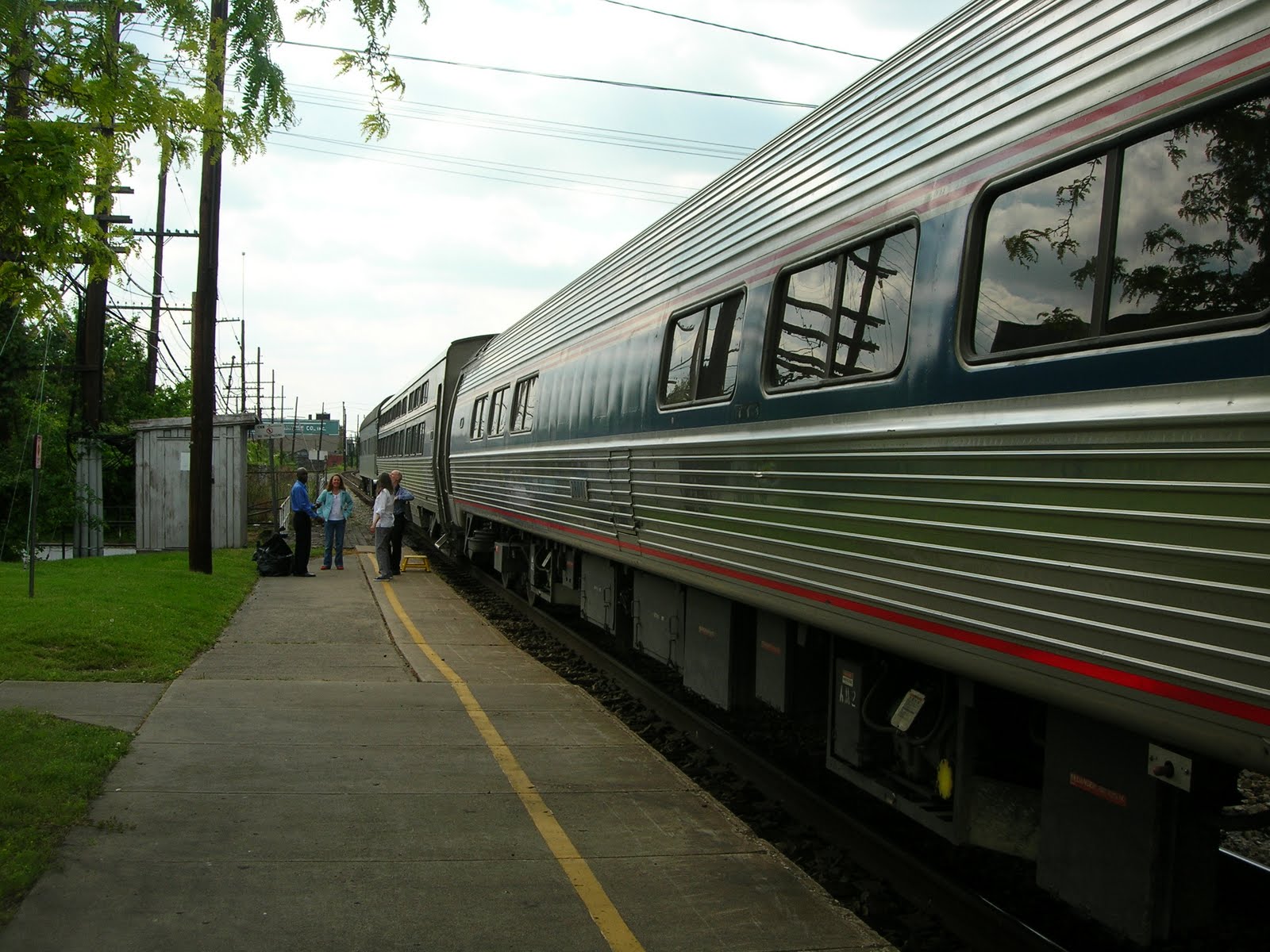
Amfleet cars in Huntington, WV, on the Cardinal.
Photos by James Ogden, unless otherwise noted.
Amtrak has two general types of equipment they use, depending on the route.  Typically eastern routes, which serve New York, use single level equipment.  This is due to restrictions imposed by the tunnels leading into Penn Station in New York.  Most of these single level cars are called Amfleet cars, and are easily distinguishable by their tube shape.  Amfleet cars include coaches and cafe cars.  For single level sleepers, Amtrak uses newer cars, called Viewliners.  On long distance trains, these can usually be found with Amfleet cars, and are distinguishable by their boxy shape and two rows of windows.  Single level dining cars are typically much older than Amtrak, and are known as Heritage equipment.  Some Amtrak diners were built as long ago as 1948.

Superliners in Glenwood Springs, CO, on the California Zephyr.
On western routes, where the New York tunnel restrictions have no influence, Amtrak typically uses bilevel equipment, called Superliners.  Superliners come in coaches, sleepers, cafe/lounge cars, and dining cars, and a transition sleeper, which is typically used as the crew quarters.  From the exterior, Superliners are easily distinguished because they have two levels, and just one center door, in the lower level of the car.  Some California routes use bilevel cars modeled after the Superliners, which look very similar.  Those can be distinguished from Superliners by the paint scheme usually, and because they typically have two sets of doors, at either end of the lower level.

On the Northeast Corridor, which runs from Boston to Washington, DC, Amtrak has electric trains.  The regional trains on that route use Amfleet cars, hauled by electric locomotives.  The high speed trains, known as the Acela trains, are trainsets with an aerodynamic locomotive at each end and single level high speed rail cars between them.  We will talk more about the specifics of the Acela equipment when we talk about the northeast corridor routes.  Outside of the electrified Northeast Corridor, Amtrak pulls the trains with diesel locomotives.

Interior of an Amfleet coach, on the Cardinal.
On Northeast Corridor regional trains, and on long distance trains that serve New York, Amtrak uses single level equipment, because of restrictions imposed by the tunnels under the Hudson River and the East River, which allow for access to Penn Station, in Manhattan.  Amfleet cars can be found on all the Amtrak trains that serve New York.  Typically shorter distance, regional trains, including the Northeast Regional service, Empire Service, and Keystone Service, will all have several Amfleet coaches, an Amfleet cafe, and very often an Amfleet business class car.  The layout in a coach or business class car is similar.  There are rows of seats for the length of the car.  There are overhead luggage racks running the length of either side of the car, above the seats.  At one end there are a couple of restrooms and a larger luggage rack.  Doors at either end of the car allow for access to cars ahead and behind.  The doors to exit the cars at stations are located at either end of the car as well.  Coaches have two seats on either side of the aisle, while business class cars typically have two seats on one side of the aisle, and just one seat on the other side.  In both coach and business class, the seats are roomy.  They are wide and offer considerably more leg room than someone may be accustomed to if they fly a lot.  On coaches that are used on long distance routes, there is even more leg room available, as there are fewer seats in each coach.

Amfleet cafe car exterior.
Photo by Jeffery Tritthart.
Available on www.railworksamerica.com
On all single level trains, Amtrak also operates an Amfleet cafe car.  The cafe cars are distinguishable from the outside because they look like typical Amfleet cars, but they are missing a pair of windows on either side, right in the center of the car.  On the inside, this is where the food service counter is located.  There are a few configurations for cafe cars, but they all have a food service counter at the center of the car.  This is where you go to get your food.  They have hot and cold snacks and beverages available.  This food is what you might compare to airplane food.  The hot stuff is all frozen and the microwaved to order.  While the food is good, it would not be considered gourmet by most.  Also, on long distance trains, with a dining car, it is more expensive to eat an entire meal in the cafe car than in the dining car.

Food serving area in an Amfleet cafe car.
Photo from www.nationalcorridors.org.
Also inside the cafe car is a dining area.  Usually, on either end of the serving area there are tables, with seats that face each other across the table.  Each table can accommodate up to four people.  The tables are available to anybody, and a walk through the cafe car will often reveal that people also use the tables to play card games, write, or just socialize with other passengers, besides eating of course.  It is also not uncommon for the Conductor to make an office out of one table.  On some trains, where there are not enough business class passengers to necessitate an entire car, the cafe car will have a small business class section on one end.  Other cars, typically used on long distance routes, will have a small lounge, with an informal seating area and some smaller tables, in one end of the cafe car.  Of course, passengers do not have to stay in the cafe to eat and can bring food back to their coach seat or sleeper room as well.

Amfleet cafe and Viewliner sleeper, in Huntington, WV, on the Cardinal.
On long distance trains serving New York, you will also find sleeping cars and dining cars.  Single level sleeping cars are almost always Viewliner cars, which were built for Amtrak in 1995 and 1996.  The original intention was to build Viewliner coaches, sleepers, diners, and lounges, but due to limited funding, Amtrak was only able to order 50 sleeping cars.  They replaced many older, Heritage sleepers.  Viewliners are recognizable for their boxy shape and for having two rows of windows.  The two rows of windows allows passengers in the upper and lower berths in each room to have a window.  On every sleeping car there is a shower.  It is a community shower, so long, hot showers are usually frowned upon, as it wastes the water carried on the car, and it means fewer people get to use the shower.  There is also an attendant on each sleeper, who will configure the rooms for sleeping or for sitting, and who keeps the shower tidy and the snacks stocked.  As you might have guessed, there is also a small, self serve, snack counter on each sleeper.  Usually this is stocked with fresh fruit, cookies or crackers, juice, coffee, and tea.  In all sleeping car accommodations, meal service in the dining car is included in the ticket price.

Viewliner Roomette, in the night tine configuration,
seen from above, on the Lake Shore Limited.
Inside a Viewliner sleeping car, there are several room options available.  The smallest, and usually the cheapest, is called a roomette.  A roomette can accommodate up to two people.  The room is very small, but it is adequate for two people.  The daytime configuration has two wide seats which face each other.  At night, the two seats fold down to become the lower berth, and the upper berth pulls down, out of the ceiling.  Inside the room, there is also a toilet, sink, and luggage rack and wastebasket.  In the roomette, the toilet and sink are not in a separate room, so someone may have to leave the room if you are travelling with someone.

If you are looking for larger accommodations, a Viewliner Bedroom might be the way to go.  This is larger than a roomette, and usually costs a little more.  A bedroom can also accommodate two people, but gives everyone a little more space.  During the day, a bedroom has two seats next to each other.  These convert to the lower berth at night, and again, the upper berth pulls out of the wall.  The bedroom has the same features as a roomette, but also includes an in room shower.  A Bedroom Suite, which can accommodate up to four people, is created by combining two Bedrooms.  Since it is a combination, it has four berths, two upper and two lower, and two sinks, toilets, and showers.  An handicapped accessible bedroom is also available, which accommodates two people, and features the same amenities as a Viewliner Bedroom.  An accessible bedroom  is designed for easier access and more space inside, for easier mobility.  All rooms have 120 volt electrical outlets.

Amtrak Heritage dining car, with an Amfleet cafe on the left and a
Viewliner sleeper on the right.
Photo from www.railroadfan.com
Single level dining cars are some of the oldest passenger cars still running on the Amtrak system, and as such are known as Heritage cars.  They all date back to before Amtrak, some built as long ago as 1948.  They were all built in a time when passenger trains were operated by what we now know as freight railroads.  At one time, private railroad companies ran all the trains in the country, whether they were freight or passenger. Many Amtrak trains take their names from their previous, privately operated counterparts.  Amtrak serves three meals a day in the dining cars, provided that the train is running for all the meals.  The dining car offers sit down meal service, similar to a restaurant.  Due to limited seating, dinners are served by reservations.  Breakfast and lunch are served on a first come, first served basis, but if the dining car gets crowded, the attendants may take your name and call you when a table becomes available.  The tables each seat four people, and because of this limited seating, passengers travelling alone or in a group of less than four may be required to sit with other passengers on the train.  This is a great opportunity to meet and talk to some fellow travelers.  Meal service in the dining car is included in the ticket price for sleeping car passengers.  For coach passengers, meals are available at an additional cost, although it is typically cheaper to eat a full meal in the dining car than in the cafe car.

Superliner coach, during a snowstorm, in
Denver, CO, on the California Zephyr.
On western routes, and a few eastern routes that do not go to New York, Amtrak uses Superliner equipment.  Superliners are all bilevel cars, with the majority of the accommodations on the upper level of each car.  The functions of coaches, diners, sleepers, and cafe cars is basically the same, although the interior arrangements are a little different.  Boarding and disembarking the Superliner equipment is handled through a door at the center of the car, on the lower level.  Bathrooms, showers, changing rooms, and a luggage rack can also be found on the lower level of each Superliner.  There is a set of stairs in the center of the car for access to the upper level.  The upper level is where the majority of the accommodations are found. On the upper level there are doors on each end of the car for access to other cars on the train.

Superliner coaches have seating on a small part of the lower level, and on the entirety of the upper level.  Just like with the Amfleets, the coaches feature wide seats with ample legroom.  Coaches have two seats on each side of the aisle that runs the length of the car.  There are overhead luggage racks above the seats on either side, and a larger luggage rack at the bottom of the stairs, on the lower level.

Superliner dining car interior, on the California Zephyr.
Superliner dining cars have all the dining seating on the upper level.  This is the only car which passengers cannot access the lower level, as it is where the kitchen is located, and it is only accessible to crew members.  For passengers who cannot make it up the stairs to the upper level, the car attendant will bring meals from the dining car back to their seat or sleeper accommodation.  Just like on the Heritage diners, breakfast and lunch are served on a first come, first served basis, and dinner is served by reservation.  The dining car attendant will announce when he or she will be coming through the train to take reservations, and passengers should speak to him or her as they walk through if they want to have dinner in the dining car.  Just like on the Heritage diners, if the dining car fills up during breakfast or lunch, one of the attendants will take down names and call people back to the dining car as tables open up.  Again, due to limited seating, passengers traveling alone or in groups of less than four may be asked to share the table with other passengers.

Superliner lounge, on the California Zephyr.  On the lower
level is the cafe area.
Superliner cafe cars are a bit different than their Amfleet counterparts.  They have the same menu as the Amfleet cafe cars, but they are also the lounge cars, and as such, are easily recognizable by their large windows.  The lower level of the car is where the food service area is located.  Also on the lower level, there are tables and seats, similar to the dining car and Amfleet cafe cars.  Each table can seat four people, in seats that face each other across the table.  On the upper level of the cafe car is the lounge area.  The lounge features large windows, which curve up onto the roof of the car.  On the upper level, there are more tables at one end of the car.  The rest of the car is lounge seats, which face the windows, and small tables between them.  Some of the seats swivel, while others are fixed in place.  This is the car to be in on most western routes, as it affords the best views of the scenery.  Of course, as the train gets closer to scenic areas, the lounge car fills up, so it is best to get there early to grab a seat, if possible.

A Superliner Roomette, in the daytime configuration, on the Empire
Builder
.
Sleeping car accommodations on Superliner equipment is similar to those of Viewliner sleepers.  The smallest room available, and usually the cheapest, is a roomette.  On Superliners, roomettes can accommodate two people.  Their daytime configuration has two wide seats that face each other.  At night, the seats fold down to make the lower berth, and the upper berth pulls out of the ceiling.  Superliner roomettes feature a small closet, wastebasket, and a small luggage rack.  There is a community bathroom on the upper level, and bathrooms and showers on the lower level of the car.

A little more space can be found by booking a Superliner Bedroom, which also accommodates two people. In addition to the features of a roomette, a bedroom also features an in room bathroom and shower.  The daytime configuration is two seats, side by side, and a chair across the room.  The seats fold down to become the lower berth at night, and the upper berth pulls out of the ceiling.  A Bedroom Suite is made by combining two Superliner Bedrooms, and can accommodate up to four people.  A bedroom suite features two bathrooms and two showers, as well as two upper and two lower berths.  It allows for a little more space for those travelling in a larger group together.

Superliner sleepers also have a Family Bedroom, which can accommodate up to four people, although two berths are smaller and designed for use by children.  A family bedroom does not have a bathroom or shower in the room, but they are available just down the hall, on the lower level.

Superliners also have a handicapped accessible bedroom, which can accommodate two people.  It has an entrance placed for easier access and a little more space inside for moving around.  The accessible bedroom is on the lower level, and it features an in room toilet, but the shower is located just down the hall from the room.

Each sleeper has an attendant who can reconfigure the rooms for daytime or night time use.  There is a community shower on the lower level of each Superliner sleeper, and bathrooms on both the upper and lower level.  Additionally, in the center of the upper level, there is a small, self serve snack bar, which usually has fresh fruit, cookies or crackers, juice, coffee and tea.  End doors on the upper level allow passage into adjoining cars on the train, and the center doors on the lower level allow boarding and disembarking.

For more information on Amtrak accommodations, visit www.amtrak.com.  They have a a "Plan" tab on their website, which has virtual tours of all the sleeping car accommodations, and other important travel planning information.  If you are thinking about travelling, try the train.  It is a quiet and relaxing way to go, and a pleasant change from the fast paced way of life so many of are so accustomed to.

Superliners getting ready to depart on a snowy morning in Salt Lake City, UT, before heading east, towards Chicago, on Amtrak's California Zephyr.

Tuesday, September 6, 2011

Route Profile: Empire Builder

Amtrak's Empire Builder is a transcontinental train, linking Chicago with the Pacific Northwest.  The entire trip, from Chicago, to the end points in Seattle and Portland, takes just about 46 hours, or two nights.  Destinations en route include Milwaukee, the Twin Cities, Fargo, Glacier National Park, Spokane, the Cascade Mountains, and the Columbia River Gorge.

Williston, ND.
All photos by James Ogden.
The Empire Builder travels from Chicago to Seattle and Portland, through the northern United States.  The train serves cities in Illinois, Wisconsin, Minnesota, North Dakota, Montana, Idaho, Washington, and Oregon.  From Chicago to St. Paul, the train travels on the Canadian Pacific Railway and stops in Glenview, a Chicago suburb, and then heads north, parallel to Lake Michigan, to Milwaukee.  Once in Milwaukee, the train turns inland a bit, connecting Wisconsin towns such as Portage and LaCrosse.  The train crosses the Mississippi River three times before finally arriving in St. Paul.  As the train leaves St. Paul, and the Twin Cities, it goes onto BNSF Railway trackage for the remained of the trip.  Heading west, the train travels overnight across Minnesota and part of North Dakota, making night tine stops in places such as St. Cloud, and Detroit Lakes.  The first stop in North Dakota is Fargo, and from there the train heads north to Grand Forks.  In Grand Forks, the train turns west again, and travels across North Dakota.

The Empire Builder in Shelby, MT.
In North Dakota, the train stops in some of the larger areas including Minot and Williston.  Also in North Dakota, the train stops in Rugby, which is the geographic center of North America.  The exact center point is designated by a monument only a short distance from the depot.  Around lunch time, the train crosses into Montana, and into the Mountain Time Zone.  Typically an announcement is made about this, because lunch is served in the Mountain Time Zone, and is therefore postponed one hour.  In Montana, the train continues across the prairie, stopping in small places like Wolf Point and Glasgow.  As it gets closer to dinner time, the train stops in Shelby, and from there heads up into the mountains.  The train crosses the continental divide in Marias Pass.  The train rises to almost a mile high just for a short time as it crosses the pass.  Only 55 miles of this line is above 4,000 feet.  As the train starts over Marias Pass, it also starts into Glacier National Park.  The park is served directly by three stations, including East Glacier Park, Essex, and West Glacier.  Essex is home to the famous Izaak Walton Inn.  Marias Pass is the day's most scenic area, and most people spend the afternoon and evening in the lounge car, watching the views go by.

Cascade Mountains, near Skykomish, WA.
Continuing west, the train descends out of Marias Pass an stops in Whitefish in the evening.  The train then travels overnight across the remainder of Montana, Idaho, and into Washington.  The train arrives in Spokane in the early hours of the morning, and splits into two trains.  Several cars are removed from the rear of the train, and a locomotive off of the front, making two trains.  When they depart from Spokane, one section goes to Seattle and the other goes to Portland.  Passengers do not need to worry about changing trains or cars during this process.  When sleeping car rooms and coach seats are assigned, the destination is taken into consideration, and passengers are on the right section of the train from the start of the trip.

Space Needle, Seattle, WA.
The Seattle section of the train continues west across Washington, crossing over the Cascade mountains.  Wenatchee is another morning stop, and from there the train heads into Stevens Pass.  Stevens Pass was named for John Stevens, who was well known for his work on the Great Northern Railway and the Panama Canal.  At the top of the pass, the train enters the Cascade Tunnel, which, at 7.8 miles long, is the longest railroad tunnel in North America.  The train will be in the complete darkness of the tunnel for about fifteen minutes.  Typically the train passes through the tunnel around breakfast time.  From there, the train descends through the Cascades to Puget Sound.  The entire morning is full of beautiful scenery, and is well worth getting up early to see it all.

Union Station, Portland, OR.
The train typically arrives in Everett towards the end of the morning commute.  From there it heads south, along Puget sound, allowing for some sweeping panoramas of the Olympic mountains across the sound.  The views of Puget Sound also offer a glimpse into the world of commercial shipping, as the Seattle areas have several places where large container and automobile ships arrive from Asia.  After one more stop along the sound, in Edmonds, the train arrives at King Street Station, in in downtown Seattle.  Connections are available to local transit and taxis.

The Portland Section of the train leaves Spokane and heads southwest, towards the Columbia River.  The train then follows the river west, staying on the Washington side of the river.  The best views of the river and the gorge are on the river side of the train.  After several morning hours of traveling along the Columbia River, the train arrives in Vancouver.  After a brief stop there, the train heads south, finally arriving at Union Station, right in downtown Portland.  Connection to the light rail, transit, and taxis is available at Union Station.

Superliner equipment in St. Paul, MN.
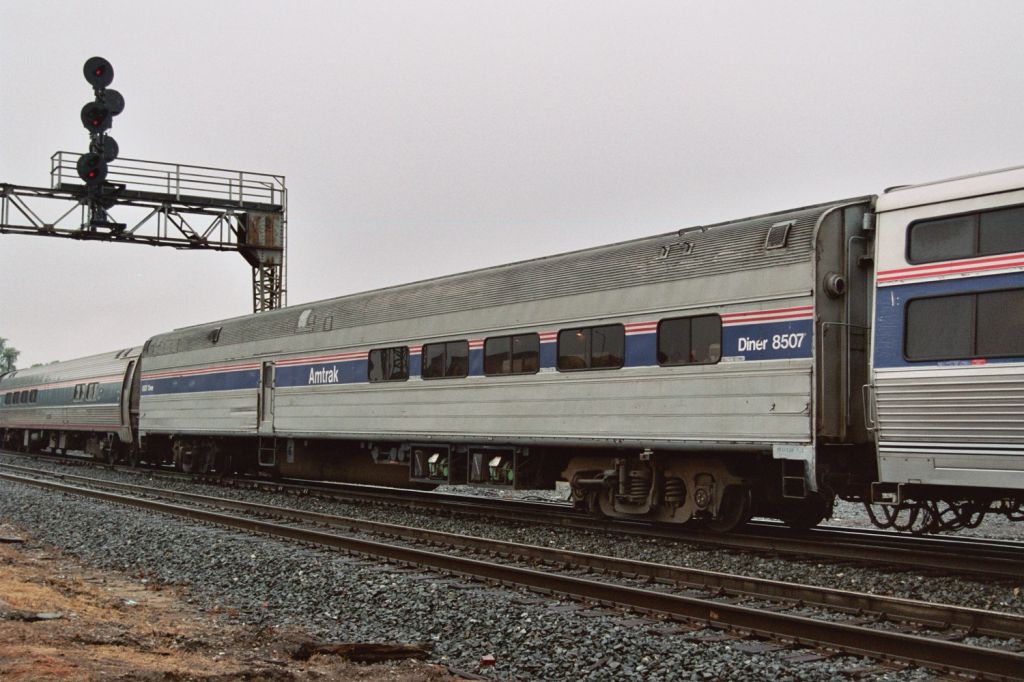
Amtrak uses Superliner equipment for the Empire Builder.  Superliners are bilevel rail cars.  Amenities include sleeping cars, a full service dining car, a cafe car, a lounge, with large windows to look at the views through, and roomy coach seats.  Sleeping car passengers have all meals in the dining car included in the price of their ticket.  Dining car meals are available to coach passengers at an additional charge.  The cafe car has a variety of snack and beverage items available from early in the morning to late at night.  This is a non smoking train.  Periodic stops are made to allow people to step off the train to smoke for a few minutes.

Thursday, July 21, 2011

Go By Train

I just stepped off the train in Davis, CA. I left Montana on Tuesday aboard the Empire Builder. I took that to Portland and got the Coast Starlight to Davis, just outside Sacramento. Both trains have a reputation regarding their adherance to the schedule. The Empire Builder is notoriously on time, while the "Coast Star-late", well, you can figure it out. However, this was not the case for either train. Due to a derailment in Minneapolis, the Empire Builder lost about an hour. Going west from there, the train got to Minot, ND where the railroad line had only opened the day before. The tracks from there all the way across eastern Montana were plagued with slow orders due to the recent flooding, and the train ended up getting to Spokane about 3 hours behind schedule. The train was so late I didn't even get to see Glacier National Park because the sun had already set by the time I got there. After Spokane, the "Baby Builder", as the Portland section is often called, made up about half an hour before arriving in Portland. I had about an hour before boarding the Coast Starlight, so I got something to eat and looked around a bit. However, the Coast Starlight then pulled in 15 minutes early. The train boarded right away but sat in the station until it was time to depart. We arrived at the next stations right on time, and eventually got to Klamath Falls, OR half an hour early. Again, we had to wait until it was time for us to depart. The train can't leave early because then it can leave people behind that haven't gotten to the station yet. I went to sleep after Klamath Falls and woke up in Sacramento...a full hour ahead of schedule. The train sat in Sacramento for an hour and then left for Davis, arriving there right on time. I am staying at a friend's house in Davis for a few days, I will be going to San Francisco tomorrow.

My Empire Builder ticket was from Williston, ND. Williston and Wolf Point, MT are both about two hours from Glendive. However, we were not able to leave the apartment until about one hour before the train was due in Williston, so we went to Wolf Point instead, which is further west, so the train gets there later. We didn't think to check the train status before leaving. I got some lunch in Wolf Point and waited...for quite a while. I was an hour early if the train had been on time, and it was about two hours late by that point. There were a few other passengers at the station. A father and son were traveling back to their home in western Montana. They had been visiting a friend in Circle, about halfway between Glendive and Wolf Point, when they wrecked their car. Stranded in the middle of nowhere, they had no choice but to take the train back home. The other passengers left the station when they heard the train status, so I did not get to talk to any of them. However, I did tell a few people on the train about my trip, and news about my journey must have spread around the train because people were coming up to me the rest of the way to Portland and asking, "Are you the kid traveling all over the country by train?" Most people are not aware that you can do that. Most of the people on that train did not know that it goes all the way from Chicago to the west coast over a span of three days and that there were people crazy enough to do just that. I, however, am one of them.

I missed the trip through the Rockies and Glacier National Park because the train was late. However, because the train was late, I did see the whole Columbia River gorge between Spokane and Portland. That is a beautiful run. The train follows the old Spokane, Portland, & Seattle alignment on the north bank of the river, the Washington side. The train is on the riverbank most of the way. On either side of the river, the hills rise out of the water like giant walls. Looming in the distance for most of the run is Mount Hood, an 11,249 foot behemoth towering over northern Oregon. Despite the clouds, you could see the whole mountain...because the clouds were below the summit! Although it was July, the giant rock was covered in snow and ice. Washington, Oregon, and northern California are full of these random mountains. They tower over everything else and are white year round. Mount Ranier in Washington, the biggest of the bunch, is where a lot of Americans that climb the Himalayas go to train. Mount Saint Helens is known for, well, exploding. Sure, they are in the Cascade Range, but these monsters are so big that they hardly seem to be in a mountain range at all. They stand apart from each other, not clustered together. The surrounding mountains are so small compared to these giant landmarks that they hardly seem to exist. Mount Hood was at least 30 miles from the tracks at the closest point, and it was visible almost the whole length of the Columbia River Gorge. None of the others were visible, but I'm sure Mount Saint Helens can be seen from the other side of the river. There was a rock wall on the north side of the Empire Builder and nothing could be seen that way.

The train arrived in Portland with not enough time to look around the city much. I did go outside and get some photos of the famous train station in Portland. "Union Station" and "Go By Train" proclaim the clocktower that once stood high over the city. Once a towering icon of the city and an important transportation hub, this antique little landmark among modern glass skyscrapers stands as a reminder of what travel once was. Formerly the only gateway into Portland, the long, empty platforms stand as a reminder of days when the tracks hosted trains from the Great Northern, Northern Pacific, Southern Pacific, and Union Pacific Railroads. Today, this station only sees two long distance trains per day. I had gotten off one and was about to get on the other.

The Coast Starlight, a remnant of the Southern Pacific, left Portland right on time. This train already had people from Seattle on board, and would go all the way to Los Angeles. That, however, was not my route. The train was sold out, so they were assigning seating. I found my seat, put my seat check there, and went to the lounge car. The train passed through Oregon City, the destination of the pioneers following the Oregon Trail in the 1840s. We followed the Willamette River right up into the Cascades. The train crossed the Cascades on a 1.8% grade, climbing to a summit of over 5,000 feet. After the Cascades, the sun went down, so I uploaded my photos from the day to my computer and went back to my coach to sleep. I woke up in Sacramento, and it was another 20 minutes to Davis.

Davis is an interesting place. There is a big university here, so there are a lot of young people with bikes. In fact, there are parking lots for bikes. There are more bikes in Davis than there are cars. A lot of people here own more than one bike, like people owning more than one car, so the bike population of Davis is probably about the same as the people population. Tomorrow I am going into San Francisco. It is a city that I have always wanted to visit, because it is very unique among American cities. I will write about that trip later.

Sunday, July 17, 2011

That's a really big butte

When I first booked this trip, I was originally going to visit James and then return home. I then realized that if I get a 15 day rail pass I could also go to San Francisco, a city I have always wanted to visit, for about the same price. Later I realized if I upgrade to a 30 day rail pass, I could ride all four of the cross-country Amtrak routes. This is what I eventually did, and planned it so I would spend most of my free time in Montana, as that was the whole point of this trip anyway.

I thought with two weeks out here in the middle of nowhere, I might get bored. I was wrong. I leave Montana in two days, and I don't know where the time went. Because of car problems earlier in my visit, I was not able to do some of the things I wanted (go to Wyoming and South Dakota, go railfanning, etc.) but I still had a lot of fun. James and I did some work on his models. We walked down to the yard a few times and he showed me what goes on there. When the car was fixed, I drove to Miles City and chased his train back to Glendive from there.

Miles City is an interesting place. On one end of town is the old Northern Pacific, the route James works on. The other side of town has the old Milwaukee Road. The town is sandwiched between the two railroads. The Milwaukee Road basically built Miles City up from the dirt. Miles City was a crew change point for them and they had a big car shop there. Northern Pacific just passed through the town, as Glendive and Forsyth were the crew change points and Miles City was too close to both places to have another crew change point there. The Milwaukee Road is long gone through Montana except for a few places. The tracks and car shops in Miles City now belong to BNSF. BNSF built a connection between the two lines just east of town so cars that need repair can go to the shops on the old Milwaukee Road. Outside of town, the Milwaukee Road tracks disappear. The right-of-way is now a dirt road called, you guessed it, Milwaukee Road. Both depots in town still exist. The Milwaukee Road depot is now the school system office building, the Northern Pacific depot is all boarded up.

On Friday, I drove to Miles City to chase James's train back to Glendive. I had five places in mind to meet the train: the depot in Miles City, the Milwaukee Road crossing east of Miles City, the Highway 253 crossing in Terry, the town of Fallon, and the Marsh Road crossing in Glendive. I left Glendive armed with my camera, my scanner, and some food for the road. I got to Miles City at about 3:15. Listening to the scanner, I knew there would be a little wait before James came through. There is no siding in Miles City, so nothing can meet there. A westbound coal train had a track warrant through there, and an eastbound coal train and James's eastbound M train were in sidings west of Miles City. After about 20 minutes, the westbound coal train came through. A little while later, I heard the two eastbounds get their track warrants. James's train came through at about 4:20. Once his train got past the depot, I hit the road again. I got on Valley Road, a road that follows the railroad out of Miles City. I would take a turn off of that road that would put me on Milwaukee Road, which crosses the tracks to get to the old right-of-way. The speed limit there is 70, so I knew I'd make it. However, the person in front of me was only going 40, and I was not able to pass him for a while. I finally did and caught up with the locomotives...just as they blasted across Milwaukee Road. I kept going, hoping I'd beat the train to Terry.

On my way to Terry, I passed the eastbound coal train I saw in Miles City. I knew I'd make it to Terry on time. I got off the interstate and found a good spot to watch the trains. The eastbound coal train came through, and then James's train followed. I heard a westbound coal train get clearance to Terry. I hoped it wouldn't show up until James's train was already there, because where I was standing, the siding was in front and I wanted a good photo of James's train. James's train showed up and picked up three loads at the grain elevator in Terry. The train pulled out again onto the main as the coal train showed up. The two trains passed each other and went on their way. However, by the time the coal train cleared the crossing, James's train was long out of sight. Because of this, I did not make it to Fallon on time, and drove straight to the Marsh Road crossing in Glendive. No sooner did I get there, I heard James's train get a track warrant from Colgate siding to Glendive. Ten minutes later, his train rolled through. This was my favorite spot, so of course the sun disappeared behind some clouds two minutes before James got there. Oh well, it's close by, I'll have to go down there again today or tomorrow to get some better photos. But with that, my chase was over, and I drove back to the apartment. James told me later that he had a trainee that day who had never heard of railfanning before, and thought I was a creepy stalker. Needless to say, James did not tell him that I am his brother.

Yesterday we went to Billings. It is three hours west of here but still in the eastern part of the state. We went there for some modeling supplies. There is not much in Glendive, not even a Walmart. That being said, the closest place to get any modeling supplies, even something as basic as paint, is Billings. We got some supplies there and headed back to Glendive. The trip to and from Billings was more interesting than Billings itself. Outside of Billings is Pompey's Pillar. This is basically a big rock sticking up out of the plains near the Yellowstone River. This is the last evidence of the Lewis & Clark expedition. Willliam Clark and other members of the expedition signed their names on this rock, and their signatures are still visible 200 years later. You can also climb to the top of the rock and see everything around. After the Lewis & Clark expedition, General Custer ran into trouble here. His army was camped near there and swimming in the river when some Native Americans, perched on top of Pompey's Pillar, started firing on them. The Little Bighorn Battlefield, where General Custer and his army met their fate, is nearby as well, but further out of the way, so we did not have time to stop there. It was interesting seeing these places that I had only heard about in history books in school.

That being said, the Empire Builder just started running between St. Paul and Havre once again. I am scheduled to get on the train in Williston, ND on Tuesday morning. I have been here for nearly two weeks and I don't think I am ready to go quite yet. But such is life. I will leave here and go on to whatever other adventures await me on this trip. Next stop: Davis, CA on Thursday.

Wednesday, July 6, 2011

Holy Toledo!

I am writing this in Chicago. I just got off the Lake Shore Limited and I have some time to kill before I board the Empire Builder for St. Paul.

I left Nashua on Saturday evening and spent the night in Boston at my younger brother's apartment. He doesn't live far from South Station, where train 449, the Lake Shore Limited, departed Sunday right on time at 11:55am. The train dashed across Massachusetts, arriving at Albany almost 40 minutes early. This gave us about a 2 hour layover there, so I got off the train with my camera and watched the action as the northbound Ethan Allen Express to Rutland, southbound Adirondack from Montreal, and the New York section of the Lake Shore Limited all arrived at Albany and did their switching duties.

Trains going to Manhattan must be electrically powered, so at Albany all southbound trains exchange their P40 or P42 diesel for a P32 dual-mode locomotive. On the outside, these locomotives are virtually identical to the diesels, but they have retractible third rail shoes. They are powered by their prime movers until Manhattan. Once there, instead of going to Grand Central Terminal, the trains instead use an old freight branch down Manhattan's west side. This is not in a tunnel and therefore it is not required to be electrified. Finally, the train arrives at the old Pennsylvania Railroad tracks leading into Penn Station. These tracks are electrified with overhead catenary and top-running third rail. The dual-mode locomotives don't have pantographs, so they use the top-running third rail into Penn Station. The retractible third rail shoes allow the locomotives to use both top-running and bottom-running third rail.

After these two trains cleared Albany, the Boston section of the Lake Shore Limited backed towards the New York section, making a 13 car train. I boarded the train, and we departed immediately after the southbound Maple Leaf arrived from Toronto. We crossed the mighty Hudson river and snaked our way through Albany and headed west. The dining car opened for business, but filled up quickly, and I was not able to make a reservation in time. I instead went to the Cafe car and got a turkey sandwich for dinner. It was good, but it definitely wasn't the diner. I went back to my coach and went to sleep.

I woke up after a solid 8 hours of sleep. I looked out the window, checked the schedule, checked the time, and thought to myself, "Holy Toledo, we're still on time!". Toledo is a smoking stop, so we sat there for a couple minutes. I like to get out and take a photo of the train at smoking stops, but the person in the aisle seat next to me was still asleep so I stayed put.

I got to know the people I was sitting with. They were a family traveling back to their home in Minnesota, they had been visiting family in northern New Hampshire. They had five young daughters, and they were all fairly well-behaved, which is impressive on such a long rail trip. They are boarding the Empire Builder here in Chicago, so who knows, I might sit with them all the way to St. Paul.

After waking up, I made my way to the diner. Breakfast is unreserved, so I just walked in and picked a seat. I ordered french toast, and a couple minutes later a heaping pile of the stuff was set in front of me. It was filling but very delicious. I went back to my coach to watch Indiana go by. After South Bend, we changed to Central Time. As we got closer to Chicago, the corn plants gave way to steel plants, county roads turned into congested interstates, and grain elevators turned into high-rises. The train slowed down to snake its way through steel plants, factories, intermodal yards, and countless other rail lines, all radiating around Chicago and feeding this capital of industrialization with raw materials to turn into everything from refrigerators to lolipops. Finally we arrived at Chicago Union Station, where I am sitting now.

Well, right after I typed that last paragraph, my laptop battery died and I was not able to find a place in all of Chicago Union Station with both an outlet and wireless internet. So I will just continue where I left off and post it all as one post.

We left Chicago from the less-crowded north gate, because the Empire Builder goes north to the twin cities before going west to Seattle and Portland. However, because of the flooding in North Dakota, that day's Empire Builder wasn't going past St. Paul, and I took the train that far. The train was two locomotives coupled back-to-back, 2 coaches, a lounge, and 2 more coaches. I sat in the lounge car the whole way.

The ironic part is that the Empire Builder does not follow the original route between Chicago and the twin cities. Great Northern Railroad built west from the twin cities, so their Empire Builder left Chicago on Chicago, Burlington, & Quincy tracks with CB&Q power. Today's Empire Builder follows the original Milwaukee Road route to St. Paul. That route got bought out by Soo Line in the 1970s and later by the Canadian Pacific. CP owns the line now.

The train pulled into St. Paul at about midnight, an hour and a half behind schedule. I didn't mind the delay, because my bus didn't leave until 8:00am so I had some time to kill. I walked from the St. Paul train station to the Minneapolis bus terminal. It was a nice night, but a long walk with a suitcase. Taxis there are expensive, the bus system doesn't run at night despite the website saying it does, and none of the transportation hubs in the area are connected very well. The bus depot was about 6 miles from the train station, mostly through University of Minnesota's campus in St. Paul. The bus depot is over the river in Minneapolis and then a short walk through downtown, which is a very clean and modern-looking city. The light rail system there does run during the night. The city was also silent at night, quieter than Nashua on a regular night, and this was the fourth of July. It was a little strange.

I got to the bus depot at about 3:15am. The place opens at 5am, so I had some time to kill. It started storming after I got there, but there is a roof over the sidewalk in front of the bus depot, so I was fine. It was about 80 degrees all night. I was the first one at the depot, but a few other people came along before 5am. Most of them were quite...interesting. Later on I'll do a blog post about the interesting people I meet on this trip. When I finally got on the bus, it was a long ride to Fargo and then another long ride to Glendive. It was a very beautiful ride though. The trees of Minnesota gave way to the plains and farms of North Dakota. I never imagined a place so empty yet so beautiful. Unfortunately, I do not have any photos of the area because the bus windows were dirty, but I am planning on driving out there and taking some photos of the scenery. It was really breathtaking.

I finally arrived in Glendive, safe and sound albeit and bit tired and dirty. The first thing I did was take a shower, because my last one had been 2 days before. That's really the biggest disadvantage of taking the train. But everything else more than makes up for it. I slept in pretty late too, I had been awake since Toledo about a day and a half before.

Today James and I drove to Miles City to see what there is to see there. But that's a story for another time. I'll keep you all posted about what adventures I go on out here in the middle of nowhere.