A couple of weeks ago, I had the opportunity to ride Amtrak's Silver Star between New York and Orlando, FL. You may remember that the previous blog post was written from the sleeper accommodations of that train. This was actually the second time which I have traveled on that particular train, and the third trip I have made on Amtrak between the Northeast and Florida.
We arrived at Penn Station about an hour before the Silver Star was scheduled to depart. That gave us plenty of time to get to the Amtrak concourse and check our luggage. Since we had tickets to ride First Class, we were allowed to board the train a couple of minutes before those with tickets for Coach. We made our way to the platform, and then towards the front of the train, where the sleeping cars were located. We had a Viewliner Roomette for the trip to Florida. We took a few minutes to get settled, and then sat down in our room, which was made up for daytime use, with two seats facing each other. Because space is tight in the roomettes, we had checked our two large suitcases and brought everything we would need for the night in a backpack. Having just a backpack in the room meant there was a little more space for us.
The train departed right on time, at 11:02am. We made our way out of Penn Station and under the Hudson River, emerging from the tunnel into the afternoon sunlight in New Jersey. Shortly after emerging from the tunnel, one of the dining car attendants came through the train to take reservations for lunch. We opted for the one o'clock seating, since we had eaten breakfast a little late anyway.
Between New York and Washington, the Silver Star makes very few stops, and only picks up passengers. During this stretch of the train reached speeds in excess of 100 mph, which was fine, although we did discover that a lot of the plastic wall and ceiling panels in the sleeper rattled a bit at high speeds. The ride was still fairly smooth though, and there was no major discomfort. Within just a few hours, we had arrived in Washington, DC.
Washington, DC, is a longer stop, despite only being a couple hours into the trip. From New York to Washington, an electric locomotive pulls the train. The overhead wire, which provides power to that locomotive, ends in Washington, and so the train exchanges the electric engine for a pair of diesel engines. During the engine change, power is cut from the train for about ten minutes. Once the diesel locomotives are coupled, power is reconnected. We took the opportunity to step off the train and observe the power change in Washington.
Once the power change was complete and a new train crew was on board, we departed Washington, DC. After pulling out of Union Station, the train went under the city, and joined entered CSX trackage on the other side. We had departed Washington on time, but experienced some minor delays almost as soon as we got on CSX track. As far as I was able to observe, these delays were caused by some freight train congestion. They were minor though, and we only lost a few minutes. However, even minor delays add up after a while. By the time we got to Raleigh, NC, that night, we were running about 45 minutes behind schedule.
In the middle of the afternoon, a dining car attendant came through the train again to take dinner reservations. Dinner was being served in three seatings, and we opted for the second one. The dining car service was very good, and the food was delicious. We enjoyed talking with some of the other passengers during dinner. I always enjoy the dining car because the food is good and everyone has an interesting story to tell. It is a nice chance to meet other people and chat casually with other passengers.
Later that evening, our sleeping car attendant came along and configured our roomette for night time use. The two seats became a lower bed and an upper bud pulled down from the ceiling. We got settled and climbed in to bed.
In the morning, we awoke somewhere in either southern Georgia or northern Florida. It turned out that Sarah had slept better than I did. She was rocked to sleep by the motion of the train rather quickly and slept soundly all night. I, on the other hand, had a hard time falling asleep and staying asleep. I have found that since I began working for the railroad, I have a difficult time sleeping on a moving train. I also find that I notice some of the characteristics of the moving train which no one else would notice, such as when the engineer bunches up the coupler slack to slow the train down. I slept well enough though, and woke up rested in spite of my difficulty getting to sleep.
We got up and showered, and then wandered to the dining car for some breakfast. During breakfast, we stopped in Jacksonville, FL. We were still running behind schedule, but only by about ten minutes. We had made up some time during the night. Breakfast was good, although I think we got to the dining car towards the end of breakfast service, because it was quiet and we had a table to ourselves.
We arrived in Orlando a couple of hours later, about 40 minutes behind schedule again. The train lost some time in the last hour before Orlando due to track and signal work. It looked like they were building a commuter rail system for the Orlando area, and some of those construction activities caused us several minor delays. The one that stands out in my mind is the grade crossing delays. They were working on the signal system, which effects the gates and warning devices at grade crossings. At several crossings, the warning systems were not working or had been deactivated. We had to stop at each of these crossings so that the conductor could get out and stop traffic prior to the train crossing the road. It sounds and is simple enough, but stopping and starting so the conductor can get off and back on, and waiting for traffic to stop, can take several minutes at each crossing.
In Orlando, we disembarked and picked up the luggage we had checked the day before, in Penn Station. The Orlando depot is a nice building, originally built by the Atlantic Coast Line. It is a little run down now, and could really use some minor maintenance, such as a coat of paint and some landscaping. It really would not take much to make it beautiful again.
Showing posts with label Trip Report. Show all posts
Thursday, October 24, 2013
Friday, July 12, 2013
Trip Report: Alaska Railroad's Coastal Classic
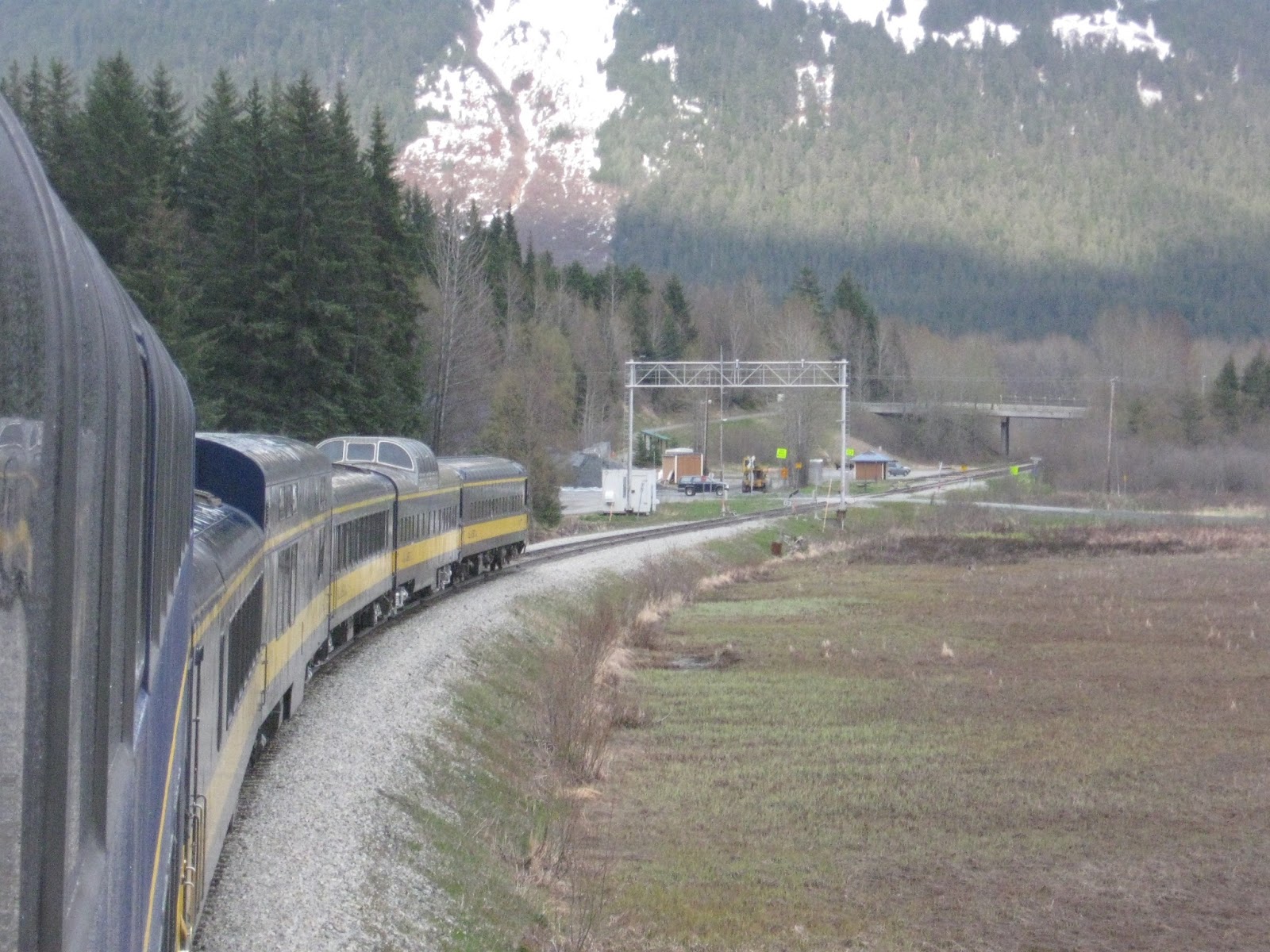
Several weeks ago, I had a day off, and Sarah and I decided to take advantage of it, by taking a day trip to Seward. The weather was nice, and it had been quite a while since either one of us had visited Seward. The southbound Coastal Classic train left Anchorage on time, at 6:45am. It is about a four hour trip to Seward, with one intermediate stop in Girdwood. The trip is quite scenic though, and the time passes very quickly.
After the train pulls out of the Anchorage station, it comes along the shore of the Cook Inlet almost immediately. A coastal biking and walking trail parallels the tracks, and early morning joggers and bikers can be seen, enjoying the beginning of the day. After a short time, the train turns inland, to cross Anchorage. The city of Anchorage is built on a triangular piece of land, with the north and south sides along the Cook Inlet, and the east side along the Chugach Mountains. The train cuts south across the west side of town, rather than following the coast out to the point. The neighborhoods the train passes through are mostly either residential or industrial, but both are quiet at this time of the day.
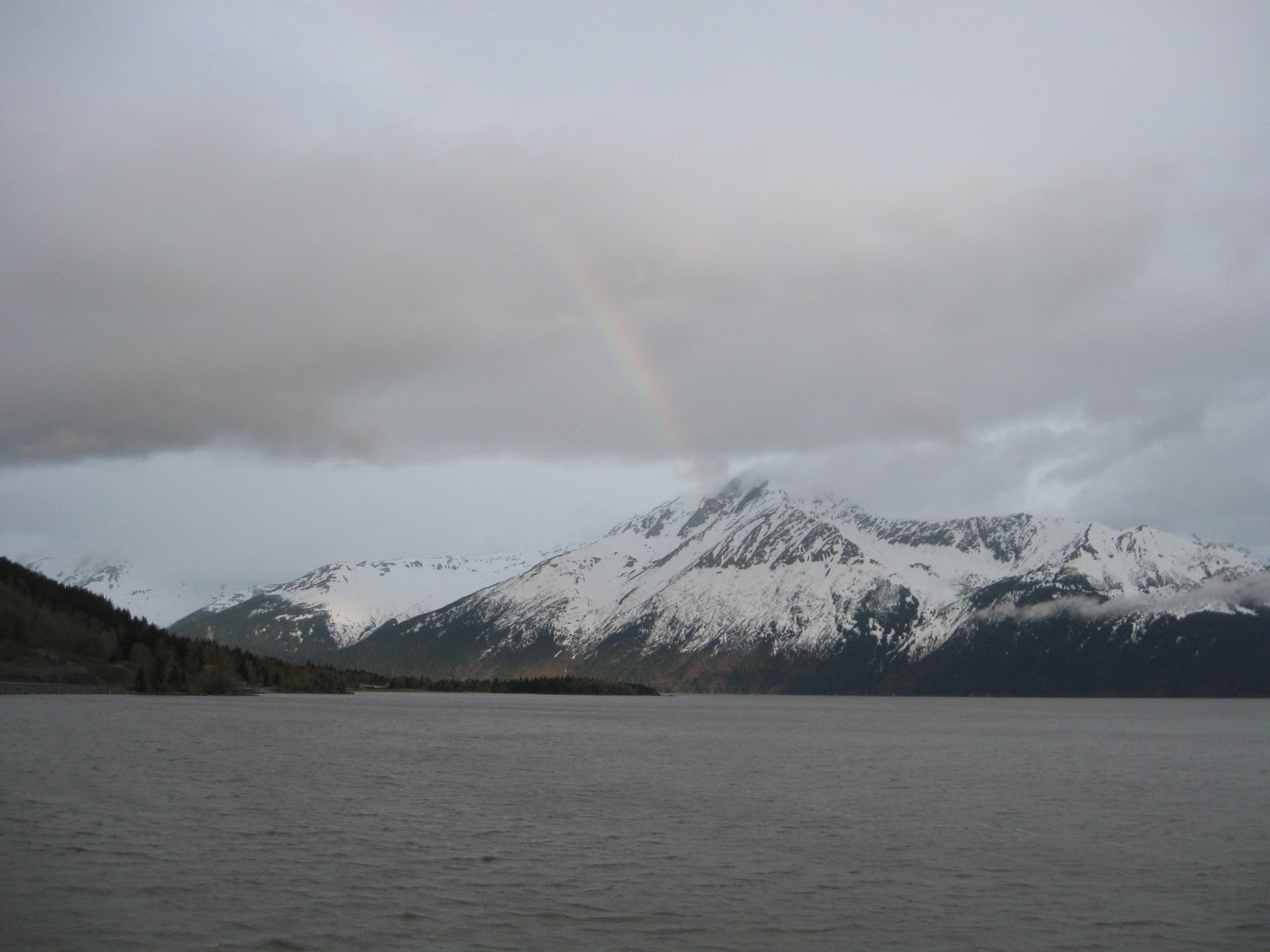
As the train nears the south end of town, it goes by an aviation club, which is nothing more than a grass strip across several backyards, and then the Cook Inlet once again comes into view. The train crosses Potter Marsh as it leaves town, and then starts up a branch of the Cook Inlet, known as Turnagain Arm. The train hugs the rocky shore of Turnagain Arm for over an hour, until it gets to Portage. With the water in a fjord between two mountain ranges, Turnagain Arm offers some stunning scenery in any kind of weather. We were fortunate to have a nice day though. It was along this stretch of railroad that we decided to enjoy breakfast, in the Dining Car. The Dining Car has some delicious meal options, with some local touches, such as reindeer sausage. There are even real flowers on each table!
Once in Portage, the train accelerates onto some relatively straight and flat track, as it heads up the Placer River Valley. As the train heads up this valley, the scenery changes from a coastal fjord to a lush green valley, and then into a mountain pass. At the south end of the valley, the train begins a ten mile ascent into the Kenai Mountains, passing Spencer Glacier. This is the steepest grade on the Alaska Railroad, at three percent. The short passenger train climbs up it with seemingly little effort though. There are five tunnels, in an area known, appropriately, as Tunnel, and a spectacular gorge, at the bottom of which the Placer River flows. By this time though, the Placer River is little more than a rushing mountain stream. By the top of the grade, at Grandview, the scenery is rugged mountains, with steep drops, cliffs, and small, winding streams. There are several glaciers in the area as well, and Trail Glacier makes a for an impressive sight. At this point, the engineer usually slows the train to a crawl, to afford a good view of the glacier to all the passengers. From there, the train begins to follow the Trail River, named for the glacier at its headwaters.
The train follows the Trail River through Moose Pass, and nearly until reaching Kenai Lake. In spots, the river is narrow, and the mountains occupy most of the view out the window. In other spots, the river widens out into large, deep green, lakes, and the mountains take a more distant place in the scenery. Eventually, the train reaches Moose Pass. While only about 25 miles from Seward, the train will spend another hour winding through the mountains to get there. At Moose Pass, the train begins to follow the Trail River less closely, and the highway comes back into occasional views, for the first time in over an hour. Shortly after Moose Pass, another lake on the Trail River comes into view, and then Kenai Lake appears on the other side. Kenai Lake is big, and the train runs along its jagged shore for several miles. Because of its size, the scenery almost looks like it did along Turnagain Arm, but the lake is a blue green color, and Turnagain Arm was grey.
Once the train passes Kenai Lake, it starts following the Snow River, and starts uphill again, to Divide. Divide is just a short distance from Seward, and the trip down from Divide to Seward is heavily wooded, mountainous, and includes another tunnel. Pretty soon, the train picks up speed, gets out of the tight mountain pass, and comes along the highway again, for the last few miles, into Seward. At the end of the trip, the train pulls up to the depot, which overlooks the harbor, and there is a flurry of activity as various buses and shuttle vans wait for passengers to disembark, so they can be taken to the various adventures and tours they have planned for the day. Seward is, however, a small town, and there is a lot to see, even just traveling around town on foot. It takes only about ten minutes to walk from the depot, at the north end of town, to the Alaska Sea Life Center, at the south end of town. Seward was rainy on our trip, but still quite enjoyable.
That evening, at 6:00pm sharp, the train began moving northward, beginning the return trip to Anchorage. The northbound trip is five minutes shorter than the trip south, and despite seeing the same scenery again, it feels like a different trip, with the sun lighting up the opposite sides of all the mountains and valleys. The train arrives back in Anchorage at 10:15pm, making this one of the best day trips available in Anchorage!
The Coastal Classic operates daily in the summer, usually from around May 15 to September 15. There is no regular passenger service between Anchorage, Girdwood, and Seward, during the winter, although some charters and excursion trains do operate over parts of the same territory occasionally during the winter months.
The Alaska Railroad operates two classes of service on the Coastal Classic, Gold Star and Adventure Class. Adventure Class consists of a reserved coach seat. Full meals are available for purchase in the Dining Car, and snacks and lighter foods are available in the Bistro Car. There is always at least one dome car, which Adventure Class passengers can use. Dome seating is unreserved and is available on a first come, first served basis. When there are a lot of people wanting to use the dome, passengers are asked to limit their time in the dome to about 20 minutes, to give everyone an opportunity to ride there. Additionally, passengers are permitted to ride in the vestibules. Side doors are Dutch doors, and the top portion is usually left open, when the weather cooperates, to allow for better pictures.
Gold Star service is the equivalent of first class. Gold Star passengers have a reserved seat on the upper level of a bi-level dome car. Beverage service is available at seat, and full meals are available for purchase on the lower level. Passengers can also purchase snacks in the Bistro Car. The upper level of the Gold Star cars also feature an outdoor viewing platform at the rear of the car. Both classes of service feature a narration provided by on board guides, throughout the trip.
The Coastal Classic offers a full service Dining Car, a Bistro Car for snacks, drinks, and lighter meals, and checked baggage service. The Alaska Railroad does offer charters for groups, in either class of service, that can operate on this train.
For more information about the train, or to make reservations, please visit www.alaskarailroad.com or call 907-265-2494.
| Cook Inlet, just outside the Anchorage depot. All photos by James Ogden |
| The view from the dome, passing Potter Marsh. |
| One of the horseshoe curves, near Tunnel. |
| Trail Glacier, near Grandview. |
| Trail River. |
| Along Kenai Lake. |
The Coastal Classic operates daily in the summer, usually from around May 15 to September 15. There is no regular passenger service between Anchorage, Girdwood, and Seward, during the winter, although some charters and excursion trains do operate over parts of the same territory occasionally during the winter months.
| Departing Girdwood, on the trip back to Anchorage. |
| Turnagain Arm, near Bird Point. |
The Coastal Classic offers a full service Dining Car, a Bistro Car for snacks, drinks, and lighter meals, and checked baggage service. The Alaska Railroad does offer charters for groups, in either class of service, that can operate on this train.
For more information about the train, or to make reservations, please visit www.alaskarailroad.com or call 907-265-2494.
| Kenai Lake, near Victor Creek. |
| Upper Trail River, between Grandview and Moose Pass. |
Wednesday, July 13, 2011
Long Distance Train Trips and What You Need to Know
First is the class difference. Long distance trains have coach class and first class. In coach class you get a coach seat and a pillow. If nobody is sitting next to you, you get two seats and two pillows, although in the summer this is very rare. You get access to the lounge car, cafe car, and diner car. In first class, you get a private room and a bed, a shower, and all your meals in the diner are free. First class fares are a coach fare and a room fare together, and rooms have two beds in them, so if you are traveling with someone you only have to pay the room fare once. The sleeping arrangements depend on whether you have a Viewliner or a Superliner sleeper, which depends on what route you take. All long distance routes in the west use Superliners, all long distance routes in the east (except the Capitol Limited and Auto Train, which use Superliners) use Viewliners. Visit www.amtrak.com to learn more about coach and sleeper arrangements. Once on the train, you can ask the conductor if there are any rooms available, and if there are you can upgrade to first class, usually for less than full fare.
Checked baggage is available on most trains. However, not all stations offer checked baggage service, so check the stations along your route before you check any baggage. If you are getting off at some obscure place in the middle of nowhere, chances are you'll have to bring your baggage as a carry-on. Amtrak has size and weight limits on carry-ons, but nobody actually checks. Checked baggage is free for the first three bags per passenger, and up to three more are allowed for a fee.
Most western trains are set up with the sleepers toward the front of the train, followed by the diner and the lounge, and the coaches are at the end. Passengers are free to walk around on the train, just make sure you don't miss your stop! The diner car has walk-in service for breakfast and lunch, but reservations are required for dinner. The lounge car has the cafe on the bottom level and the top level has floor-to-ceiling windows that go the whole length of the car. I like to hang out in this car all day. Make sure when you leave your seat, you take your ticket stub with you and leave your seat check at your seat. The seat check tells other people that that seat is taken, so when someone gets on the train at another station they won't take your seat. Eastern trains (except the Capitol Limited and Auto Train) do not have a lounge car, but they do have a cafe car.
Long distance trains make smoking stops. If you smoke, this is a good time to get off the train and smoke on the platform for a few minutes. Smoking is not allowed on board the trains. I use this opportunity to get out and take some photos of the train. Do not leave the train's side, because it does not stop very long, and it will not wait for you.
Finally, get to know your fellow passengers. You're stuck with them for a few days, and most of them have interesting stories to tell. I am writing an article about the people I meet on my July trip, which will be published at a later date.
Monday, January 10, 2011
My Longest Trip on the Long Island Railroad
This week's post picks up where last week's post left off. To see last week's post, click here. Last week I talked about riding the Acela to New York on a Sunday, where I would meet James and stay until Tuesday morning, when I would ride the Regional back home.I arrived at Penn Station about 20 minutes late. That wasn't too much of a problem, the next Long Island Railroad train to Mineola was leaving in another 20 minutes, so I had plenty of time to buy my ticket. I bought my ticket and waited for my train to be announced. A Ronkonkoma train (not stopping at Mineola) was announced, boarded, and left on time. A Babylon train was announced, boarded, and left on time. My train was next. But they weren't announcing it. The scheduled departure time came and went, and still no word about my Huntington train. Then the announcer came on the loudspeaker and said that Long Island service east from Penn Station is suspended until further notice.
I needed a plan B. I figured, they only said service west of Penn Station was suspended, so I figured I'd take the subway out to Jamaica and try my luck there. I bought a Metrocard and got on the E line, which goes from the World Trade Center, through Penn Station, and out to Jamaica, which is in Queens. Jamaica is Long Island's busiest stop, all their lines except the Port Washington line go through Jamaica. I got off the subway, exited through the turnstiles, and was greeted by a pile of snow...underground. It was snowing so much and the wind was blowing so hard that snow had blown right into the subway station. I went up the snow covered staircase and ended up on the street...only there was so much snow that it was not recognizable as a street anymore. I went into the Jamaica terminal only to find out that all service had been suspended "until further notice." I was not the only stranded passenger, there were hundreds of others in that train station. I figured the AirTrain terminal would be less crowded, so I made my way upstairs to get there.
When you go upstairs, there is a long hallway that goes over the eight station tracks at Jamaica and connects them all together and to the AirTrain terminal. This hallway is roofed so it is protected from most weather but it is still technically outdoors. I had only ever been there on nice days before, so I always considered it to be indoors. However, when I went upstairs, everything was covered in snow and it was freezing cold because the roof turned the whole hallway into a wind tunnel. I trudged through the snow drifts and made my way through all the blowing snow and after what seemed like forever I reached the fully enclosed AirTrain terminal. By this point it was almost midnight, and I was hungry. I braved the elements and went outside to find a place to eat. I found place that had just opened that day and was open for 24 hours, so I grabbed a bite to eat there and went back to the AirTrain terminal. At that point there was nothing else to do except try to get comfortable for the night, as there were no trains, buses, or taxis running and I was still ten miles from my destination.
I did not sleep well that night. I was on a tile floor with no padding and there were hundreds of stranded people all around me. My biggest worry was about something getting stolen while I was asleep, but fortunately that did not happen. I went to the same place for breakfast that morning, and then tried to find out what was going on. It had stopped snowing and the sun was out, but the wind was still blasting the bitter cold air everywhere you went and New York was under two feet of snow. Trains, buses, and taxis were still not running. I had no choice but to wait.
Finally, buses started running, but only as frequently as they could dig them out of the snow. Nothing was running on a schedule, you just had to go to the nearest bus stop and hope one comes before it got dark. That is exactly what I did. I found my way to a bus stop for a bus to Nassau county and waited. The bus stop was near a store, so I went inside to get away from the wind. There I met some other people waiting for the same bus. They told me they had been waiting there for five hours and no Nassau bus had come yet. But I had no choice except to wait for the bus, so I did.
An hour later, around 2pm, a bus to Nassau County came. All of us in the store crowded onto the already packed bus and went on our way. The bus stops at the Mineola train station, which is where I would get off. I called James and told him to meet me there. The bus was crowded and slow, but at least I was finally going somewhere. On the way to Mineola, we passed other snowed-in cars and buses. One bus had been pulling out from a bus stop when a plow passed it, snowing it in. The bus was just left there, there was nowhere it could go. Fortunately, nothing like that happened to my bus, and I eventually showed up in Mineola. James was there to meet me and drive me to our grandparents house just down the street. When I arrived, I added up my travel time. 27 hours to get from Nashua to Garden City. By this point I was hungry and tired, and didn't stay up very late. I went to bed that night, knowing I'd be getting up the next day to go back home.
Tuesday morning dawned with good news from the Long Island Railroad. Limited service was running on the Huntington, Ronkonkoma, and Babylon lines. One train every hour was running on each line in each direction. Mineola is on both the Huntington and Ronkonkoma lines, so we figured there would be half hour service at Mineola. Not quite. While we were buying our tickets, three westbound trains went by. When we were ready to board a train, we waited two hours for the next one. When it finally came, it didn't stop. We waited another half hour or so before getting on the train. We figured this would happen and left a lot earlier than we really needed to on a normal day, so we made it to Penn Station with a little time to spare. However, the train back to Boston was late, which was good because it bought us a little time.
We made the Regional train and rode back to Boston relatively uneventfully. We got the T to Lowell and met our Mom there, who brought is back to Nashua, safe and sound.
Regarding the title of this post, I guess I never really took the Long Island Railroad to get to my grandparents house, but I had planned on it! All the photos in this post and more are viewable in a Facebook photo album located here.
Monday, January 3, 2011
Trip Report: Amtrak's Acela Express Service
On December 26 I had the opportunity to take Amtrak's Acela train from Boston to New York. James had flown to New York on Friday night, and I was meeting him there. Our grandparents live in New York, so we would stay until Tuesday, when we come home on the Northeast Regional. Having family in New York, I take the train on this route quite often, but always on the Regional service. This was my first time on the Acela.Of course, I happened to pick a day when a big snowstorm is slamming the entire East Coast. It started snowing lightly in the morning, but the big stuff was supposed to be in the afternoon and evening...when I would be traveling. I showed up to the bus terminal in Nashua to get my bus to Boston. One of my friends was working the ticket counter and told me I picked a good time to get the bus, as all the buses after mine were canceled due to the weather. I bought my ticket and got on the bus, and as I rode closer to Boston, the snow kept getting heavier. I got to Boston on time and got my Amtrak tickets. I checked the departure board to see that my Acela was the last southbound Amtrak train running, all others were canceled due to the weather. Not a good sign for my New York connection to the Long Island Railroad!
I had some time to kill before my train left, so I went to the end of one of the platforms to take photos of another Acela train leaving. Aside from this train, the station was empty. While I was out there, a Regional backed into the station to head south, and a few MBTA trains came and went. Another Regional arrived and the southbound one left almost at the same time, and the Acela left about ten minutes later. After that I was getting cold so I headed back inside to wait for my train.
The train was announced right on time. I boarded the train, picked a seat with a table and a good window and sat down. The train's consist was a power car, a first class car, a business class car which was also the quiet car, another business class car, a cafe car, two more business class cars, and the other power car. I was in the business class car just past the cafe car. The seats were either leather or leather-like, it was hard to tell, but definitely much more comfortable than the Amfleet seats. I sat down at a table, which had a power outlet and the whole train had free wi-fi. I actually started writing this blog post on the train.
We made good time through Massachusetts, Rhode Island, and Connecticut. We stopped at Back Bay, Route 128, and Providence. I was amazed at how quickly we got that far. Once we left Providence, we made no stops until New Haven, and we got there in a hurry. It was definitely a much faster train. However, upon reaching New Haven, we left Amtrak trackage and entered Metro-North territory, where the track speed dropped from 150mph to 60mph.
For a high-speed train, I feel this is unacceptable. 150mph through Massachusetts and Rhode Island is an excellent standard, but 60mph through Connecticut is not. It is the same speed as the commuter trains and slower than cars on the Interstate. There is nothing high-speed about it. New Haven is most of the way to New York. The train is scheduled to take two hours to get to New Haven, and another hour and a half to get to New York. I don't blame Amtrak for this. It is on Metro-North property and Metro-North should learn to cooperate with Amtrak like countless other rail agencies have.
We made it to New York about 20 minutes late. Considering the snow that was piling up by this point, I feel we made pretty good time. I made my way over to the Long Island concourse, bought my ticket, and waited for my train to Mineola. But that is a story for next week's blog post!
Monday, November 22, 2010
Trip Report: PLRR's All Day Fall Foliage Excursion
(Steven)
Plymouth and Lincoln Railroad operates two tourist trains in the state of New Hampshire. The Hobo Railroad operates south from Lincoln in the White Mountains, and the Winnipesaukee Scenic Railroad operates south from Meredith along the shores of Lake Winnipesaukee. Both trains operate on different parts of the same railroad line, starting in Tilton, which is the northernmost point on the fictional Merrimack & Souhegan's trackage. From Tilton, the line went north to Plymouth and Wells River, VT and on to Montreal. In Plymouth, the Lincoln Branch split off from the main and ran north to Lincoln. The line between Plymouth and Wells River is long gone, and all that is left of the network is the line to Lincoln, where PLRR operates.


Upon arriving in Plymouth, the train stopped just north of town in front of the Common Man Inn. The inn had a sign out front saying "Welcome Hobo Railroad" because we would be stopping there for lunch. We all got off the train and went inside. Lunch was being served buffet style, and included lasagna, turkey, stuffing, and a few types of soup. Being male, I had to try a little of everything, and it was all excellent. I had eaten at the Common Man before and was very impressed with their food. We had an hour to eat, and I was done before then, so I went back outside to take some photos of the train. Once the hour was up, everyone boarded the train again, and we continued north.


During the summer, the railroad operates the two trains described above. However, in the fall, they add a few special trains. Depending on how much money you want to spend, you can ride north from Meredith to points such as Ashland, Livermore Falls, or all the way to Lincoln. More info on these trains can be found at their website. I chose to ride the all day train to Lincoln, which includes stops northbound in Plymouth for lunch at the Common Man Inn, and southbound at Ashland to take a tour of the restored depot, all included in the price of the ticket.
I arrived at Meredith and boarded the three car train. The consist was Alco S1 1008 "Edward E Howland Jr.", a former Portland Terminal switcher; Budd RDC1 6105 "Winona", an ex-MBTA, ex-B&M RDC that has had its motors removed; Bangor and Aroostook 103 "Determination," a parlor car built for Canadian National and purchased by BAR for their business train; and New York Central 1642 "Cold Harbor," a privately owned 20th Century Limited parlor car. The RDC served as Coach Class, where I sat, the "Determination" served as Presidents Class, and the "Cold Harbor" served as First Class.

We pulled out of Meredith right on schedule and immediately followed the shore of Lake Waukewan. We ran through many people's backyards, and a lot of people were out waving to the train that only comes through in the fall. We rode past Lake Winona, although it was hard to see the lake through the trees. We arrived in Ashland, and the train slowed down so we could see the town. It is a pretty town, with a beautifully restored depot and freight house. The freight house is privately owned, but the depot is maintained by the Ashland Historical Society. After going through the town, we crossed the Ashland High Trestle, which is a trestle high above a small river and visible from most of the town. After going over the trestle we went under Interstate 93, which we would be following most of the way to Lincoln.
Upon arriving in Plymouth, the train stopped just north of town in front of the Common Man Inn. The inn had a sign out front saying "Welcome Hobo Railroad" because we would be stopping there for lunch. We all got off the train and went inside. Lunch was being served buffet style, and included lasagna, turkey, stuffing, and a few types of soup. Being male, I had to try a little of everything, and it was all excellent. I had eaten at the Common Man before and was very impressed with their food. We had an hour to eat, and I was done before then, so I went back outside to take some photos of the train. Once the hour was up, everyone boarded the train again, and we continued north.
After leaving Plymouth, we went through some tight curves while climbing a steep grade, and the wheels made quite a bit of noise. After climbing the grade, we went past Livermore Falls, which is the site of an old paper mill on the Pemigewasset River. The mill is long gone, but the stone foundations are still there. We crossed the river and continued north, and after a few miles we came to Blair Bridge. It is a covered bridge in the town of Blair. The railroad does not go over it, but it can be seen from the railroad. It is still used, it is a single lane bridge with a speed limit of 5mph. There is a sign on the antiquated bridge stating that riding or driving on the bridge faster than a walk would earn you a $5 fine.

A few miles to the north we passed through the town of Campton. There is not much of a town there, but that is where you get off the highway to go to Waterville Valley, which is a tiny town with a big ski area nestled in the middle of the Sandwich Range. I have done some hiking there, as there are five 4000-footers surrounding Waterville Valley. After passing Campton, we continued north through Thornton and into Woodstock. Woodstock is where the Hobo Railroad trains operate to on a regular basis, so once we got there the track got a whole lot better and we sped up from 15mph to about 25mph. We kept that pace through Woodstock and up to the yard limit in North Woodstock, where the Cafe Lafayette Dinner Train leaves from.

We crossed into Lincoln and went onto the wye. Since there is no passing siding in Lincoln, and the next one south is occupied by the dinner train, the locomotive could not run around the train. Instead, we pulled up just past the wye and stopped there. Our locomotive, the 1008, pulled off the train and went into the stub end yard. Another locomotive, the 958, an Alco S1 of Maine Central heritage, coupled onto the end of the "Cold Harbor" and shoved us into the station. That locomotive would pull our train south to Meredith. We had about half an hour in Lincoln, where we could buy something in the gift shop or take a tour of the Flying Yankee train. Having seen the Flying Yankee earlier that month and several times before, I went to the gift shop and bought a book I had seen there last time but didn't have the money for it. We boarded the train again to head south, and I traded seats with the people across the aisle from me, so I could see out the other side of the train this time.

The train headed south and the sky cleared up a bit, so I got some better shots southbound than I did northbound. Also, since we were now the last car on the train, I went to the back and rode in the vestibule for part of the trip. On the way south, we stopped in Ashland for a tour of the depot. The waiting area has been turn into a kind of a museum, with different railroad related artifacts on display. The office was open and had a train order hoop and other artifacts on display inside there as well.

After looking at the depot, we boarded the train again and continued south. We reached Lake Waukewan as the sun was setting, and the lighting was beautiful. We pulled into Meredith just after sunset and our journey was over. The locomotive then ran around the train to get ready for a fall dinner train leaving in an hour, so I hung around to watch the switching and then left.
Overall, it was a fun trip. The sun was fighting with the clouds all day, so some of my shots aren't the greatest. We also had a late fall this year, and I was on the earliest train, so we didn't see much foliage. However, it was a lot of fun and I look forward to riding this train again next year.
Subscribe to:
Posts (Atom)