Showing posts with label Amtrak (AMTK). Show all posts

Friday, October 24, 2014

Railfanning in White River Junction, VT

I had been to White River Junction before as a kid, but not recently.  About two weeks ago, I was just passing through, but I had my camera on me, so I decided to stop at the station and see if anything was going on.  White River Junction was once one of New England's busiest interchange points, and today it is still a fairly busy place.  I would not call it a "hot spot," but if you go there to watch trains go by you will probably not be disappointed.  At one time, four railroad lines met there.  One line went south along the Connecticut River, through Palmer, MA.  One went southeast through Concord, NH to Boston.  One went north along the Connecticut River to Newport, VT, where it turned towards Montreal.  One went northwest across Vermont on a more direct route to Montreal.  Today, the line through NH only goes across the river to Lebanon, where it serves a few local industries, the rest of the line is a trail.  It is operated by the Concord & Claremont Railroad.  The other three lines are all still there.  The line to Newport is operated as a branch line serving local industries.  The Washington County Railroad, a subsidiary of the Vermont Rail System, operates that line.  The other two lines are operated by the New England Central Railroad, which was recently brought under the Genesee & Wyoming umbrella.  Amtrak's Vermonter operates on the NECR tracks to St. Albans, not far from the Canadian border.

I showed up at 11:00 and a crowd was gathered on the Amtrak platform.  Three SD40-2s were doing some yard switching, and kept showing up at the station and then backing into the yard again.  You can't see the yard from the station because it is around a curve and the trees block your view, but it is close enough that you can see the train as it switches the yard.  The lead engine was an SD40T-2, also known as a tunnel motor, and was painted in the Genesee & Wyoming colors.  The second engine was a patch job from Union Pacific, lettered for Connecticut Southern, and the third engine was also a patch job but for NECR, and it was an SD40-2 in an SD45 carbody.

NECR 3317, an SD40T-2 recently repainted in Genesee & Wyoming colors, leads two other SD40-2s switching the yard.  There is a crowd gathered for the southbound Amtrak train, scheduled to arrive shortly.
NECR 2680 is an SD40-2 rebuilt from an SD45.  Notice the flared radiator grills on the end of the long hood.
The yard switcher backed into the yard again, and a few minutes later, Amtrak's southbound Vermonter showed up, right on time, on its trip to Washington, DC.  The Vermonter has a cab car on the end.  It is led by the P42 from St. Albans, VT to Palmer, MA, where it switches to CSX's main line across Massachusetts to get to Springfield.  NECR and CSX cross at a diamond there, and the two main lines are connected to each other.  However, the setup there allows southbound trains from NECR to go east on CSX, but the Vermonter has to go west to get to Springfield.  So it switches over to the CSX line in Palmer and then is led by the cab car to Springfield, where it turns south to New Haven, CT.  At New Haven, the P42 is pulled off the train and an electric locomotive, either an HHP-8, an AEM-7, or a new ACS-64, pulls the train the rest of the way to Washington.

Amtrak's southbound Vermonter arrives just in time at White River Junction.
Passengers get on board the Vermonter.
The Vermonter continues on its journey to Washington.  The cab car will lead the train from Palmer, MA to New Haven, CT.
After the Vermonter left, the yard switchers pulled out of the yard and backed in one more time, and then pulled the train out and headed south behind the Vermonter.  I have no idea where the train's destination was, just that it was heading south.

3317's conductor steps off the train.
Genesee & Wyoming bought out New England Central recently.  This is NECR's new logo on the side of freshly painted 3317.
B&M 494, a 4-4-0 built by Manchester Locomotive Works in the late 19th century, watches as its modern counterpart heads south.
Once the southbound freight train left, so did I.  I got back in my car at 11:20, having only spent twenty minutes at White River Junction on an unplanned stop not expecting to see anything at all!

Thursday, October 24, 2013

Trip Report: Amtrak's Silver Star

A couple of weeks ago, I had the opportunity to ride Amtrak's Silver Star between New York and Orlando, FL. You may remember that the previous blog post was written from the sleeper accommodations of that train. This was actually the second time which I have traveled on that particular train, and the third trip I have made on Amtrak between the Northeast and Florida.

We arrived at Penn Station about an hour before the Silver Star was scheduled to depart. That gave us plenty of time to get to the Amtrak concourse and check our luggage. Since we had tickets to ride First Class, we were allowed to board the train a couple of minutes before those with tickets for Coach. We made our way to the platform, and then towards the front of the train, where the sleeping cars were located. We had a Viewliner Roomette for the trip to Florida. We took a few minutes to get settled, and then sat down in our room, which was made up for daytime use, with two seats facing each other. Because space is tight in the roomettes, we had checked our two large suitcases and brought everything we would need for the night in a backpack. Having just a backpack in the room meant there was a little more space for us.

The train departed right on time, at 11:02am. We made our way out of Penn Station and under the Hudson River, emerging from the tunnel into the afternoon sunlight in New Jersey. Shortly after emerging from the tunnel, one of the dining car attendants came through the train to take reservations for lunch. We opted for the one o'clock seating, since we had eaten breakfast a little late anyway.

Between New York and Washington, the Silver Star makes very few stops, and only picks up passengers. During this stretch of the train reached speeds in excess of 100 mph, which was fine, although we did discover that a lot of the plastic wall and ceiling panels in the sleeper rattled a bit at high speeds. The ride was still fairly smooth though, and there was no major discomfort. Within just a few hours, we had arrived in Washington, DC.

Washington, DC, is a longer stop, despite only being a couple hours into the trip. From New York to Washington, an electric locomotive pulls the train. The overhead wire, which provides power to that locomotive, ends in Washington, and so the train exchanges the electric engine for a pair of diesel engines. During the engine change, power is cut from the train for about ten minutes. Once the diesel locomotives are coupled, power is reconnected. We took the opportunity to step off the train and observe the power change in Washington.

Once the power change was complete and a new train crew was on board, we departed Washington, DC. After pulling out of Union Station, the train went under the city, and joined entered CSX trackage on the other side. We had departed Washington on time, but experienced some minor delays almost as soon as we got on CSX track. As far as I was able to observe, these delays were caused by some freight train congestion. They were minor though, and we only lost a few minutes. However, even minor delays add up after a while. By the time we got to Raleigh, NC, that night, we were running about 45 minutes behind schedule.

In the middle of the afternoon, a dining car attendant came through the train again to take dinner reservations. Dinner was being served in three seatings, and we opted for the second one. The dining car service was very good, and the food was delicious. We enjoyed talking with some of the other passengers during dinner. I always enjoy the dining car because the food is good and everyone has an interesting story to tell. It is a nice chance to meet other people and chat casually with other passengers.

Later that evening, our sleeping car attendant came along and configured our roomette for night time use. The two seats became a lower bed and an upper bud pulled down from the ceiling. We got settled and climbed in to bed.

In the morning, we awoke somewhere in either southern Georgia or northern Florida. It turned out that Sarah had slept better than I did. She was rocked to sleep by the motion of the train rather quickly and slept soundly all night. I, on the other hand, had a hard time falling asleep and staying asleep. I have found that since I began working for the railroad, I have a difficult time sleeping on a moving train. I also find that I notice some of the characteristics of the moving train which no one else would notice, such as when the engineer bunches up the coupler slack to slow the train down. I slept well enough though, and woke up rested in spite of my difficulty getting to sleep.

We got up and showered, and then wandered to the dining car for some breakfast. During breakfast, we stopped in Jacksonville, FL. We were still running behind schedule, but only by about ten minutes. We had made up some time during the night. Breakfast was good, although I think we got to the dining car towards the end of breakfast service, because it was quiet and we had a table to ourselves.

We arrived in Orlando a couple of hours later, about 40 minutes behind schedule again. The train lost some time in the last hour before Orlando due to track and signal work. It looked like they were building a commuter rail system for the Orlando area, and some of those construction activities caused us several minor delays. The one that stands out in my mind is the grade crossing delays. They were working on the signal system, which effects the gates and warning devices at grade crossings. At several crossings, the warning systems were not working or had been deactivated. We had to stop at each of these crossings so that the conductor could get out and stop traffic prior to the train crossing the road. It sounds and is simple enough, but stopping and starting so the conductor can get off and back on, and waiting for traffic to stop, can take several minutes at each crossing.

In Orlando, we disembarked and picked up the luggage we had checked the day before, in Penn Station. The Orlando depot is a nice building, originally built by the Atlantic Coast Line. It is a little run down now, and could really use some minor maintenance, such as a coat of paint and some landscaping. It really would not take much to make it beautiful again.

Wednesday, October 9, 2013

Passenger Car Switching

Today I write from a Viewliner Roomette on Amtrak's southbound Silver Star. This may be the first time we have composed a blog post from a moving train. It probably does not come as a surprise that a trip report will be put together after this journey, but that will be at a later date. Today I thought I would talk about switching passenger cars and a few other things from work.

Earlier today, I boarded the Silver Star in New York, with my wife, Sarah. We elected to take the train to Florida to visit her parents rather than fly because we both enjoy train travel and the cost for us to travel First Class on Amtrak was slightly lower than the cost for both of us to fly. When the train departed New York, it was lead by an AEM-7 electric locomotive. The overhead catenary, which provides electricity to operate such a locomotive, ends in Washington, DC. Upon arriving at Union Station, the electric locomotive was removed and a pair of P42DC locomotives were placed at the head end. This was the first time Sarah had ever seen this operation, and explaining what was going on got me thinking a bit about work, particularly about passenger switching.

When I started working with Alaska Railroad, there were many similarities to what I had learned on BNSF. One big difference between Alaska Railroad and nearly every railroad in the Lower 48 is that Alaska Railroad operates both freight and passenger trains. This is not like a freight railroad hosting Amtrak, which is quite common in the continental United States, because the host railroad rarely does any passenger operations beyond allowing Amtrak to use the trackage. Amtrak provides the passenger train crew and equipment. In Alaska, the Alaska Railroad operates the freight trains, but also operates the passenger trains. The Alaska Railroad provides the crew and equipment for passenger operations.

Since Alaska Railroad operates both freight and passenger trains, this means that train crews could potentially go back and forth between passenger equipment and freight equipment during the course of a tour of duty. This would have been an extremely rare situation for road crews, but was more common in the yard. During the summer, Anchorage Yard had two crews each day that were specifically assigned to switch passenger equipment. Occasionally, when they were either busy or not on duty, another crew could be assigned to take care of a few moves in the coach yard.

Every day in the summer, at 4:30am, the morning passenger switch crew came on duty. The first passenger train scheduled to leave Anchorage was the southbound Coastal Classic, which went to Seward. The train was made up the night before, by the evening passenger crew, so there was rarely any switching to do in the morning. This was done to expedite the morning movements and ensure an on time departure, at 6:45am. Occasionally the locomotives had to be added, but even that was typically done by the roundhouse hostlers, in the middle of the night. Once we got on the train, the Brakeman would release the hand brakes and walk through the train, getting the doors and steps positioned for use at the depot. The Conductor and Engineer would compare paperwork with the train dispatcher and perform an air brake test. As the train departed the yard, a couple of carmen would perform a visual roll by inspection, for safety. We would head south out of the yard, on to the main track. Once the Brakeman had walked through the train, he would stay on the rear car. Once on the main track, the train had to be backed up to the depot. The Brakeman would serve as the eyes for the engineer during that movement. At the depot, the train would be secured. The road crew would take over and bring it to Seward from there.

For the yard crew, there were still more trains. The Denali Star, which operates to Fairbanks, was next. This was usually the most complex. The evening crew usually had things in order, to minimize the work for the morning crew, but because this train operates with private tour company cars, it is impossible to have it put together the night before. The morning crew would first get on the locomotives and pull the Alaska Railroad portion of the train out of the yard. Next, the Wilderness Express cars, if there were any that day, would be added to the rear. They could only be added after they had finished servicing them and lowered the derail protecting the entrance to their track. Sometimes they were ready when the crew got there, other times the crew had to wait a few minutes for hem to finish up their work. Behind the Wilderness Express cars, Holland America Line's McKinley Explorer cars were added, followed by Princess Cruise Line's private cars. Since Holland America and Princess are sister companies, their tour operations in Alaska are combined and operate under the name HAP Alaska-Yukon. Both companies' private cars are serviced together, on the same track, and the evening crew usually had them put together, in the right order, the night before. Once they were added to the train, an End of Train Device was added and tested, and then an air brake test was conducted. Once again, the carmen did a visual inspection as the train departed the coach yard. This train went around the wye on the way out of the yard, and then backed out to the main track. The engineer spotted the train at the depot, where it was secured to await the road crew and an 8:15am departure northbound.

The last train of the morning was the Glacier Discovery, which went to Whittier and Chugach National Forest. This was usually the easiest train, since all the switching was almost always done the night before. After an air brake test and a visual inspection from the carmen, the train headed out to the main track and was then backed in to the depot. Just like the others, it was secured to await the road crew and the trip southward.

When the morning passenger crew was done the morning switching, there were still several hours left to work. Usually a short lunch break was on the agenda, followed by some freight switching. This was, of course, all determined by the yard master.

At 6:30pm, the evening passenger crew came on duty. Their switching was typically more complex, since they were responsible for setting up trains, as much as possible, for the morning crew. The first train scheduled to arrive was the southbound Denali Star, which was so long it had to be split in two when it arrived at the depot. That train was due at 8:00pm every day, and the evening crew would meet it at the depot. The cars belonging to Princess and Holland America would be cut off east (railroad north) of the C Street crossing, just outside the depot. Motor coaches were provided by Holland America and Princess for their passengers, and there is a large paved area there for easy transfer from the train to the waiting coaches. The remainder of the train would pull up behind the railroad depot. When the train arrived at the depot, some of the servicing was done immediately. The crew would have to wait until everyone servicing the train was finished. Once the toilets were all pumped, baggage unloaded, and money counted and removed, the train could head to the yard. Once in the yard, the switching began. The switching could be simple, or it could seem to go on all night. The current position of cars and the arrangement needed the next day determined the complexity of the switching. Other variables that contributed to complexity included the need for car to visit the shop or have wheels trued. Wheel truing is a process that removes flat spots and other imperfections from wheels, resulting in a smoother, safer ride.

When all the Denali Star switching was complete, it was time to do a different train. Usually. Y the time it was complete, both the Coastal Classic and the Glacier Discovery had arrived and were parked at the depot. It was up to the Conductor which one got done next. Both needed to go around the wye, so they would be facing south, since all the switching happens at the south end of the coach yard. Usually the Glacier Discovery was the easier one, since it usually just had to be put away for the night, with little or no switching. The Coastal Classic usually had a little switching, and sometimes a Wilderness Express car or two to put away. Both trains however were far easier to put away than the Denali Star usually was.

Switching passenger equipment could be frustrating at times, for a variety of reasons. One of the most frustrating aspects of passenger switching was the speed. All the coach tracks were limited to walking speed, and the train must be stopped prior to coupling to other equipment. This sounds and is simple enough, but it adds considerable time to even a simple switching move.

Perhaps the most frequent frustration of passenger equipment switching is the overwhelming amount of connections and the limited amount of space between cars. When cars are coupled together, the air hoses must be coupled and the angle cock opened. On freight cars, this is a quick task. On passenger cars, there are electrical jumpers, communication cables, and a walkway in close proximity to one another. Additionally, the air hoses and angle cocks are not located beside the coupler, but rather directly below it. In some situations, it is so crowded between cars that the only way to couple hoses and open angle cocks is to crawl under the car and lie down between the rails, facing up at the bottom of the car. Needless to say, almost anyone who switches passenger cars finishes the day covered in grease, oil, and dirt.

At this point however, I do not have to worry about crawling in the dirt under passenger cars. The Alaska Railroad experiences a pretty significant drop in traffic around the end of September, and consequently they lay off about a third of the workforce. This is a temporary, seasonal layoff, and everyone laid off is guaranteed their job and seniority in the spring, if they still want it. I was notified on September 18th that I no longer had enough seniority to hold a job, and I would be laid off. I will go back to work in the spring, in April or May, depending on manpower needs. It will be sooner if they decided to train ten or more Conductors this winter, but I will not find out definitely about that for at least another month yet. Most people would be disappointed to be laid off, but I am enjoying it. While I enjoy my job, it is nice to have a break. I had taken a week off in the past three years when I got my layoff call, and I was ready for a vacation! Besides, it gives me the opportunity to visit distant family and take leisure train rides, such as this one, aboard Amtrak's Silver Star. I'll be enjoying dinner in the diner next!

Monday, March 4, 2013

Walthers City Station Project

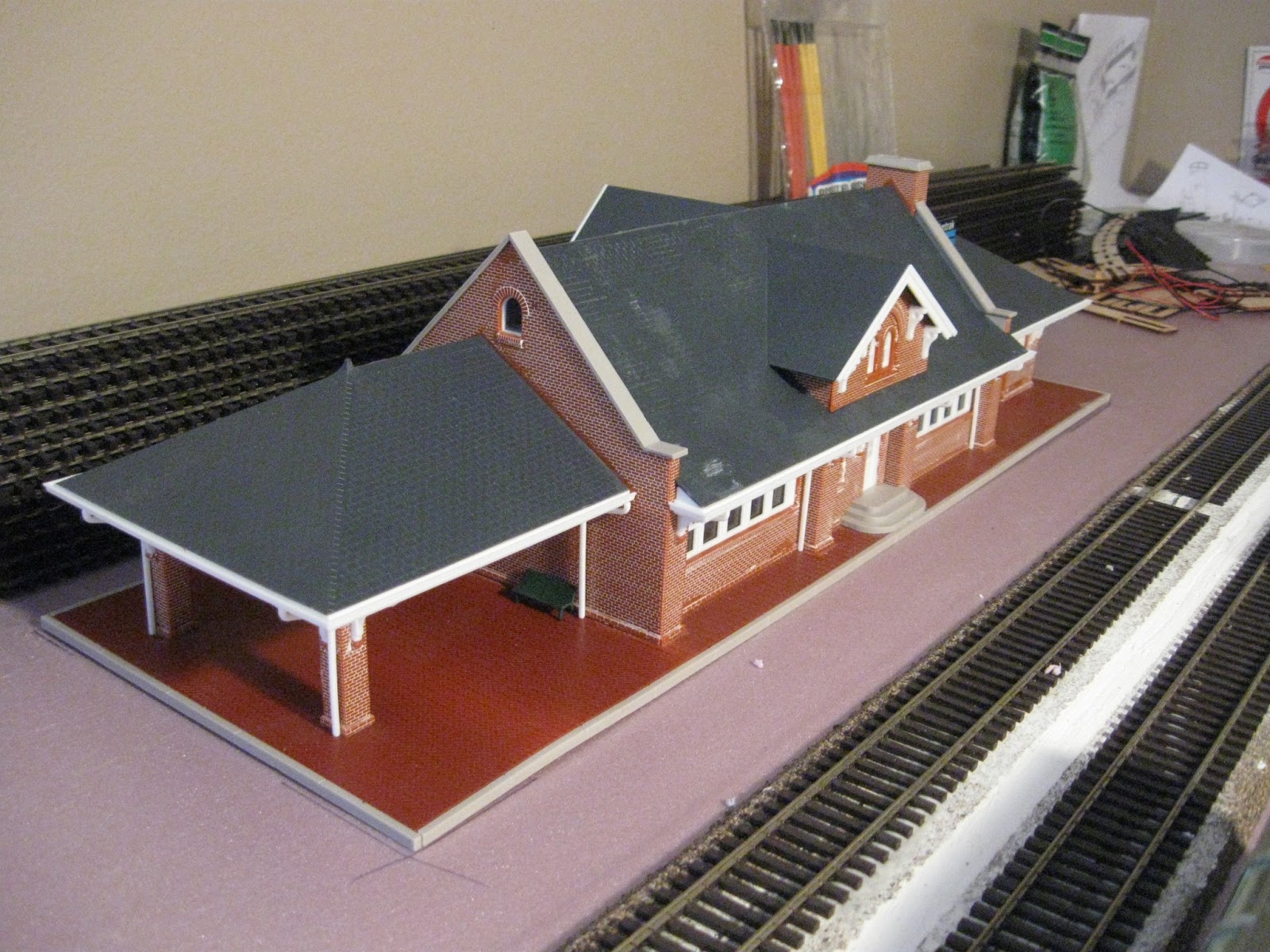
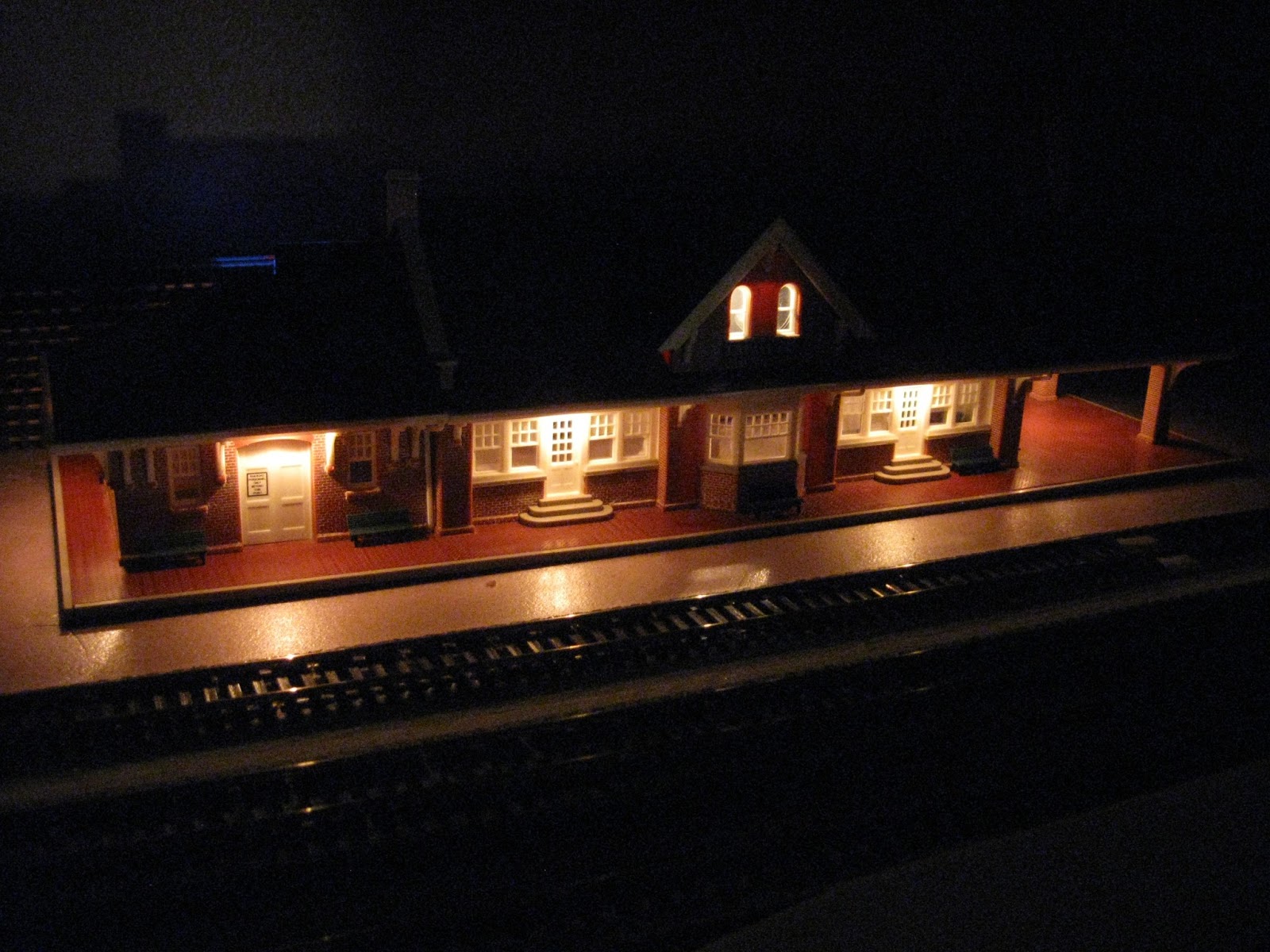
I recently (finally) completed Walthers' City Station, for my model railroad. It has had a few personal touches added to it as well. The most noticeable addition is interior and exterior lighting. I have also added some benches, and a neon Amtrak sign. Other than that, the kit is pretty much the same as it was designed to be built, out of the box.

I decided to add lighting when I first started building the model. When I first bought it, it was shipped to New Hampshire, and Steven, in a fit of ambition, decided to start on it. When he moved, he shipped what he had done out to me. At that point, he had added mortar to the brick walls and assembled the main walls. He had also installed most of the windows.

When I got it, I started planning where I wanted lights. This building has fairly small windows, which are difficult to see into, so I decided not to put a detailed interior in it. While I wanted light in the windows, I really wanted a nicely lit exterior, providing lighting for the outdoor waiting areas and the platform. I had quite a few miniature light bulbs on hand from a few other projects, and decided to use those. They operate on 12 volts, so I would not need to put in any resistors or other electronics. I decided there would need to be lights by every door, to light the steps, so people could get in and out safely. Additionally, I wanted lights under the portico, on one end of the depot, so that people waiting under there would have light. A few other lights under the overhang in the roof would balance everything out, and eliminate dark areas around the depot.

Once I decided where to put all the lights, I painted all the interior walls black, to help eliminate any light leaks. I then drilled holes for the bulbs, exactly the size of the bulbs. I then painted the holes black, to help reduce any glow in the plastic, around the light bulbs. I did not want lots of hanging lights, so the light bulbs would be embedded in the plastic to some degree, giving it more of a recessed lighting look. Before installing any light bulbs, I used a scrap piece of plastic from the kit, drilled a hole in it, and placed a light bulb in it and turned it on. I wanted to make sure the light bulbs would not melt the depot! I put the test light bulb on a higher than recommended voltage, and let it sit for several hours. While the plastic was warm, the heat from the light bulb did not seem to be enough to cause it to melt. With that confirmed, I began installing the light bulbs in the depot itself.

As I Installed the light bulbs, I tried to keep the wiring as neat and organized as possible. While it is difficult to actually see in the windows, I did not want wires hanging down in places they would cause shadows or would be easily seen. The interior would be lit, so even wires inside could cause noticeable shadows if they were in the wrong place. After I installed the exterior light bulbs, I put in all the inside ones. I did not want the depot to radiate light, I just wanted there to be enough inside to make it look used. I did not want dark windows on the building.

As I was finishing up installing the light bulbs, I decided I wanted to add a neon Amtrak sign. Miller Engineering (www.microstru.com) makes a fairly significant selection of simulated neon signs, for several model scales, including HO, N, and O. I found an Amtrak sign that was originally designed to be used as a sign hanging from a wall, over a sidewalk. I intended to put it on the roof, although I did not want one as big as their Amtrak billboard. I made a small cut in a wall next to where I wanted the sign, using a hobby knife. I tested the sign several times to make sure it would fit, as I was cutting the hole. The hole was the smallest thickness I could get away with and have the sign fit. I installed the wiring behind the wall, which is high enough up to hide it from view through the windows. Below the table top of the model railroad, I installed a converter module to power the sign, using power from my 12 volt accessory bus wire. I then ran the sign wires and all the light bulb wires to a 4-pin modular plug, like those used in phone lines.

Beneath the layout, I ran some feeder wires from the accessory bus to the hole in the table top. Another set of feeder wires went to the sign module. Under the table, I wired the sign leads and the lighting leads to a 4-pin modular connector, similar to a phone jack. When I placed the depot on the table, all I had to do underneath the table was plug in the modular plug and connector, and turn on the light switch, and the depot lit up. I like using the modular connectors because they allow for quick, easy connections. I can remove the depot easily, for cleaning, and when the time comes to weather my track.

As an afterthought, I decided to add some blinds inside the windows, to help conceal the lack of an interior. I also found some green benches, and placed those around the outside of the depot. Additionally, I found an electric meter, and mounted that on an exterior wall. I still would like to add some support legs to the neon sign, but other than that, I am quite satisfied with the depot. I like how much light it gives off, and once there is a platform in place, it will be a nice centerpiece to the station area.


Friday, April 27, 2012

Photo of the Week: 4/27/2012

Today's photo of the week goes back to my trip in July.  I have a whole lot of photos from that trip that I haven't shared, but don't worry, I'm not going to bombard you with them now!  Towards the end of the trip, I woke up one morning with the sunrise out my coach window over southern New Mexico. Around breakfast time, the Sunset Limited crossed the Rio Grande and into Texas.  There is a very short segment of Texas where the Rio Grande borders New Mexico and not Mexico, and that is where the train crosses the river.  Shortly after crossing into Texas, the train makes a stop in El Paso:


There are a few places in this area where the train is a few feet from the river and the Mexican border.  The Mexican city of Ciudad Juarez, directly across the river from El Paso, is a much different looking city.  I won't go into the details or start an opinion war about immigration by comparing the two, but it was certainly interesting to see the two cities side by side.  I did not go over the Ciudad Juarez, I stayed near the train station, which is the brick building with the tower in the right side of the photo.

Friday, April 6, 2012

Photo of the Week: 4/6/2012

Last spring, you may remember that the entire Midwest seemed to be flooded.  While the Forsyth Sub and the Glendive area did experience some flooding, it was minor compared to what was experienced in other areas, such as Minot, ND.  Various washouts kept things moving slowly on the Forsyth Sub.  I was still in training, and I decided to take advantage of all the time off we were getting between trips.  I decided to visit my grandparents, who live in a Long Island suburb of New York.  Being a last minute trip, flights could not be found for even a slightly reasonable price, so I decided to take Amtrak.  When I arrived at the depot in Williston, ND, the ticket agent began to explain that there would likely be delays because of the flooding, and then started a surprisingly elaborate description of how all the water was effecting the railroad.  I stopped her and explained that I was employed by the BNSF, and I understood exactly why Amtrak would be delayed.  She looked relieved that I was not complaining to her!  A few minutes later the Empire Builder pulled into the station, and I boarded.  The next morning, we had a service stop in St. Paul, MN, and I decided to step off the train and take a look around.  I had been there before on a few occasions, but they were all after dark.  This was my first daylight visit.

What I found in St. Paul was a former Milwaukee Road Skytop lounge car, coupled to a full length dome car.  I knew they were there, but had never gotten a good look at them, so I took the opportunity!  The Skytop cars have always intrigued me, because they are so unique, and an icon of the Hiawatha trains that the Milwaukee Road once ran across the country, between Chicago and Tacoma, WA.  These care are available for charter, and one day I'd like to do just that!  Here they are, with another private car, idling at the St. Paul depot.  The Empire Builder was behind me.


I think some preparations were being made to move the car, because there were some people working on and around it, and it was connected to power.  I do not know what the plan was for it though.  I do regret that I did not ask one of those people if I could see the interior of the car.  I keep telling myself that someday I will get to charter and ride these cars, although that day may be a while in the future still!

We would love to see your pictures!  If you have any pictures you would like featured on Photo of the Week, please email it to us with your name, a brief description of the photo, and of course, the photo itself, in 800 x 600 or larger resolution.  We will let you know if your photo is chosen, and you will receive full credit for your submission.

Friday, March 30, 2012

Photo of the Week: 3/30/2012

Usually, I share photos I've taken with my digital cameras, because they are on my computer and easy to share. Recently, however, I've been digging through my photos that I shot on film, and I thought I'd share one today. If you read this blog regularly, you probably know I go to Long Island fairly frequently to visit my family there. I haven't driven there in a few years, and the last time I did, I made a few stops along the way, including this spot in Connecticut, where this photo is taken:


This is Niantic. The train does not stop here, but whizzes past the crescent shaped shoreline on a gentle curve. I had seen the spot from the train, and I wanted to take a look around. The beach is small, but there is a path along the railroad track, where I shot this photo. Behind me, the tracks cross a drawbridge over an inlet to a small harbor, which is on the other side of the tracks. Currently, this whole area is a mess of construction, the drawbridge is being replaced and the beach and boardwalk area have all been turned into construction staging. I really don't know much about the project except for what I've seen from the train, but it looks like they are also building a new boardwalk, so the town will get something in return when the project is completed. The project was started shortly after this photo was taken in August of 2009, and I don't know when the project will be finished.

Want to see your own photo featured in Photo of the Week? Click here to find out how to submit a photo!

Friday, February 24, 2012

Photo of the Week: 2/24/2012

As you probably noticed, James and I were both away on vacation during the first part of February. Once I returned, I was quite busy for a while, and I have not been able to do any writing on the blog because of that. The vacation was a cruise, so I did not get many rail photos during the week. However, the cruise left from Florida, and I took Amtrak's Silver Meteor to get to the ship before the cruise and to get home after the cruise. As much as I love trains, I was more excited about the cruise, and I didn't get many rail photos, but I did manage to snap this one as we raced past the Auto Train facility in Sanford, FL:


Auto Train was started as a private company in 1971 to carry people, and their automobiles, between Lorton, VA, and Sanford, FL. It was very successful, and the company quickly looked into expanding service. A second route opened in 1974, connecting Louisville, KY with Sanford. However, this route was not as successful, and was closed three years later. Despite its popularity, however, Auto Train was forced to shut down in 1981, a result of several major derailments costing the company more money than it had. Two years later, in 1983, Amtrak started up its own version of this successful train, and has been running it ever since. Today, it is one of Amtrak's most popular trains, because it gives people the easiness of taking the train somewhere instead of driving, but also giving passengers their own car once they get to their destination.

Want to see your own photo featured in Photo of the Week? Click here to find out how to submit a photo!

Friday, December 30, 2011

Photo of the Week: 12/30/2011

Today's photo is a photo of Amtrak's 40th anniversary train.  On May 1, 2011, Amtrak celebrated its 40th anniversary, and this train started its tour of the country in Washington, DC.  It toured the northeast, arriving in Boston at the beginning of August, which is when I saw it.  The train continues to tour the country until April 30, 2012, stopping every weekend to open up for the public.  The train consists of a P40, a F40PH, a 10-6 sleeper, three baggage cars, and an Amfleet cafe car.  The entire train was picked out of the deadline at Beech Grove shops in Indiana and rehabilitated for the job.  The whole train wears a matching phase 3 paint scheme.  Here is the photo of the train:


I visited the train at Boston's South Station.  The tour was free, so I went on board.  The 10-6 sleeper is the home for the train's crew, and is not open to the public.  The tour starts in the first baggage car, which has been reconfigured as a display car.  The three baggage cars take you on a tour of Amtrak's 40 year history, and includes displays of vintage seats, advertising, dining car menus, uniforms, and model trains.  It was a very interesting tour, and I would go see it again if it came back to this area.

The train is still touring the country.  It is on break for the holidays right now, but next weekend it is open for tours in Fort Worth, TX.  You can see a complete schedule at www.amtrak40th.com.  If you have not seen this train yet, I highly recommend seeing it before it finishes its tour of the country!

Friday, November 25, 2011

Photo of the Week: 11/25/2011

Today's photo comes to you from my July trip again. This was shot in Palm Springs, CA when I was riding the Sunset Limited to San Antonio. Palm Springs is a smoking stop, and I usually get off at the smoking stops to take a photo of the train I'm riding. At first I thought this was just a snapshot of the train, and I ended up keeping the photo without really looking at it. A few weeks ago, I was showing these photos to my sister, and she really liked this one because of the people greeting each other at the train station. I never even noticed the people in the photo, I was taking a picture of the train! Anyways, here is today's photo:


Coming home is always nice. After spending a month on the rails, I got back to Boston and saw my family waiting for me. As much as I wanted to get back on the train and take off for another month, I wanted more to get off the train and spend time with my family again. This time of year, a lot of people are taking the train to see family. The Wednesday before Thanksgiving has always been the busiest travel day for every passenger transportation agency across the country, with the other days in that week being very busy too. As you travel home to see family or friends, we hope you have safe travels during this holiday season.

Friday, November 4, 2011

Photo of the Week: 11/4/2011

First of all, I apologize for missing posts this week. On Saturday, the east coast was hit with a big snowstorm, and I lost power until Wednesday evening. This morning I am writing this post from Amtrak train 171, a Northeast Regional train, on my way to New York for the weekend. Yes, that means you can expect some new Long Island Railroad photos appearing here in the near future! Amtrak recently, and by that I mean this past Monday, launched free wifi service on Northeast Regional trains, as well as some other eastern routes including the Vermonter and the Downeaster. You can read more about it on Amtrak's website.

Anyways, enough about that. I don't have any photos of this trip yet, so I will have to fall back on my July trip for a photo. Here is this week's photo:


This is the famous street running at Jack London Square in Oakland, California. The track closest to the camera is not used, and actually ends at both ends of the street. The middle track is used for freight only, and does not have a platform at the station. The furthest track, with the Amtrak train on it, is the passenger track. At the end of the street, the track splits and goes into the Jack London Square station, which is the end of the line for a lot of these trains. The original California Zephyr once ran here, but now it ends at Emeryville. I rode the train here to get to San Francisco during my July trip. I took the ferry across the bay. The ferry terminal is a few blocks up from the train station, so I walked along this street and got this photo as a train went by.

Tuesday, October 11, 2011

Route Profile: Lake Shore Limited

Lately, all the Amtrak routes we have talked about have been long ones, some of the longest in the country in fact.  All of them have been at least part of three days, and two entire nights on the train.  Today, we are moving east and covering a shorter route.  The Lake Shore Limited is Amtrak's most popular train from the east coast to Chicago, operating daily between Chicago, New York, and Boston.  As this train heads west, a section leaves from Boston, and heads west across Massachusetts, and another section leaves Penn Station, in New York, and heads north initially.  The two sections meet in Rensselaer, NY, just across the river from Albany, and from there they operate as one train the rest of the way to Chicago.  Services available on this train include sleeping car accommodations, a full service dining car, and a cafe car.  Reservations are required on this train.

South Station platform area, Boston.
All photos by James Ogden, unless otherwise noted.
The Boston section of the Lake Shore Limited departs from Boston's South Station around lunch time, and then heads west.  The first stops are in the Boston suburbs of Framingham and Worcester.  After the train leaves Worcester, the stops become farther apart, the next one being Springfield, in the middle of the state.  Springfield is a brief smoking stop typically, and some people transfer to trains headed south, to Connecticut.  From there the train crosses the Connecticut River, and then starts up into the mountains.  As the train crosses western Massachusetts, it crosses over the Berkshire Mountains.  While the Berkshires are not nearly as large as the Rocky Mountains, there are still some dramatic views to be seen.  Both sides of the train will have views periodically.  Here the views are often seen through the trees.  Being in New England, the entire place is covered in trees.  It makes for a gorgeous ride in September and October, when many of the trees are changing color for the fall.  After a brief stop in Pittsfield, MA, the train crosses into New York, and heads to Rensselaer.  Typically the Boston section arrives in Rensselaer before the New York section.

The Hudson River, in the winter, clogged up with ice.
The New York section of the train departs from Penn Station, in the heart of Manhattan, in the middle of the afternoon.  Once the train slips away from the platforms, it will spend the first few minutes of the trip underground.  When the train emerges from the tunnels, it is on the west side of Manhattan, and on the left side of the train is a view of the Hudson River.  Shortly after the river appears, the George Washington Bridge can be seen, connecting Manhattan and New Jersey.  The train follows the river north, all the way up the west side of Manhattan.  The train will slow down to cross the swing bridge over the Harlem River, where it enters the Bronx, near Spuyten Duyvil.  Here it enters tracks operated by the Metro-North Railroad, one of the New York commuter railroads.  The Lake Shore Limited will run through most of the commuter stations, only stopping in Croton-Harmon and Poughkeepsie, before arriving in Rensselaer.  For the 141 miles between Manhattan and Rensselaer, the train follows the Hudson River.  A seat on the left side of the train affords the best views of the Hudson River and the valley.  During this part of the trip, one of the notable landmarks the train passes is the United States Military Academy, easily visible across the Hudson River, on the hill, a few minutes after the Croton-Harmon station stop.

A frozen Lake Michigan, on a chilly January morning.
Once both sections of the train have arrived in the Rensselaer station, there is some switching to be done.  Typically the New York section pulls in on track two, since that is one of the longest station tracks.  The Boston section, which usually arrives on the Main Track, then pulls away from the platform and into the yard area.  The dual mode, diesel/electric locomotive is removed from the New York section, and then the Boston section is backed down on the New York section, making one longer train.  Air hoses, communications lines, and electrical jumpers are all reconnected, air tests are completed, and then the train is ready to depart west.  If you are on the train when this switching is done, do not be alarmed if power goes out.  This is part of the routine, and it comes back on after a few minutes, when all the appropriate connections between cars are made.

Once the Lake Shore Limited leaves the Rensselaer station, it starts to head west.  Right outside of the station, it crosses the Hudson River, and then continues west to the next stop, in Schenectady, only a short distance away.  Schenectady is home to General Electric, and their neon sign is plainly visible from the train station.  In the winter months, it is usually dark by the time the train gets to Schenectady.  In the summer, it will still be daylight though.  As the train heads west across the state, towards Buffalo, it follows the Mohawk River and the Erie Canal.  At one time, the Erie Canal was a major transportation link between Albany and Lake Erie.  As important a link as it once was, it was made obsolete surprisingly fast as the railroad was built between Albany and Buffalo.  The railroad proved to be a faster means of transportation than the canal, and consequently everything that once traveled on the canal soon switched to the railroad.  Today, Interstate 90 also follows that route.  Between the railroad and the highway, very little traffic is left for the canal, and most of it is recreation.

The Chicago skyline, visible across a railroad yard.
After a near midnight stop in Buffalo, the train continues west into a small part of Pennsylvania, along Lake Erie.  The train stops in Erie, PA, which is where the locomotives pulling it were actually built.  If you happen to be awake during this part of the trip, there are some views of the lake on the right hand side of the train.  In the summer months, the eastbound train will pass through Erie in the early morning daylight.  The locomotive factory can also be pretty easily spotted, also on the right hand side of the westbound train.  The train crosses into Ohio and makes several more stops in the dark hours of the early morning, in Cleveland, Elyria, Sandusky, Toledo, and Bryan, and then heads into Indiana.  For those who happen to wake up during the night, in Ohio, there are some more views of Lake Erie, especially in the Sandusky area.  Once the train crosses into Indiana, the dining car will be open for breakfast, which is served on a first come, first served basis.  At that point, people on the train start waking up, and the train comes to life, so to speak.

In Indiana, the train makes only a few stops.  The first one is in the small town of Waterloo, which is near Fort Wayne.  After a very brief stop in Waterloo, the train stops in Elkhart and South Bend.  South Bend is, of course, home to the Notre Dame Fighting Irish, although there will be little evidence of that at the railroad station.  South Bend is the last stop before the train arrives in the Windy City.  Between South Bend and Chicago, the train will cross into the Central Time Zone.  An announcement will be made, and at that point, passengers will need to adjust their watches one hour.

The coach yards, in Chicago.  The Lake Shore Limited
arrives from the top of the picture, where the dark tower
are, and proceeds through the middle of these yards to
Union Station.
After the train leaves South Bend, it goes through the industrial towns of Gary and Hammond, Indiana.  While these towns can hardly be considered scenic, it allows for an unusual and interesting glimpse into industrial America, and into our past.  These towns were once large, successful places.  They thrived on the steel industry.  Steel was produced in mills visible from the train, and the steel produced in those towns once drove the economy of the entire world.  Steel from those mills once built railroads, airplanes, ships, and automobiles.  Many people, rich and poor, and countless famous people, once sailed, rode, or flew on that American steel.  What is visible from the train today is very different.  Most of the steel mills are quiet, producing nothing but an eyesore.  Only a few still operate, and at a considerably slower production rate than they are capable of.  Many jobs, that once drove America, are simply gone, and the people who held them have moved on too.  That part of the trip is an interesting glimpse into the past, and an ugly reminder of all the jobs that have moved out of the country.

As the Lake Shore Limited gets away from the steel mills of Gary and Hammond, suburban Chicago begins to develop around the train.  Lake Michigan is visible periodically on the right hand side of the train.  Well kept suburban homes make way for more apartments and condos, and pretty soon, the suburban areas have turned to urban sprawl.  The train rides on an embankment through the urban areas, and the view is of many roofs, seeming to go on forever in every direction.  The Chicago skyline is visible through buildings, bridges, and trees.  As the train nears the end of the line, it slows down to a crawl.  It crosses the lift bridge over the Chicago River.  At that point, the Amtrak coach yards and engine facility are visible on the right.  At the same time, there is a brief view of the Chicago skyscrapers.  By that point, the train is right in downtown Chicago.  Within another minute, the train is in complete darkness, as it enters a tunnel under the downtown area of Chicago.  The tunnel is short, and within another minute, the train has made its final stop, at Union Station, in Chicago.

The Loop, in Chicago.
From Union Station, passengers can go upstairs to the street.  The Chicago River is right next to the station, and just across the river, and about a two minute walk, is the Willis Tower.  The entire Loop neighborhood of Chicago is within easy walking distance, and even Lake Michigan is only about fifteen minutes away.  There are lockers in the station for luggage, if Chicago is only a short layover for another train.  For passengers traveling in First Class on their next train, luggage can be checked in the station in the Metropolitan Lounge.  For those looking for a meal, typically food is considerably cheaper outside of Union Station.

Tuesday, October 4, 2011

Route Profile: Southwest Chief

Amtrak's Southwest Chief is a long distance train operating daily between Chicago and Los Angeles. The train covers 2265 miles in about 43 hours. Destinations along the way include Kansas City, Topeka, Albuquerque, the Grand Canyon, and Los Angeles.

The train leaves Chicago on BNSF tracks, which it will follow all the way to Los Angeles. The train follows the same route as the California Zephyr and other short distance trains to Galesburg, where it takes a more southerly route than the Zephyr. The train crosses a small corner of Iowa before making its way across Missouri to Kansas City. The scenery through here is mostly farmland, with the Mississippi River crossing shortly after Galesburg. You will go to sleep in Missouri, probably near Kansas City.

During the night the train crosses Kansas, making a few stops there. You will wake up near the Kansas/Colorado state line. In Colorado you have your first smoking stop of the day, in La Junta, where you can get off the train and stretch your legs for a few minutes. The Colorado scenery on this train is not the same as on the Zephyr, the landscape is mostly plains here. The train does not spend much time in Colorado, because it turns more to the south to get to New Mexico.

Before crossing into New Mexico, the landscape turns more mountainous. The train crosses the Colorado/New Mexico state line and the Continental Divide at the same place, in Raton Pass, at an elevation of over 7000 feet. After crossing the Divide, the train descends the other side of the pass and stops in Raton. The scenery will stay somewhat mountainous across New Mexico. The Southwest Chief does not stop in Santa Fe, but you can get a commuter rail train there from Lamy or Albuquerque. Albuquerque is the train's long stop where it restocks the food and water and everything else on the train, so you are there for almost an hour. There are some vendors on the platform selling New Mexico souvenirs, and they have some pretty cool stuff there.

It will get dark about the time you get to Arizona, and you will sleep across that state. People going to the Grand Canyon get off at Williams Junction, so that is a busy stop. The train makes other stops in Arizona, before you wake up the next morning in southern California. The scenery here is also mountainous, and you will go through the famous Cajon Pass that morning. The pass is very scenic, and if you like trains, there are lots of them. Don't get too comfortable in your lounge seat though, because the train is scheduled to arrive in Los Angeles at 8:15 that morning, and the trip is done.

If you are thinking of visiting Los Angeles or the Grand Canyon, Amtrak's Southwest Chief is the way to go. It's not my favorite Amtrak route, but it is scenic enough to capture your attention. It is one of the faster transcontinental routes, taking less than 48 hours from end to end. This train frequently runs on time, so scheduling issues should not be too much of a concern. This popular train books up quickly though, so grab the tickets while you can!

Tuesday, September 20, 2011

Route Profile: California Zephyr

The California Zephyr is a long distance train run by Amtrak between Chicago and Emeryville, near San Francisco. The entire trip covers 2438 miles and takes about 48 hours to complete. Destinations along the way include Burlington, Omaha, Lincoln, Denver, Winter Park, Grand Junction, Salt Lake City, Reno, Sacramento, and San Francisco. This train operates daily in both directions.


The train leaves Chicago on BNSF tracks and crosses Illinois at a pretty good speed. You stop in a few small towns along the way, but the scenery is mostly cornfields. After Galesburg, the train crosses the Mississippi River on a long bridge. Immediately after the bridge, the train makes a tight turn to the right and enters the station at Burlington. The rest of the day is spent crossing Iowa, which you entered while crossing the Mississippi River. The sun will set before reaching Omaha.


You will wake up the next morning east of Denver. Because of the way Denver Union Station is set up, the train has to enter and leave the station from the same end. The two railroad lines that Amtrak uses to enter and leave Denver both come into the station at the same end. The train will go around a wye and back into Denver station. This is a normal operation, so don't be alarmed. This is where the train takes on water and supplies and a fresh crew, so the train stops in Denver for the better part of an hour. Normally the train uses the original Denver Union Station, but right now Amtrak is using a nearby temporary station because Union Station is undergoing construction for Denver's transit system.


Amtrak leaves Denver on Union Pacific tracks, which it will follow all the way to Emeryville. This is where the ride really becomes cool. Immediately after leaving Denver, the train starts climbing the foothills to the Rocky Mountains. The mountains just rise up out of the plains like a wall standing thousands of feet tall. It's really incredible. The train twists and turns its way up to the mountains, all the while Denver gets smaller and smaller as the train climbs higher and higher above the mile high city. The train disappears into a tunnel, and Denver and the plains disappear out of sight. This area is known as the tunnel district, as there are 28 tunnels in about 50 miles. The longest tunnel is the Moffat Tunnel, which is 6.2 miles long. This is where the train crosses the Continental Divide, and at 9,270 feet above sea level, it is by far the highest of the four transcontinental routes. The Moffat Tunnel was built to reroute trains around Rollins Pass, which was an additional 30 miles and climbed to over 11,000 feet above sea level.


During the summer, a National Park Service representative gets on the train in Denver to narrate the trip in the lounge car. You will spend most of the day crossing Colorado, and the lounge car is the place to be for this. Even with the huge windows going all the way to the ceiling, it is hard to see some of the peaks because they are so high! You will pass through many scenic areas, such as Gore Canyon and Glenwood Canyon. In Glenwood Canyon, if both trains are running on time, you will pass the eastbound California Zephyr. The train parallels I-70 through Glenwood Canyon. Normally an interstate highway might be considered an eyesore, but here it is actually really cool to see how it was built through that canyon.


The National Park Service representative gets off the train at Grand Junction, but that does not mean the scenery is over. After Grand Junction, Colorado gives you one last hurrah as you pass through Ruby Canyon, which is named because of the way the rocks glow red in the sunlight. In Ruby Canyon, you will cross into Utah. The state line is actually painted on the wall of the canyon, so keep your eyes open for that! It is easy to miss, I have only seen it once.


In Utah the scenery gets a little dry, literally. The train turns away from the Colorado River, which it has been following almost since the Continental Divide, and crosses the desert to Salt Lake City. By this time it is evening, and you will sleep across Utah. But it's okay, there's not much to see there except an empty desert. Salt Lake Valley is about the only thing worth mentioning. You go through there in the middle of the night, so you don't really see anything, but it is a cool place to visit.


You'll wake up the next morning in Nevada. The train only makes three stops across the whole state of Nevada, if that gives you an idea of how empty it is. Shortly after waking up, however, the train finds its way into Reno, the biggest little city in the world. A few years ago, Reno dug a big trench and put the railroad tracks in it. This was because the town was built around the railroad tracks, and with today's massive trains, a single train can shut down the town for a while. The trench allowed the railroad to pass through the town without blocking any crossings, because now the roads simply go over the trench. Because of the trench, you can't really see Reno very well.


After Reno the train starts to climb again, this time into Donner Pass. Donner Pass is famous for two separate winter incidents, which I will talk about more in Thursday's post. Donner Pass is in the Sierra Nevada Range, and while in these mountains you will cross into California. After descending the other side of Donner Pass, the train will stop in Sacramento. Sacramento is where the Amtrak California service starts, and the Coast Starlight stops here as well. Only a few shot stops later, you find yourself at Richmond, and then Emeryville. At Richmond, you can detrain and get on BART (Bay Area Rapid Transit) to get into San Francisco, or you can get off at Emeryville and take a bus run by Amtrak into San Francisco. The bus would probably be easier. Once in San Francisco, there is an endless list of things you can do there.


If you are thinking of going on a vacation, I would highly recommend this train. It is by far my favorite of the Amtrak routes, and can be a vacation by itself. But it brings you to San Francisco, which is probably my favorite of the cities I've been to. You could really make an unforgettable vacation by spending, say, a week in San Francisco and getting there and back by rail. Don't forget to check out the California State Railroad Museum in Sacramento as well!