Showing posts with label Steam Locomotives. Show all posts

Monday, June 16, 2014

Union Pacific Big Boy #4014

Union Pacific recently purchased one of their Big Boy locomotives, a massive 4-8-8-4 articulated steam engine, from a park in southern California.  In late April and early May, the engine was moved from California to Cheyenne, Wyoming, for restoration.  Once restoration is complete, it will join the Challenger #3985 and the Northern #844 in Union Pacific's steam program.  While on the move, the Big Boy was put on display in various towns along the way, including Salt Lake City, UT and Ogden, UT.  I was still living in the area then, and I was able to go up to Ogden to see the engine on the day it was on display there.

The Big Boys were designed for Union Pacific's steep mountain grades between Ogden, UT and Green River, WY.  In modern days, when more horsepower is needed, more locomotives are put on the train and cables are connected between them so that one train crew can control all the locomotives from the lead locomotive.  In areas where helper engines are needed, these are put on the back of the train and usually have their own crew.  Steam engines, by nature, can't do that.  Every engine on a train has to have its own crew.  That is why, in steam days, you rarely saw doubleheaded trains.  Both engines had to have their own crew, and had to rely on whistle signals to let each other know what they were doing.  This was inconvenient, and Union Pacific didn't like doing it on their line between Green River and Ogden.

Thus the Big Boy was born.  UP wanted a locomotive that could pull a train on that line without help.  They had a 4-8-8-4 wheel arrangement, meaning they had two sets of eight driving wheels each.  They burned coal, but the 4005 was later converted to burn oil, but the conversion was poorly designed and did not work properly.  The design has been improved since then, and like the other two engines in UP's steam program, the 4014 will be converted to burn oil.  They were built by American Locomotive Company, the first twenty (4000-4019) were built in 1941 and five more (4020-4024) were built in 1944.  They earned their nickname when a worker at the ALCo plant in Schenectady, NY wrote "Big Boy" on the front of one of the engines as it was under construction.  The nickname stuck, and today that is what everyone knows this design by.  The locomotives were not in service long, as diesels began taking over shortly after they were built, and the last one ran July 21, 1959.

Below are some of the photos I shot in Ogden, for a full album visit our facebook page.


For the rest of the photos, please visit the photo album on our facebook page.  If you have not "liked" our page, search for "Ogden Brothers Trains" on facebook and you will find it.


Tuesday, November 5, 2013

Raymond Loewy

Raymond Loewy was an industrial designer who would be celebrating his 120th birthday if he were still alive today. While he was not a railroad man, we have chosen to talk about him because his industrial design work did have an influence in the railroad industry.

Loewy was born in France on November 5, 1893, and he was educated at the University of Paris. Most of his design work however was in the United States. In the railroad industry, he had a close relationship with the Pennsylvania Railroad, beginning in 1937. His best known railroad designs were for their passenger locomotives. He is most often connected to the GG1 electric locomotive, although it should be noted that he did not actually design the locomotive. He suggested that the locomotive body  be welded, to improve the overall appearance, and he designed the pinstripe paint scheme that many of them wore, highlighting the shape and contours of the locomotive.

PRR K4 Pacific #3768
Image from Wikipedia.
Loewy did design a number of locomotives for the Pennsylvania Railroad. In 1938, one of his earliest locomotive designs was a streamlined shroud for K4 steam locomotive #3768. For some time, this locomotive pulled the Broadway Limited. Like most steam locomotives that wore streamlined shrouds, the metal casing covered many of the mechanical components of the locomotive, making access for maintenance and repairs difficult. Eventually the railroad determined that the shroud proved to be too much trouble, and it was removed from the locomotive.

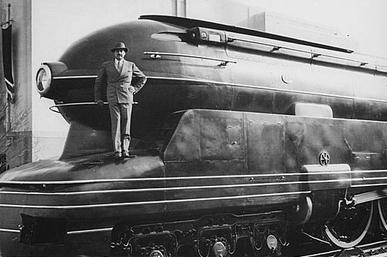
Loewy poses on the S1 Class locomotive.
Image from Wikipedia
In 1939, the Pennsylvania Railroad completed the experimental S1 class locomotive. Only one locomotive was produced, and it too featured a streamlined shroud, designed by Loewy. The S1 was originally intended to replace the Pennsylvania's fleet of aging K4 locomotives. The mechanical aspects of the locomotive were designed as a joint effort between the Pennsylvania Railroad, Lima Locomotive Works, American Locomotive Works, and Baldwin Locomotive Works. The Pennsylvania Railroad had hoped it would have the same performance and success as their GG1 locomotives. In the end however, it proved to be too big. It was the longest rigid frame steam locomotive ever built, and it had trouble negotiating some of the curves on the PRR. There were also problems with wheelslip and clearances. The locomotive was scrapped in 1949, and the railroad began to focus more on the T1 class steam locomotives.

A T1 class locomotive at the Baldwin plant, prior to
delivery to the PRR.
Image from Wikipedia.
In 1942, the Pennsylvania Railroad introduced its last steam locomotive, the T1 class. The T1 class locomotives were designed to be fast passenger locomotives. While very impressive locomotives technologically, they proved to be difficult to maintain. They were designed to operate at speeds up to 100 mph, although high speeds cause excessive wear and tear on valves, resulting in higher maintenance costs. They were so powerful that if the engineer was not careful, violent wheelslip could occur even at 100 mph. The T1 class was said to be "free steaming" locomotives, meaning the boiler was capable of producing more steam than the locomotive consumed at any throttle setting. The streamlined shell of the T1 class locomotives became known as a "Sharknose," and was designed by Loewy. The shroud on the T1 class left more of the running gear exposed, and allowed slightly better maintenance access than streamlining had on earlier locomotives.

After the T1 class locomotives, the Pennsylvania Railroad began to shift its focus to diesel, and eventually all passenger trains were pulled by diesel locomotives. Loewy redesigned many of the railroad's Baldwin diesels, and gave them a "sharknose" appearance similar to that of the T1 class steam locomotives. Besides locomotives, Loewy also did other design work for the Pennsylvania Railroad, which included marketing materials, passenger car interiors, and several station.

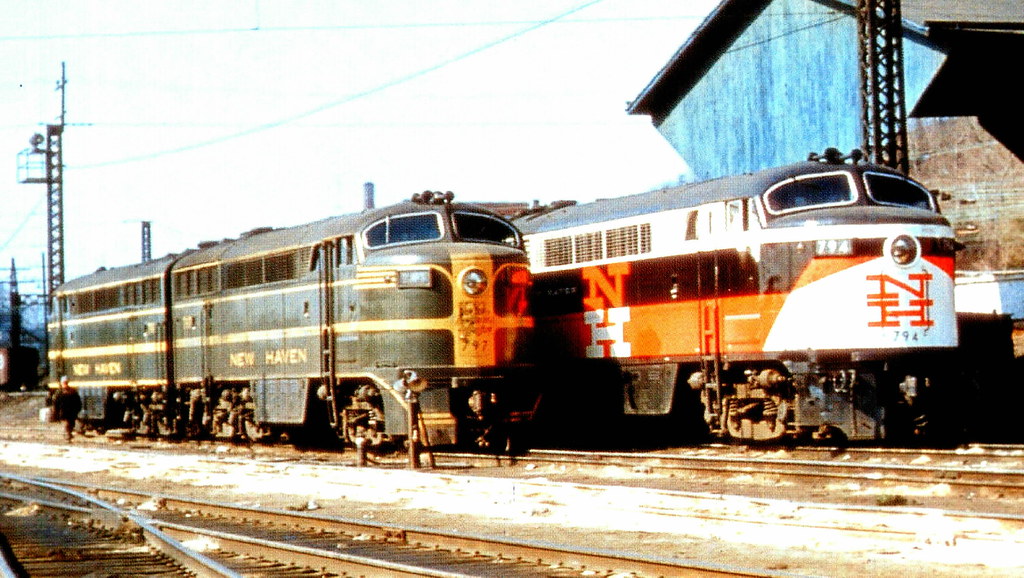
New Haven C-Liner locomotives.
Image from Flikr user torinodave72
Outside of the Pennsylvania Railroad, Loewy did design work for other railroads and other locomotive builders. In the late 1940's, Loewy worked with Fairbanks-Morse in the design of some of their new diesel locomotives, including the "Erie-built," the "C-Liner," and several others. In 1949, he also designed the Norfolk & Western Railway's new Roanoke, VA, station, which is now the home of the O. Winston Link Museum.

The railroad industry made up only a small portion of Loewy's work. Within the transportation industry, he also did extensive design work for Studebaker, designing a new corporate logo and some of the elements of their automobiles. He also designed the TWA logo in 1959 and the interior of Air France's Concorde in 1975. NASA's Skylab station was also a Loewy design. Outside the transportation industry, he also did work for Macy's, Saks, Sears-Roebuck, and many other firms. He also redesigned the Coca-Cola bottle and later designed their first steel soda cans. The Air Force One livery and the Coast Guard's "racing stripe" service mark were also Loewy designs. For a full list of his designs, please visit http://en.wikipedia.org/wiki/Raymond_Loewy#Loewy_designs.

Image from Google
Google has honored the work of Raymond Loewy with the Google Doodle on the left. It is designed to resembles Loewy's K4 class locomotive design, using the locomotive wheels to spell out Google.

Monday, June 17, 2013

Drivers Removed

As you have most likely noticed, I have not written in some time. Basically, two things have been going on in my life, work and restoring the steam locomotive.

First of all, work has been going well. Two weeks ago, we took our final exams. Our exam grades would determine our seniority, so there was some motivation to do well. Higher grades would get a better seniority. There were several parts to the test. The first part had been our field training, which had occurred a couple of weeks prior. The grade we got on that would be one third of our overall grade. The written portions would cover the other two thirds. The first part was basically a vocabulary test. There were dozens of glossary terms, and we had to write the definition. Additionally, there were a few other things we were supposed to know, such as the current rule of the week. After that, there were pictures of all the different signal indications. We had to write the name of each aspect and write out each indication. Once we were done with signals, we had five essay questions, about various topics, such as signals, restricted speed, and a few other things.

When we were finished with the test booklet, we turned it in and our teacher got us set up on a computer, in another room. There we had 98 multiple choice questions to answer, which covered selected rules from the General Code of Operating Rules and the Alaska Railroad Air Brake and Train Handling manual. That was the only portion on which we saw our grade. When we hit the submit button, on the computer, it instantly graded the test and showed how many we got wrong. I missed one, on which I had neglected to carefully read the entire set of answers. When we were finished, we were allowed to leave. Since the written portion had to be corrected by hand, we would not know what our seniority was until later in the afternoon.

I received a call from the crew office after lunch. I was informed that I had gotten the highest score in the class, and as a result, I was awarded the highest seniority in the class. We would all be moved to the Anchorage Brakemen's Extra Board at 0001 on Tuesday. I decided to place a bid on a job, since you are not subject to force unless you are on the extra board, unless they are forcing you from one position to another (such as from Brakeman to Conductor). On Alaska Railroad, I am only qualified as a Brakeman, so that is not an issue. I wanted a regular assignment just so I would know I would not get forced to Fairbanks. There was only one Brakeman job up for bid, and it was a good one. It was a morning yard job, starting at 0700, and working Monday through Thursday. It seemed too good to be true, and I was sure someone with more seniority, a lot more seniority actually, would probably be awarded the bid. The bid closed the next day, and much to my surprise, it was awarded to me. I would be expected to show up for work on Wednesday and finish the week on that schedule. That is what I have been doing since we all took our exams.

557 cab, ready for sand blasting and paint.
All photos by James Ogden.
On Saturdays, I have been going to Wasilla to work on the steam locomotive, #557. On most weekends recently, I have spent the day taking ultrasound measurements of various parts of the boiler and firebox, so we can tell how thick the steel is. The steel must be able to withstand the normal boiler operating pressure, which on this locomotive is 225 psi. In order to do that, it must be at least a certain thickness. The locomotive is 70 years old, and has been sitting, idle, for more than half of that time, in Washington. It rains a lot in most of Washington, and needless to say, there is corrosion. It is bad in some spots and bearable in others. These thickness tests help us to know how bad the corrosion is, and whether or not we will need to make repairs to the boiler.

The weight is off the drivers.
This most recent Saturday was different. I finished doing the ultrasound of the firebox, and then the entire crew that was there focused on one task, which is unusual. We had acquired four 100 ton capacity air jacks, some steel beams, and a lot of old bridge timbers, which we would use to lift the locomotive. We set up the steel beams through the space between the boiler and frame. We used the bridge timbers and some other hardwood scraps as dunnage, and we placed the jacks around the locomotive, two per steel beam. The jacks were placed on several of the bridge timbers until they reached the beams without having to be extended at all. We had a commercial grade, diesel air compressor parked outside, and hoses running to all the jacks. Once we were satisfied that everything was secure and in proper places, we commenced lifting the locomotive.

Lifting the locomotive was a slow process. The air jacks can lift a fairly large load, but that is accomplished through a lot of reduction gears, giving it enormous torque, but making them operate very slowly. The movement was almost imperceptible. It was most easily noticed by checking the progress every several minutes. The process reminded me of the Panama Canal, where enormous objects are raised and lowered, but it all happens very slowly. Despite the slow speed at which the locomotive moved, it still felt like there was a lot going on! It was very important that it be lifted level and upright, so that it would not tip or put excessive strain on any set of jacks.

557 is airborne!
The locomotive needed to be lifted about 30 inches in order to get the drive wheels out of their housing and the axles clear of the lowest parts on the frame. The problem was that the jacks only could lift about 16 inches. We extended the jacks fully, and then placed more timbers under the locomotive, as close as we could get them to the bottom of the frame. Once all the timber was in place, the locomotive was lowered onto the timber, and the jacks were removed.The timbers the jacks had been standing on were extended by adding even more timber, and then the jacks were replaced, again at a height where they reached the steel beams while fully lowered. Once everything was in place, the second half of the lift took place, in just the same fashion as the first. Once again, progress was slow, but we were constantly watching the locomotive to make sure it was completely level and the lift was happening evenly.

The forklift hauling the #4 axle away.
Once the locomotive was the proper height, the lift was stopped, and the compressed air was disconnected so that no changes could be made to the height of the jacks. We placed some scrap wood between the rails, and knocked the crown brass and journal boxes off the axles. At this point, nothing was holding them on besides gravity. Once the journals were off the axles, we rolled the axles out towards the rear of the locomotive. Now, rolling 54 inch drive wheels is not an easy task at all! The drive wheels on steam locomotives have fairly large counterweights on them, opposite where the connecting rod is attached. This allows the wheels to turn smoothly despite the driving force being applied to only one side of a wheel. The wheels are mounted on the axle on a 90 degree offset from each other so that the locomotive can never be in a situation where it cannot start the wheels moving. This means that the counterweights are near each other when you try to roll the wheel. If they are coming up, it takes a lot of energy to move the wheels the way we were doing it. Once they come over the top, the wheel tries to get away, and it takes a few people to hold it back!

Storing the drivers.
The drive wheels were rolled out towards the rear of the locomotive, where our little forklift was in position to carry them off to storage. Well, that forklift, which is about as small as they come, has surprised us before. The very first thing it ever did was move the locomotive! We had wondered if it would be able to move the wheels, and it did. The rear wheels were bouncing and threatening to lift off the ground, but it made it! The wheels were all placed on blocks so they cannot roll. Once all the drive wheels were out and stowed, it was time to remove the pilot truck. As it turned out, that would not quite clear the front coupler or sill. At least, it would not clear it on the rails. We ended up having to derail the pilot truck, and wiggle it out straddling a rail. Since railroad equipment generally moves easiest on the rails, that proved to be quite a task! On the pilot truck, we removed the entire thing, not just the wheels and axle, so it was heavier than any of the drivers. The forklift was unable to lift that without some counterweight, so several people stood on the back of the forklift to weigh it down, and keep it from tipping forward. Apparently the actual lifting capacity exceeds the weight of the thing! By that point we had pretty well run out of storage space for the moment, until a few things were better organized. We ended up just putting the pilot truck outside. Obviously, we were not too worried about anyone walking away with it!

Pilot truck.
Once all the wheels were out, we lowered the locomotive again. We lowered it to the blocks we had originally placed it on while we repositioned the jacks. It will sit like that for a couple of months while the while thing is sand blasted and painted. Once that is done, the wheels go back under it.

At this point, the 557 restoration has reached a milestone. There are very few things left to remove, and the rebuilding will begin very soon. Rebuilding will take quite a bit longer than disassembling it has, but it is also a more precise task. We estimate that rebuilding it will take about two years, and we are all hopeful that 557 will be pulling excursion trains during the summer season in 2015.


All the wheels are out.

Wednesday, May 29, 2013

Steam Locomotive Restoration

In late 2011, the Jansen family, which owns Lynden Transportation, purchased a steam locomotive from the estate of Monte Holm, a former resident of Moses Lake, WA. Mr. Holm had purchased the locomotive as scrap in 1964, from the Alaska Railroad. It stayed on his property, in Moses Lake, until 2011. When the Jansen family purchased the locomotive, #557, it was donated to the Alaska Railroad, with the understanding that it would be restored and returned to service within the next eight years. Shortly thereafter, it was moved from Moses Lake, first to Seattle, then to Whittier, AK, by barge, and finally to Anchorage.

#557, all photos by James Ogden.
The 557 spent some time in Anchorage, for the Alaska Railroad's annual open house and for some inspections. During that time, a group was organized to restore the locomotive, and preparations were made for yet another move, this one relatively short, to Wasilla, AK. The newly formed Engine 557 Restoration Company began work once the locomotive was in its new home, in a nondescript warehouse, near the railroad, in Wasilla. Work finally began in the middle of 2012, with a group of dedicated volunteers.

Since I first became aware of this project, over two years ago, I have been following progress on the locomotive. I had wanted to get involved, but being in Montana, it would have been a long commute to make it to the work sessions every week. Since moving to Alaska, I have been out to work on 557 at least once a week.

Boiler Measurements
The 557 restoration project is still in the disassembling stage. The entire locomotive has to be carefully dismantled so that it can be inspected, cleaned, repaired, and restored. Parts must be inspected, cleaned, and measured as they are removed, and carefully cataloged, so they can be located and reattached later. The most important part of the dismantling of the locomotive is the measurements of the boiler. The entire boiler and firebox must be measured for thickness, to ensure that corrosion has not eaten away too much metal, and it will be able to stand the 225 psi operating pressure when it is fired up for the first time again. This has been a very time consuming part of the project, because of the number of measurements that must be taken. Some of them are in tight spaces, such as the bottom of the boiler. A few even have to be taken on the inside of the boiler, because other parts are riveted to the outside, making the actual boiler plates inaccessible except on the inside. The firebox must also be measured for thickness inside and out. While this is a time consuming part of the project, it is also a one person job, because there is only one ultrasound device to measure with, and some of the locations needing to be measured are so cramped that more than one person would simply be impossible. Measuring the locomotive has been my project for several weeks now, and I hope to be finishing up by this weekend.

Main Rod
Other people have been working on other parts of the locomotive. The connecting rods and drive rods have all been sandblasted and polished over the last few weeks. Any imperfections in them have been either buffed out or filled and reshaped. The bearings in them have received a lot of attention, as they will be responsible for transferring the tractive effort to the wheels.

Additionally, the cab had a bit of a rust problem, particularly around the bottom. The sheet metal and angle irons in the cab have been patched or replaced, depending on the severity of the rust. Everything that gets replaced gets weatherproofed and sealed up, to prevent corrosion and help the locomotive last as long as possible.

The tender has seen much less action than the locomotive, so far. The tender is in fairly good shape, but still needs some work. Some preparations have been made to life the body of the tender off its trucks, so the trucks can be removed and rebuilt. The Alaska Railroad has all the facilities to rebuild the trucks, and will be doing that. The old brass journal bearings will be replaced with new, Timken roller bearings, for improved reliability and better operation. The body of the tender needs a thorough cleaning, inside and out, and some fresh paint. There is surprisingly little rust on the tender, which should make restoring it considerably easier.

#557's Tender
Currently the Alaska Railroad is optimistic that the 557 will be ready for operation in 2015. This largely depends on the number of volunteers available to work and the number of financial or in kind donations the locomotive receives. The current plan is to have the locomotive operate a few times a week, during the summer, on a route from Anchorage, to Portage, a distance of about 50 miles. The train will turn on the wye in Portage, and return to Anchorage, stopping in Girdwood to take on more water. Of course, all these plans are dependent on getting the locomotive operational before then. We are still in the dismantling stage, and reassembling the locomotive will take quite a bit longer than taking it apart!

For more information on the project, check out John's Alaska Railroad website.
Donations can be made through the Alaska Community Foundation, instructions can be found at http://www.alaskarails.org/pix/former-loco/557/support/donate.html.
If you are interested in working on the project, the person to contact is Pat Durand. He can be reached at sewtrain557@gmail.com.