Today I am going to stray from the ordinary Wednesday posts a bit and talk about Amtrak equipment. As some of you may have noticed, yesterday we launched our new series profiling Amtrak routes, and we thought it would be a good idea to talk about the different equipment Amtrak uses and the amenities offered by each. We will not be talking about the specifics of every piece of equipment here, because there are some cars that are very route specific, such as the Pacific Parlour. For such route specific cars, we will talk about them when we profile their route. Today we just want to talk about the different equipment, and the differences between a cafe car and a dining car, for example.
 |
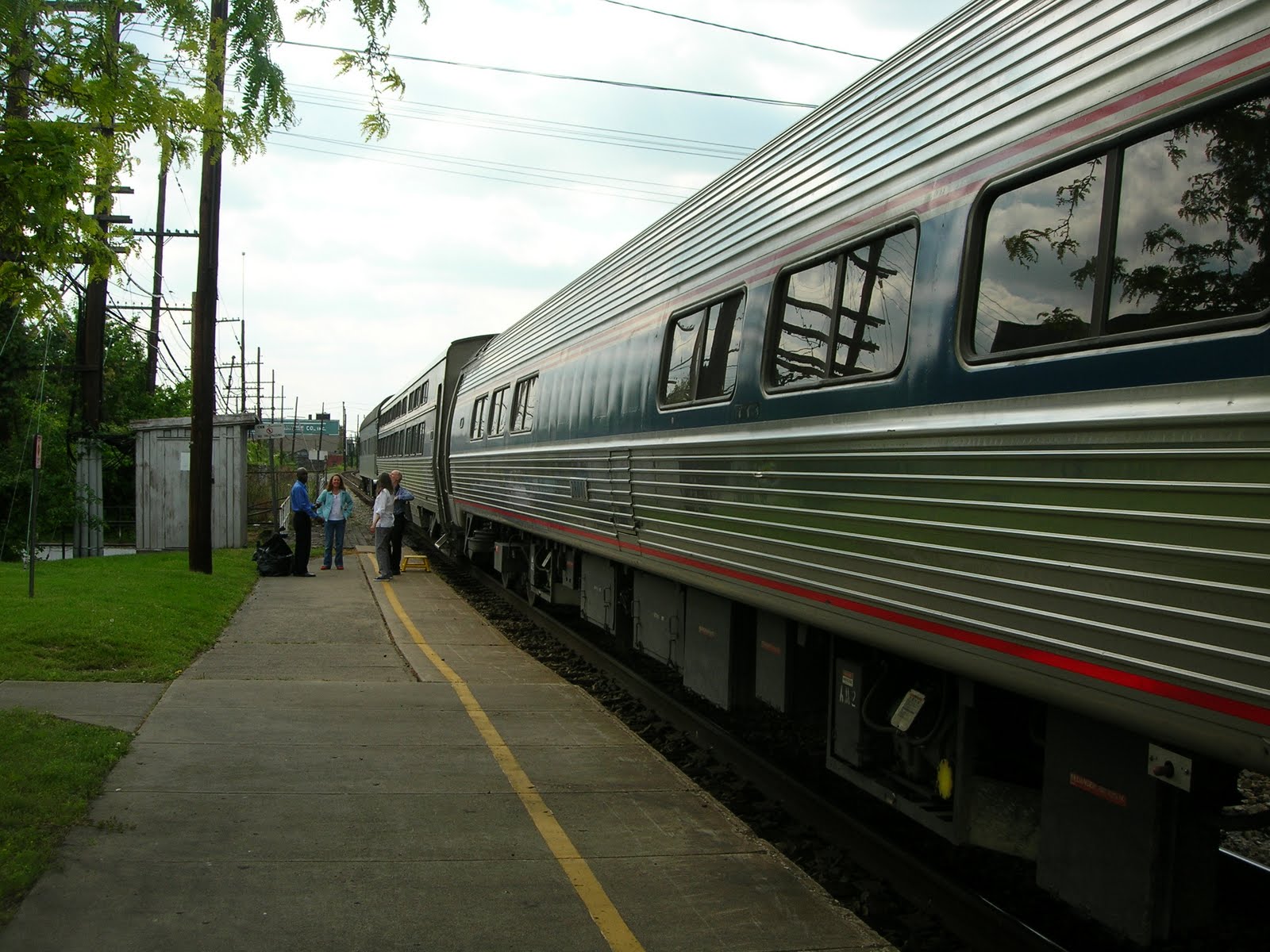
Amfleet cars in Huntington, WV, on the Cardinal.
Photos by James Ogden, unless otherwise noted. |
Amtrak has two general types of equipment they use, depending on the route. Typically eastern routes, which serve New York, use single level equipment. This is due to restrictions imposed by the tunnels leading into Penn Station in New York. Most of these single level cars are called Amfleet cars, and are easily distinguishable by their tube shape. Amfleet cars include coaches and cafe cars. For single level sleepers, Amtrak uses newer cars, called Viewliners. On long distance trains, these can usually be found with Amfleet cars, and are distinguishable by their boxy shape and two rows of windows. Single level dining cars are typically much older than Amtrak, and are known as Heritage equipment. Some Amtrak diners were built as long ago as 1948.
 |
| Superliners in Glenwood Springs, CO, on the California Zephyr. |
On western routes, where the New York tunnel restrictions have no influence, Amtrak typically uses bilevel equipment, called Superliners. Superliners come in coaches, sleepers, cafe/lounge cars, and dining cars, and a transition sleeper, which is typically used as the crew quarters. From the exterior, Superliners are easily distinguished because they have two levels, and just one center door, in the lower level of the car. Some California routes use bilevel cars modeled after the Superliners, which look very similar. Those can be distinguished from Superliners by the paint scheme usually, and because they typically have two sets of doors, at either end of the lower level.
On the Northeast Corridor, which runs from Boston to Washington, DC, Amtrak has electric trains. The regional trains on that route use Amfleet cars, hauled by electric locomotives. The high speed trains, known as the Acela trains, are trainsets with an aerodynamic locomotive at each end and single level high speed rail cars between them. We will talk more about the specifics of the Acela equipment when we talk about the northeast corridor routes. Outside of the electrified Northeast Corridor, Amtrak pulls the trains with diesel locomotives.
 |
| Interior of an Amfleet coach, on the Cardinal. |
On Northeast Corridor regional trains, and on long distance trains that serve New York, Amtrak uses single level equipment, because of restrictions imposed by the tunnels under the Hudson River and the East River, which allow for access to Penn Station, in Manhattan. Amfleet cars can be found on all the Amtrak trains that serve New York. Typically shorter distance, regional trains, including the Northeast Regional service, Empire Service, and Keystone Service, will all have several Amfleet coaches, an Amfleet cafe, and very often an Amfleet business class car. The layout in a coach or business class car is similar. There are rows of seats for the length of the car. There are overhead luggage racks running the length of either side of the car, above the seats. At one end there are a couple of restrooms and a larger luggage rack. Doors at either end of the car allow for access to cars ahead and behind. The doors to exit the cars at stations are located at either end of the car as well. Coaches have two seats on either side of the aisle, while business class cars typically have two seats on one side of the aisle, and just one seat on the other side. In both coach and business class, the seats are roomy. They are wide and offer considerably more leg room than someone may be accustomed to if they fly a lot. On coaches that are used on long distance routes, there is even more leg room available, as there are fewer seats in each coach.
 |
Amfleet cafe car exterior.
Photo by Jeffery Tritthart.
Available on www.railworksamerica.com |
On all single level trains, Amtrak also operates an Amfleet cafe car. The cafe cars are distinguishable from the outside because they look like typical Amfleet cars, but they are missing a pair of windows on either side, right in the center of the car. On the inside, this is where the food service counter is located. There are a few configurations for cafe cars, but they all have a food service counter at the center of the car. This is where you go to get your food. They have hot and cold snacks and beverages available. This food is what you might compare to airplane food. The hot stuff is all frozen and the microwaved to order. While the food is good, it would not be considered gourmet by most. Also, on long distance trains, with a dining car, it is more expensive to eat an entire meal in the cafe car than in the dining car.
 |
Food serving area in an Amfleet cafe car.
Photo from www.nationalcorridors.org. |
Also inside the cafe car is a dining area. Usually, on either end of the serving area there are tables, with seats that face each other across the table. Each table can accommodate up to four people. The tables are available to anybody, and a walk through the cafe car will often reveal that people also use the tables to play card games, write, or just socialize with other passengers, besides eating of course. It is also not uncommon for the Conductor to make an office out of one table. On some trains, where there are not enough business class passengers to necessitate an entire car, the cafe car will have a small business class section on one end. Other cars, typically used on long distance routes, will have a small lounge, with an informal seating area and some smaller tables, in one end of the cafe car. Of course, passengers do not have to stay in the cafe to eat and can bring food back to their coach seat or sleeper room as well.
 |
| Amfleet cafe and Viewliner sleeper, in Huntington, WV, on the Cardinal. |
On long distance trains serving New York, you will also find sleeping cars and dining cars. Single level sleeping cars are almost always Viewliner cars, which were built for Amtrak in 1995 and 1996. The original intention was to build Viewliner coaches, sleepers, diners, and lounges, but due to limited funding, Amtrak was only able to order 50 sleeping cars. They replaced many older, Heritage sleepers. Viewliners are recognizable for their boxy shape and for having two rows of windows. The two rows of windows allows passengers in the upper and lower berths in each room to have a window. On every sleeping car there is a shower. It is a community shower, so long, hot showers are usually frowned upon, as it wastes the water carried on the car, and it means fewer people get to use the shower. There is also an attendant on each sleeper, who will configure the rooms for sleeping or for sitting, and who keeps the shower tidy and the snacks stocked. As you might have guessed, there is also a small, self serve, snack counter on each sleeper. Usually this is stocked with fresh fruit, cookies or crackers, juice, coffee, and tea. In all sleeping car accommodations, meal service in the dining car is included in the ticket price.
 |
Viewliner Roomette, in the night tine configuration,
seen from above, on the Lake Shore Limited. |
Inside a Viewliner sleeping car, there are several room options available. The smallest, and usually the cheapest, is called a roomette. A roomette can accommodate up to two people. The room is very small, but it is adequate for two people. The daytime configuration has two wide seats which face each other. At night, the two seats fold down to become the lower berth, and the upper berth pulls down, out of the ceiling. Inside the room, there is also a toilet, sink, and luggage rack and wastebasket. In the roomette, the toilet and sink are not in a separate room, so someone may have to leave the room if you are travelling with someone.
If you are looking for larger accommodations, a Viewliner Bedroom might be the way to go. This is larger than a roomette, and usually costs a little more. A bedroom can also accommodate two people, but gives everyone a little more space. During the day, a bedroom has two seats next to each other. These convert to the lower berth at night, and again, the upper berth pulls out of the wall. The bedroom has the same features as a roomette, but also includes an in room shower. A Bedroom Suite, which can accommodate up to four people, is created by combining two Bedrooms. Since it is a combination, it has four berths, two upper and two lower, and two sinks, toilets, and showers. An handicapped accessible bedroom is also available, which accommodates two people, and features the same amenities as a Viewliner Bedroom. An accessible bedroom is designed for easier access and more space inside, for easier mobility. All rooms have 120 volt electrical outlets.
 |
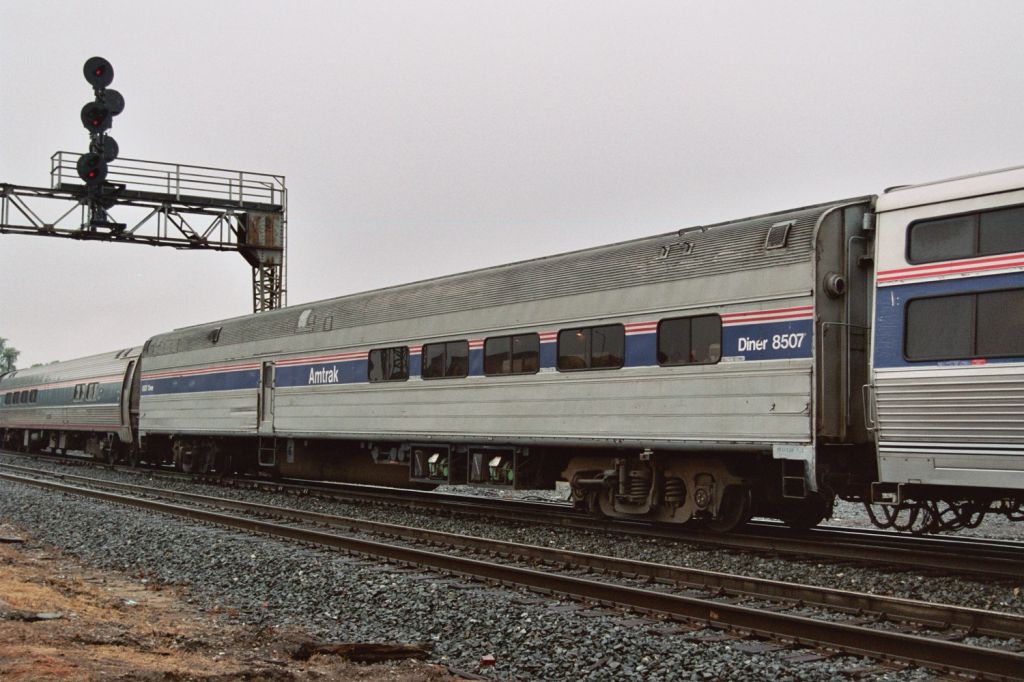
Amtrak Heritage dining car, with an Amfleet cafe on the left and a
Viewliner sleeper on the right.
Photo from www.railroadfan.com |
Single level dining cars are some of the oldest passenger cars still running on the Amtrak system, and as such are known as Heritage cars. They all date back to before Amtrak, some built as long ago as 1948. They were all built in a time when passenger trains were operated by what we now know as freight railroads. At one time, private railroad companies ran all the trains in the country, whether they were freight or passenger. Many Amtrak trains take their names from their previous, privately operated counterparts. Amtrak serves three meals a day in the dining cars, provided that the train is running for all the meals. The dining car offers sit down meal service, similar to a restaurant. Due to limited seating, dinners are served by reservations. Breakfast and lunch are served on a first come, first served basis, but if the dining car gets crowded, the attendants may take your name and call you when a table becomes available. The tables each seat four people, and because of this limited seating, passengers travelling alone or in a group of less than four may be required to sit with other passengers on the train. This is a great opportunity to meet and talk to some fellow travelers. Meal service in the dining car is included in the ticket price for sleeping car passengers. For coach passengers, meals are available at an additional cost, although it is typically cheaper to eat a full meal in the dining car than in the cafe car.
 |
Superliner coach, during a snowstorm, in
Denver, CO, on the California Zephyr. |
On western routes, and a few eastern routes that do not go to New York, Amtrak uses Superliner equipment. Superliners are all bilevel cars, with the majority of the accommodations on the upper level of each car. The functions of coaches, diners, sleepers, and cafe cars is basically the same, although the interior arrangements are a little different. Boarding and disembarking the Superliner equipment is handled through a door at the center of the car, on the lower level. Bathrooms, showers, changing rooms, and a luggage rack can also be found on the lower level of each Superliner. There is a set of stairs in the center of the car for access to the upper level. The upper level is where the majority of the accommodations are found. On the upper level there are doors on each end of the car for access to other cars on the train.
Superliner coaches have seating on a small part of the lower level, and on the entirety of the upper level. Just like with the Amfleets, the coaches feature wide seats with ample legroom. Coaches have two seats on each side of the aisle that runs the length of the car. There are overhead luggage racks above the seats on either side, and a larger luggage rack at the bottom of the stairs, on the lower level.
 |
| Superliner dining car interior, on the California Zephyr. |
Superliner dining cars have all the dining seating on the upper level. This is the only car which passengers cannot access the lower level, as it is where the kitchen is located, and it is only accessible to crew members. For passengers who cannot make it up the stairs to the upper level, the car attendant will bring meals from the dining car back to their seat or sleeper accommodation. Just like on the Heritage diners, breakfast and lunch are served on a first come, first served basis, and dinner is served by reservation. The dining car attendant will announce when he or she will be coming through the train to take reservations, and passengers should speak to him or her as they walk through if they want to have dinner in the dining car. Just like on the Heritage diners, if the dining car fills up during breakfast or lunch, one of the attendants will take down names and call people back to the dining car as tables open up. Again, due to limited seating, passengers traveling alone or in groups of less than four may be asked to share the table with other passengers.
 |
Superliner lounge, on the California Zephyr. On the lower
level is the cafe area. |
Superliner cafe cars are a bit different than their Amfleet counterparts. They have the same menu as the Amfleet cafe cars, but they are also the lounge cars, and as such, are easily recognizable by their large windows. The lower level of the car is where the food service area is located. Also on the lower level, there are tables and seats, similar to the dining car and Amfleet cafe cars. Each table can seat four people, in seats that face each other across the table. On the upper level of the cafe car is the lounge area. The lounge features large windows, which curve up onto the roof of the car. On the upper level, there are more tables at one end of the car. The rest of the car is lounge seats, which face the windows, and small tables between them. Some of the seats swivel, while others are fixed in place. This is the car to be in on most western routes, as it affords the best views of the scenery. Of course, as the train gets closer to scenic areas, the lounge car fills up, so it is best to get there early to grab a seat, if possible.
 |
A Superliner Roomette, in the daytime configuration, on the Empire
Builder. |
Sleeping car accommodations on Superliner equipment is similar to those of Viewliner sleepers. The smallest room available, and usually the cheapest, is a roomette. On Superliners, roomettes can accommodate two people. Their daytime configuration has two wide seats that face each other. At night, the seats fold down to make the lower berth, and the upper berth pulls out of the ceiling. Superliner roomettes feature a small closet, wastebasket, and a small luggage rack. There is a community bathroom on the upper level, and bathrooms and showers on the lower level of the car.
A little more space can be found by booking a Superliner Bedroom, which also accommodates two people. In addition to the features of a roomette, a bedroom also features an in room bathroom and shower. The daytime configuration is two seats, side by side, and a chair across the room. The seats fold down to become the lower berth at night, and the upper berth pulls out of the ceiling. A Bedroom Suite is made by combining two Superliner Bedrooms, and can accommodate up to four people. A bedroom suite features two bathrooms and two showers, as well as two upper and two lower berths. It allows for a little more space for those travelling in a larger group together.
Superliner sleepers also have a Family Bedroom, which can accommodate up to four people, although two berths are smaller and designed for use by children. A family bedroom does not have a bathroom or shower in the room, but they are available just down the hall, on the lower level.
Superliners also have a handicapped accessible bedroom, which can accommodate two people. It has an entrance placed for easier access and a little more space inside for moving around. The accessible bedroom is on the lower level, and it features an in room toilet, but the shower is located just down the hall from the room.
Each sleeper has an attendant who can reconfigure the rooms for daytime or night time use. There is a community shower on the lower level of each Superliner sleeper, and bathrooms on both the upper and lower level. Additionally, in the center of the upper level, there is a small, self serve snack bar, which usually has fresh fruit, cookies or crackers, juice, coffee and tea. End doors on the upper level allow passage into adjoining cars on the train, and the center doors on the lower level allow boarding and disembarking.
For more information on Amtrak accommodations, visit
www.amtrak.com. They have a a "Plan" tab on their website, which has virtual tours of all the sleeping car accommodations, and other important travel planning information. If you are thinking about travelling, try the train. It is a quiet and relaxing way to go, and a pleasant change from the fast paced way of life so many of are so accustomed to.
 |
| Superliners getting ready to depart on a snowy morning in Salt Lake City, UT, before heading east, towards Chicago, on Amtrak's California Zephyr. |

 The California Zephyr's history actually goes back before the California Zephyr was inaugurated. Back in the 1930s, the Chicago, Burlington & Quincy Railroad, or CB&Q, ordered some all-new, diesel powered, all stainless steel passenger trains from the Budd Company. Boston & Maine had a similar trainset, more info on these trains here. To help promote this new service, they needed a new, modern name for these trains. Borrowing from Greek mythology, they used the name of Zephyrus, god of the west wind, and called their trains "Zephyrs." They liked the name so much they even stuck it to their other trains that didn't use the shiny new stuff.





 After Reno was a big desert. The train picked up speed here, as it was a straight and flat run across the desert. I had seen a desert once before, from the California Zephyr in southern Utah. However, it was raining that day, so for the past two years my mental image of a desert included rain. However, this time it was a typical cloudless, sunny day in the desert. I got some photos of the desert, including the sun setting over the distant mountains. After the sun went down, I went back to my coach to sleep. I did not sleep well that night. The air conditioning on the train worked too well, and I had not brought a jacket or a blanket, so I was cold all night. When I got up, the first thing I did was go to the cafe car and order a hot chocolate. That warmed me up nicely, and I went upstairs to sit in the lounge all day again. Again, the scenery was desert. If I had never been to Utah before, I would have thought that was all the train passed through all night. However, during the night the train passed through Salt Lake and Utah valleys, both of which are the big population centers of Utah. They are probably the greenest parts of Utah, but I think they still qualify as desert. But they certainly are not flat and empty like the area the train was going through now.


