Yes, you are getting two posts from me this week. Why? Well, I have two days off this week. Trust me, this is going to be more of an exception than the rule. But enjoy it while it lasts!
First of all, before I get into everything I want to talk about, I want to open this particular series up to all of you. If you would like to see me to talk about something in particular when I write this series of stories and experiences, please feel free to
email me, and I will do my best to put something together. If you have questions, again, please send me an email at
ogden.bros.trains@gmail.com, and I would be happy to help. I would love to hear from you!
Today I want to talk about variations in locomotives. Now, I like to consider myself to be fairly observant, but sometimes I do not notice the little details. Well, at least not until they matter. As far as relatively modern diesel locomotives go, I would have told you as a railfan that I like those built by
EMD better. The reason why was simple--looks. I simply think they are better looking diesels. I would not say I hated the locomotives built by
General Electric, but I did think they were less attractive. As a railfan, where my only concerns were realistic modeling preferences and good photographs, that is all that mattered really. If it looked good in photographs I took, and it looked good on my model railroad, I was a happy
foamer! Working for the railroad has made different things important, at least in daily operations.
For the last five days, I have been working a utility position in the yard at Glendive. The utility crew is responsible for putting locomotives on trains before the train crew gets there, so that their train is ready to go when they are. Glendive has a locomotive servicing and fueling facility. Because of this, nearly all the trains that arrive here have their locomotives taken off and brought to the roundhouse for servicing. The servicing can be extensive, making major repairs, or it can be as simple as topping off the fuel tank before continuing the trip. Almost every locomotive has a control cab, so in theory, an engineer could do all this moving by himself by changing which cab he operates form whenever he changes direction. While this is often possible, it is very impractical.
To make moving locomotives around the yard more practical, and faster, a conductor is also on the crew. Since most movements require the engineer to operate in reverse, usually with one or more locomotives between him and the back of the consist, the conductor is his eyes at the point, or leading end of the movement. The conductor can give him instructions over the radio, but most conductors prefer hand signals for their convenience. This means that the conductor must be in a place where he can be seen by the engineer. The best place for that is the bottom step at the leading end of a locomotive. There he is close enough to the side of the engine to be seen by the engineer in most situations, while still in a position to hang on during the ride. In such an operation, the size of that step makes a big difference!
Besides being required to ride equipment, the conductor climbs on and off equipment a lot. During one move, the conductor usually has to climb on and off of locomotives several times to line switches or couple locomotives to cars. This is another reason the size of the steps make a difference. Once a locomotive, or a consist of locomotives, is coupled to the train it belongs on, the air hoses must be coupled for the air brakes, the hand brakes on the locomotives must be set, and each locomotive needs to be electronically isolated from the others, for added safety. All of this requires more climbing on and walking around on locomotives. Doing all of this is where I started to notice some details that I had not noticed before. Lets take a look.
 |
| Image from www.bonanza.com |
First off, lets look at the steps on a typical locomotive built by EMD. I realize the photo is a model, but this was the best photo I could find of a pair of steps on a locomotive, and I really have not had a chance to take any myself. These steps are steep, as usual on a locomotive, so you would climb up and down them more like a ladder, facing the locomotive as you do so. There are a few things I really do not like about these steps. First of all, as you climb higher on them, they get narrower. This locomotive is not so bad, but some of them, with more steps, give me just enough space to squeeze both feet up against each other on the top step. Fortunately, it is pretty rare that you would need to spend any time standing on the top step. Also notice that the steps cut into the walkway. This means, once you have climbed to the top, you need to hang on while you swing yourself around that corner, back over the steps, to get around to the side. Usually this is more noticeable if you are coming from the end and walking around to the side, because you have to hang on to something and watch out for that hole. Another thing, which you would never notice until you have climbed on and off of several of these, is the positioning of the handrails. It does not look like a problem, but consider that as you climb up the steps, you are moving closer to the center of the locomotive, and the hand rails, which are more or less vertical, really are not. By the time you are on that top step, the hand rail is behind you, even if you are leaning back a bit as you climb up. Again, this is more of a problem on locomotives that have more steps. I am not sure that can be avoided, but it can be annoying at times! I will say, EMD has corrected this on their latest units, the
SD70M-2 and the
SD70ACe. They have steps which are almost identical to those on GE locomotives.
 |
| Image from www.actionroad.net |
Now, let's look at the steps on a GE locomotive, and hopefully you see why I like them better. Basically, they are easier and more comfortable to use. First of all, they are all the same width. As you climb up the steps, they do not get smaller on you. The handrails turn toward the center of the locomotive more than on the EMD counterparts, which makes them closer to you as you climb up. As you get to the top, you still run into the problem of having the handrail on the locomotive side get behind you, but not nearly as much. Also, notice that the bottom step sticks out quite noticeably. This gives the conductor a great place to stand while giving hand signals to the engineer. On EMD locomotives, the bottom step is the largest, but it does not stick out nearly as far. I would go as far as to say the bottom step on a GE locomotive is downright spacious! It is really nice when you need to turn around to check on something. You can move around down there without having to worry about falling off! Also, up at the top, there is more space to get around the steps, if you are simply trying to walk past them, from the side of the locomotive to the end. I know the picture really does not show that in this case, but look at the bright side, at least it is a photograph of a real locomotive this time!
Now the steps are not the only issue I want to mention. I will not get into locomotive handling or response or anything like that because I am a conductor. I just do not deal with that kind of stuff. That is all up to the engineer. Maybe when I get to that point I will talk about my thoughts. I want to talk about the cabs though. I am not going to get into wide cabs versus standard cabs, but I do want to talk about visibility. Nearly all the trains we send out over the road have
wide cab locomotives, so we are just going to go over those, from a conductor's perspective.
 |
| Image from www.railpictures.net |
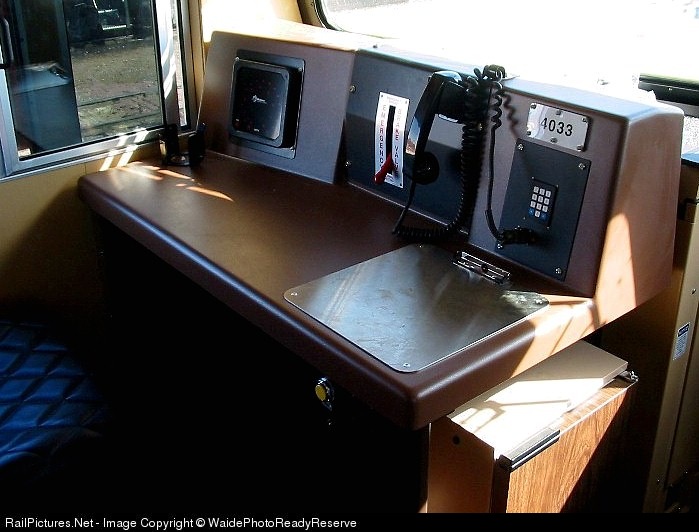
As a conductor or engineer, you want a pretty clear view of what is coming at you. Visibility is very important, but so is comfort, because the cab is a home away from home for many hours each day. The conductor needs certain things on his side of the cab, such as a speedometer, radio, desk for paperwork, an emergency brake, and a horn button. Now, my short experience has shown that generally, the GE locomotive have a little better visibility. This shows the conductor's side of a typical GE widecab locomotive. Specifically, this is a typical model of the
Dash 9-44CW. However, even in more recent models, the area has evolved very little. The speedometer is that black square thing on the left. The emergency brake is that red lever in the center. To the right is the radio handset, radio keypad and the locomotive number. Down below the surface of the desk is the yellow horn button. You will notice that the speedometer, emergency brake, and radio keypad are designed to be right in front of the conductor, but they are not high enough to block the view out the front. The conductor can slouch a bit, and even put his feet up, and still have a decent view of what is to come. That is not to say I would ever slouch or put my feet up on the job! :) Also, having the radio down below the desk means that the wire is not in the way or your paperwork when you are trying to talk to the dispatcher and copy a track warrant.
 |
| Image by Mike Bates, www.railpictures.net |
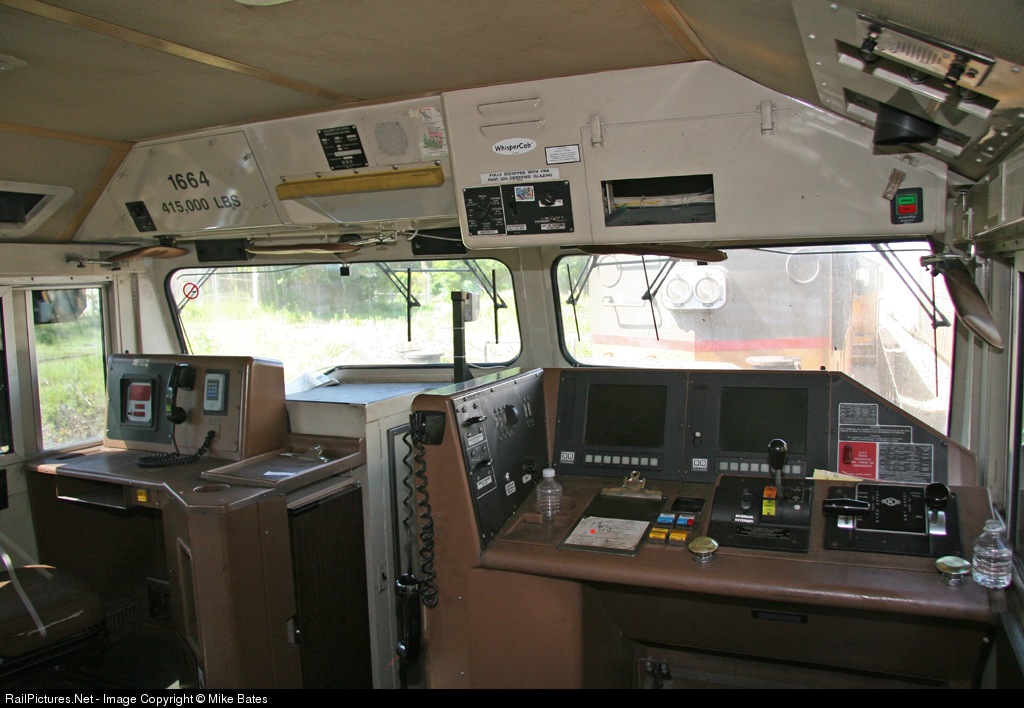
Now, with EMD locomotives, I think their earlier wide cab units had better visibility. Also, it seems to me that the conductor's visibility has gotten progressively worse with every model! An older,
SD60M, had great visibility! The only problem with it was they put the emergency brake below the desk and the speedometer up in the ceiling above the desk. There is absolutely nothing to block the conductor's view, but that is not entirely a good thing. To see the speedometer, the conductor either has to stand up and take a step back or lean back really far in the seat and squint a little. While the visibility is great, it is still not the most practical design. With later models, things got better. To the left is a picture of the conductor's side on the
SD70MAC, which has its pros and cons. The biggest pro is that the speedometer is in a place where the conductor can realistically see it and read it--right in front of him. One of the biggest cons, the speedometer is mounted on a panel the size of a country in Europe, so the only way you can see over it well is if you are sitting up straight all the time, and who does that?! The radio keypad is also on that surface, moved down form the ceiling, and the radio was moved up from under the desk, which is okay, but the wire can get in the way sometimes. Usually to solve that problem, the wire gets wrapped around one of the sun visors on the ceiling.
 |
| Photo from www.railpictures.net |
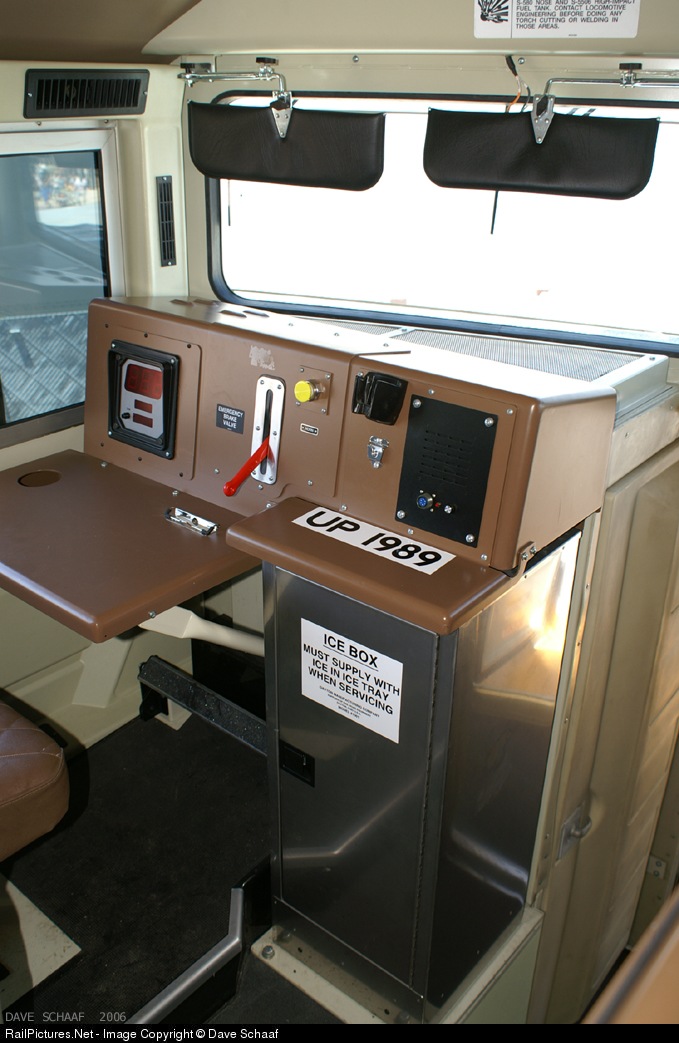
The newest EMD locomotives, the
SD70ACe has solved a few problems and created a few more. Take a look. The speedometer panel has not gotten any smaller, but it has gotten lower, which seems to help with visibility. The emergency brake and horn have moved above the desk. The radio is also up top, but off to the right, where the wire does not get in the way of the paperwork. So several problems were solved. However, this is my least favorite cab honestly. The desk area is very small. That has to handle a signal awareness form, which you take notes on regularly, and track warrants, which you also write on regularly. Besides all that, it must also hold the general track bulletins, work orders, and any used track warrants and speed restriction forms you may have received. I usually end up with three or four piles of paperwork, and this desk gives you space for two. The visibility seems to have improved, however this cab has smaller windows, and you sit farther back from them, which means visibility over the desk is better, but not the visibility out to the track ahead. Having said all that, these are some of the quietest locomotive cabs around, unless you left the window open. With the doors and windows all closed up, you hardly feel like you are on a locomotive with a massive diesel engine roaring behind you. Isolating the cab from the noise and vibration was done very well, and that helps to make up for the other problems. The biggest problem with this cab is the fact that the desk does not continue to the right. There is nowhere to put your feet up!
Some locomotives are better than others, and generally speaking, cabs and locomotives have improved in comfort in newer models. However, the person designing locomotives is still sitting behind a desk, not in the locomotives he or she designs. As long as that is the case, there will always be things that bug the people who spend all day on the locomotives. What seems like a good idea on paper is not always a good idea on the road. Using locomotives regularly has started to change my opinion about them. I still think EMD builds prettier locomotives, with the exception of the SD70ACe. But given the choice, I would rather work on a product of General Electric. I like that spacious bottom step for giving hand signals to an engineer three locomotives away. It just makes work easier. I like having a desk in the cab big enough to spread out three or four piles or paperwork and put my feet up while we sit for hours in a siding. So I will take a GE to work with, but an EMD to photograph and play with.