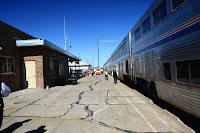
Showing posts with label Southwest Chief. Show all posts

Thursday, October 6, 2011

History of the Southwest Chief

Today's Southwest Chief is a combination of two trains formerly operated by the Atchinson, Topeka, and Santa Fe Railroad; we'll call it Santa Fe or ATSF for short. The trains were known as Super Chief and El Capitan, and both made the same fast run from Chicago to Los Angeles on Santa Fe's main line, along with slower trains making the same route but with less fanfare, lower fares, and more stops. The route that Amtrak follows today is the same route Santa Fe used.


On May 12, 1936, Santa Fe inaugurated an all new train, the Super Chief. This was the first diesel powered, all-Pullman train in the United States. Many railroads did not dieselize until after World War 2. The Santa Fe only had one trainset at first, and operated it once a week on a 40 hour schedule between origin and destination. About a year later, Santa Fe re-equipped the train with lightweight cars and new diesels and more trainsets, and inaugurated it once again. The inaugural run was completed in 36 hours and 49 minutes, a record which stands to this day. Before the war, Santa Fe ran this train nonstop between Kansas City, MO and Barstow, CA, with the exception of crew change points and servicing stops. During the war, the schedule was relaxed and passengers could get on or off at some of the bigger cities along the route, and after the war the schedule was relaxed again to allow passengers to get on and off at all the stops. The train was designed for celebrities traveling to Los Angeles, and earned the nickname "Train of the Stars."

In 1938, El Capitan started running once a week in each direction as an all-coach version of the Super Chief. El Capitan ran the same 40 hour schedule as the Chief, but made more stops because it was a coach train. Because of the extra speed and the Super Chief-style luxury, the fare was higher than any other train on the route, with the exception of the Super Chief itself. Also in 1938, the Super Chief began running twice a week. El Capitan followed suit in 1946, and the Super Chief was upgraded to daily operation the same year.

Photo from www.bcoolidge.com.
In 1952, Santa Fe announced plans to upgrade the Super Chief with bilevel cars from the Budd Company, as well as full length domes for El Capitan. Upon delivery of these cars in 1955, they switched trains, and the bilevel coaches went on El Capitan and the Chief got the dome cars. In 1958, the two trains started running as a combined train during off-peak seasons, they ran under the Super Chief name, number, and schedule. Both trains, however, continued to receive the same hype and luxury they always had right up until May 1, 1971, when Amtrak took over passenger service on the line.

Amtrak acquired the Super Chief and El Capitan equipment and ran both trains under their original names. In 1973, Amtrak dropped El Capitan, and in 1974 Santa Fe asked Amtrak to stop using the names Super Chief and Texas Chief, another former Santa Fe train that Amtrak took over, because Santa Fe felt that the Amtrak trains didn't live up to their original names, and the trains didn't deserve the names anymore. Super Chief and Texas Chief were renamed Southwest Limited and Lone Star. In 1984, Santa Fe allowed Amtrak to use the Chief name again, and the Southwest Limited became the Southwest Chief, and it runs under that name to this day.

Photo by Steven Welch.
El Capitan may have been discontinued in 1973, but its legacy lives on. The bilevel cars originally used on that train were used by Amtrak on many western routes, and when Amtrak needed new cars for their western routes they designed the Superliners, which were based on El Capitan's bilevel design. The original bilevels were slowly phased out of service, and today the only ones still running can be found on Amtrak's Coast Starlight. The Coast Starlight operates between Seattle and Los Angeles, and features a "Pacific Parlour" car, originally an El Capitan lounge car.  One of these cars even made an appearance in the popular 2003 film The Italian Job.

Tuesday, October 4, 2011

Route Profile: Southwest Chief

Amtrak's Southwest Chief is a long distance train operating daily between Chicago and Los Angeles. The train covers 2265 miles in about 43 hours. Destinations along the way include Kansas City, Topeka, Albuquerque, the Grand Canyon, and Los Angeles.

The train leaves Chicago on BNSF tracks, which it will follow all the way to Los Angeles. The train follows the same route as the California Zephyr and other short distance trains to Galesburg, where it takes a more southerly route than the Zephyr. The train crosses a small corner of Iowa before making its way across Missouri to Kansas City. The scenery through here is mostly farmland, with the Mississippi River crossing shortly after Galesburg. You will go to sleep in Missouri, probably near Kansas City.

During the night the train crosses Kansas, making a few stops there. You will wake up near the Kansas/Colorado state line. In Colorado you have your first smoking stop of the day, in La Junta, where you can get off the train and stretch your legs for a few minutes. The Colorado scenery on this train is not the same as on the Zephyr, the landscape is mostly plains here. The train does not spend much time in Colorado, because it turns more to the south to get to New Mexico.

Before crossing into New Mexico, the landscape turns more mountainous. The train crosses the Colorado/New Mexico state line and the Continental Divide at the same place, in Raton Pass, at an elevation of over 7000 feet. After crossing the Divide, the train descends the other side of the pass and stops in Raton. The scenery will stay somewhat mountainous across New Mexico. The Southwest Chief does not stop in Santa Fe, but you can get a commuter rail train there from Lamy or Albuquerque. Albuquerque is the train's long stop where it restocks the food and water and everything else on the train, so you are there for almost an hour. There are some vendors on the platform selling New Mexico souvenirs, and they have some pretty cool stuff there.

It will get dark about the time you get to Arizona, and you will sleep across that state. People going to the Grand Canyon get off at Williams Junction, so that is a busy stop. The train makes other stops in Arizona, before you wake up the next morning in southern California. The scenery here is also mountainous, and you will go through the famous Cajon Pass that morning. The pass is very scenic, and if you like trains, there are lots of them. Don't get too comfortable in your lounge seat though, because the train is scheduled to arrive in Los Angeles at 8:15 that morning, and the trip is done.

If you are thinking of visiting Los Angeles or the Grand Canyon, Amtrak's Southwest Chief is the way to go. It's not my favorite Amtrak route, but it is scenic enough to capture your attention. It is one of the faster transcontinental routes, taking less than 48 hours from end to end. This train frequently runs on time, so scheduling issues should not be too much of a concern. This popular train books up quickly though, so grab the tickets while you can!

Tuesday, August 9, 2011

Southwest Chief

As the California Zephyr departed Burlington, IA, I checked the schedule. The train was running five and a half hours late, and I was worried about my connection. I was getting off in Galesburg, IL, to get on the Southwest Chief. Normally, I'd have a six hour connection there, but if the train lost any more time, I wouldn't make that connection. I called Amtrak to check the train status on the Southwest Chief, and thankfully, it was running 45 minutes late. The Zephyr did not lose any more time, and I got to Galesburg with a little over an hour to kill. There is plenty of freight action in this small town, so I just sat down with a camera and watched freight trains go by. The Southwest Chief arrived, and I climbed on board, ready for the new adventures and the new people this train would bring.

I found my seat, next to a man holding a fireproof box. I put my stuff there and went to the lounge car, which was about 10 feet away from my coach seat. I sat there for the rest of the day, although there wasn't much to see across Illinois and Missouri. I went back to the coach seat for the night. When I sat down, the man sitting next to me got up and went to the lounge car for the night, leaving his seat empty. I lay down across both seats and slept pretty well that night. When I woke up the next morning, I went into the lounge car again. The man with the fireproof box was still there, and when he saw me come into the lounge car, he got up and went back to the coach seat, never saying a word to me. I thought this was all very strange.

That morning we crossed from Kansas into Colorado. However, this area of Colorado is much different from what I saw two days before on the California Zephyr. I actually thought I was already in New Mexico! Rather than the Rockies, I saw desert. A lot of desert. More desert than I thought existed. It was actually beautiful at first. But it did get boring after a while. However, the train didn't stay in the desert all day.

Crossing into New Mexico, the train also crosses the Continental Divide at over 7,000 feet above sea level. This area is called Raton Pass, and is a famous area on the old Santa Fe Railroad. The mountains also had trees. Notice I used the word "had." A few weeks prior to this trip, the Southwest Chief was cancelled due to wildfires in this area. Most of the trees through here were charred remains of trees. I'm sure this area is more scenic when the trees are alive and well. It was kind of gloomy and sad when I went through there.

After Raton Pass, New Mexico started looking like southeast Colorado again. Honestly, it was getting kind of boring. It was nothing but dirt, cactuses, and sagebrush as far as I could see. Occasionally there was an antelope or some cattle off in the distance. There were usually a couple mountains off in the distance as well. Every so often you'd pass a fence dividing the desert in two and you'd wonder, why do people own all this land? In the evening, the train returned to civilization and stopped in Albuquerque. This was a longer stop, so I got out of the train and looked around. There were some vendors on the platform, so I bought an Albuquerque shotglass for my grandfather, who has a very large collection of shotglasses. I also saw some of the New Mexico RailRunner commuter trains there.

After Albuquerque, I went back to the coach to sleep. Once again, the man with the fireproof box got up and went to the lounge car for the night, never saying a word to me. He got off the train during the night. I woke up the next day in southern California. We went through Cajon Pass in the morning before arriving in Los Angeles about three hours late. Honestly, I thought this train was overrated. While nothing went wrong during the trip, I think people love this train only because the Santa Fe used to run it. I think people love Raton and Cajon Passes only because the Santa Fe went through them. Those were really the only scenic areas on the train, and they weren't very scenic. But my opinion about the scenery might be because I had just ridden the California Zephyr. If I had ridden the Southwest Chief first, I wonder if my opinion would be different?

I did meet some cool people on this train though. There was a family traveling to the Grand Canyon and eventually to Los Angeles. They were going to go up the west coast and take the Empire Builder back east. They were on a 15 day rail pass. There was also a girl about my age from New York whose grandfather, a railfan, had convinced her to get a rail pass and go across the country. She got off in Arizona to visit friends there. There were also a few boy scout troops taking to train to Philmont Scout Ranch in New Mexico. They all got off in Raton, I'm not sure how far Philmont is from there. They came from all over the country. That is something I always wanted to do when I was in scouting, but my troop never went to Philmont.

Los Angeles is the furthest from home this trip takes me. 5 days and 4,000 miles separate me from my house in Nashua to where I now stand. Once again, I will board a train, the Sunset Limited, where I will see new places and meet new people. The Chief was the last westbound train I would take on this trip, the Sunset Limited is the first of three trains that will bring me back home.