A couple of weeks ago, I was called to work on a Whittier freight train. We went to Whittier with some freight for the barge, did a little switching, and then returned to Anchorage with freight that had come off the barge. It was a pretty simple and straightforward trip, although we were surprised when we arrived in Whittier by the presence of a film crew from Windfall Films. Windfall Films is the producer for the reality television show Railroad Alaska. They stopped us on the way in to clip on wireless microphones and have a job brief, and then they filmed us switching. Anyway, on the way back we had to stop in Portage to wait for a Seward bound freight train to pass. Our train and theirs were too long to meet anywhere between Portage and Anchorage, so we had some time to kill while they got to Portage. It was a beautiful day, so we decided to take some pictures.
Left to right are as follows:
John, Manager of Operating Rules and Training
Ryan, Student Engineer
Keith, Brakeman
And me, the Student Conductor.
Davy, the Conductor, was behind the camera, and the engineer opted to stay in the cab.
Appropriately, ARR #4004, the Spirit of Whittier, was the leader on the return trip from Whittier. Our other locomotive was the #4014. This train was known as a "turn," since it went to Whittier, dropped off cars, turned around, and came back with new cars.
Showing posts with label SD70MAC. Show all posts
Sunday, March 30, 2014
Tuesday, May 1, 2012
Alaska Railroad Cars
Some of you may recall that several months ago, I acquired some decals for the Alaska Railroad. Ever since I lived in Alaska, in 2009 and 2010, I have wanted to recreate one of their passenger trains. Commercial models are available for Holland America Tours' private dome rail cars, but not for any of the Alaska Railroad passenger cars. When I first acquired the decals, I was figuring I would just paint up a couple of cars. At this point, the two Budd domes I originally acquired for this project have some company.
I found a couple of ACF dome coaches, from Walthers' Union Pacific City series, a couple of ACF 44-seat coaches, and a baggage car, also from Walthers' Union Pacific City series. The other day I was in a hobby shop and came across some undecorated coach and diner kits, and forgetting that I already had a pair of coaches on order, I bought two of the kits and a diner kit. It seems that I will have a pretty good sized passenger train when all is said and done! Around Christmas time, my wife bought me an airbrush, so I now just need to learn to use that and I can go to town on the painting. Out of the cars I have, five are undecorated, two are decorated, but are gray, and can probably just take another coat of paint, and three must be stripped of their paint before I can do anything with them. Once I get some paint thinner and some more turpenoid, I will be ready to start. In the mean time, I have been doing other prep work for the cars.
In addition to the cars, Steven also sent me a locomotive that I had completely forgotten that I even owned. It was sitting in his train room and I had not seen it in a while. It is an Amtrak E8B. I have no use for it in that paint scheme, as I try to focus on post-2000 in my modeling. My original plan was to sell it, along with about a dozen other items I have in my "list on eBay" pile, but then I discovered an interesting painting and kitbashing project for it. The Alaska Railroad has an E8B they use as a power car. Over the years, it has had its prime movers removed, and generators installed, and is used to generate the Head End Power (HEP), required by the passenger cars. Now, the Alaska Railroad has some Geeps and SD70MAC's that also generate HEP, but sometimes a train needs a little more power, or for some reason a HEP equipped locomotive is not available. Their E8B is P-30, and is an interesting piece of equipment. Originally, E-series engines had six axles under them, but somewhere along the line, P-30 was reduced to only four, making it a pretty unique E8! Most of the roof details were changed when it was turned into a power car, as four smaller generators replaced the original prime movers. Since I only have one, non-HEP SD70MAC in Alaska Railroad colors, I figured I would need P-30 if I wanted my little passengers to have lights and heat!
When all the cars are finished, my Alaska Railroad fleet will look like this:
SD70MAC #4002 Spirit of Seward
E8B Power Car #P-30
Baggage Car #101
Coach #200
Coach #201
Coach #203
Coach #204
Diner #400
Dome Coach #501
Dome Coach #502
Dome Coach #521
Dome Coach #523
McKinley Explorer #1050 Kenai
McKinley Explorer #1051 Knik
McKinley Explorer #1052 Chena
McKinley Explorer #1053 Kobuk
McKinley Explorer #1054 Eklutna
McKinley Explorer #1055 Nenana
McKinley Explorer #1057 Talkeetna
I think it should make a great Denali Star, I just need to find a model railroad with convincing Alaska scenery to run it on! I'll post some pictures on our Facebook page in the morning, although they will be mostly undecorated cars for now.
I found a couple of ACF dome coaches, from Walthers' Union Pacific City series, a couple of ACF 44-seat coaches, and a baggage car, also from Walthers' Union Pacific City series. The other day I was in a hobby shop and came across some undecorated coach and diner kits, and forgetting that I already had a pair of coaches on order, I bought two of the kits and a diner kit. It seems that I will have a pretty good sized passenger train when all is said and done! Around Christmas time, my wife bought me an airbrush, so I now just need to learn to use that and I can go to town on the painting. Out of the cars I have, five are undecorated, two are decorated, but are gray, and can probably just take another coat of paint, and three must be stripped of their paint before I can do anything with them. Once I get some paint thinner and some more turpenoid, I will be ready to start. In the mean time, I have been doing other prep work for the cars.
In addition to the cars, Steven also sent me a locomotive that I had completely forgotten that I even owned. It was sitting in his train room and I had not seen it in a while. It is an Amtrak E8B. I have no use for it in that paint scheme, as I try to focus on post-2000 in my modeling. My original plan was to sell it, along with about a dozen other items I have in my "list on eBay" pile, but then I discovered an interesting painting and kitbashing project for it. The Alaska Railroad has an E8B they use as a power car. Over the years, it has had its prime movers removed, and generators installed, and is used to generate the Head End Power (HEP), required by the passenger cars. Now, the Alaska Railroad has some Geeps and SD70MAC's that also generate HEP, but sometimes a train needs a little more power, or for some reason a HEP equipped locomotive is not available. Their E8B is P-30, and is an interesting piece of equipment. Originally, E-series engines had six axles under them, but somewhere along the line, P-30 was reduced to only four, making it a pretty unique E8! Most of the roof details were changed when it was turned into a power car, as four smaller generators replaced the original prime movers. Since I only have one, non-HEP SD70MAC in Alaska Railroad colors, I figured I would need P-30 if I wanted my little passengers to have lights and heat!
When all the cars are finished, my Alaska Railroad fleet will look like this:
SD70MAC #4002 Spirit of Seward
E8B Power Car #P-30
Baggage Car #101
Coach #200
Coach #201
Coach #203
Coach #204
Diner #400
Dome Coach #501
Dome Coach #502
Dome Coach #521
Dome Coach #523
McKinley Explorer #1050 Kenai
McKinley Explorer #1051 Knik
McKinley Explorer #1052 Chena
McKinley Explorer #1053 Kobuk
McKinley Explorer #1054 Eklutna
McKinley Explorer #1055 Nenana
McKinley Explorer #1057 Talkeetna
I think it should make a great Denali Star, I just need to find a model railroad with convincing Alaska scenery to run it on! I'll post some pictures on our Facebook page in the morning, although they will be mostly undecorated cars for now.
Labels:
Alaska Railroad (ARR),
Dining Car,
Projects,
SD70MAC
Wednesday, August 10, 2011
Prototype Railroading: Picture Time!
I have not shared a lot of pictures from work on here really. I do not actually take a lot, just because usually I am thinking more about getting the job done right and getting home. But I thought I would share a few today, with their associated stories. If I did it right, you should be able to click on them to make them larger. Enjoy!
The first picture is a puzzle for you! This was taken on an SD70MAC locomotive. We had to ride a train out to pick up another train, and the speedometer on the Conductor's side. Now a SD70MAC has a maximum speed of 75 mph, and the fastest we are allowed to operate around here is 60 mph.
We were not actually operating at 125 miles per hour. In fact, we were riding in the second locomotive on the train, which is where we found this. The computer on board was having a bit of a fit. The locomotive was running just fine, at about walking speed when the picture was taken. But if you had looked at any of the computer screens, you would have seen that the locomotive could not decide between throttle and braking, stopped and moving, and it kept thinking the horn and bell were going. So the answer to the puzzle...computer problems!
The next picture is another cab shot. This is a newer, more modern locomotive. On some, the Conductor gets a "big screen TV," as we like to call it. On most engines, the conductor gets a speedometer, and sometimes an odometer that measures in feet. Some locomotives have fancy screens though, which are identical to the screens that the engineer looks at on his side. This has all the information the engineer needs to run the train safely. It shows air pressure in the brake pipe, equalizing reservoir, main reservoir, brake cylinder, and the air flow rate. It also shows the position of the reverser and throttle, as well as the tractive effort being put out by the locomotive. The tractive effort is the amount of force the locomotive is pulling with, which can be as high as 150,000 pounds.
Now, we will look at the engineer's side of the engine. The screens look similar to the one above, but he has two screens so he can monitor more things at one time. The biggest difference is that the Conductor only has a horn button and emergency brake valve on his side, while the engineer has all the controls. All the levers to the left of the computer screens make the train move or stop. They include the reverser and throttle, three types of brakes, bell, horn, lights, the radio, and climate controls for the cab. There are also switches for some of the electronics on the train, such as the generator field switch. The most used electrical switches are put here, within easy reach of the engineer. The rest, and the less commonly used, are on the back wall of the cab, as seen in the photo below.
This photo is what you would see if you were sitting in the conductor's seat, and looked over your right shoulder. It is on the outside of an electrical cabinet, behind the engineers seat. The start and stop switches are located on that wall on newer locomotives, as well as circuit breakers for just about everything, and a battery disconnect switch. On the back wall there are also coat hooks, where we hang out safety vests. There is a small stool that folds out of the wall, for a fourth seat. And there is a door out to the walkway behind the cab. From the walkway there are access panels to the engine and other major mechanical components.
The next picture is one of the more unusual things I have seen. One afternoon, we were sitting in Colgate siding, which is only about seven miles west of Glendive. There is a farm crossing towards the east end of the siding, so when we pull in there, we try not to block it, in case the owner needs to get across to access his crops.
On this particular day, a few weeks ago, we did not see the farmer anywhere, but we did catch his sheep trying to escape. We do not know how they got out, but at one point during the wait in the siding, I looked up to this view: That is a lot of sheep! They somehow got out of their pen, and began heading across the tracks to one of the crops. Once across the tracks, the herd spread out and they all began eating the crop. A little while later the farmer came out on a four wheeler and chased them all back across the tracks to their enclosure. I can not imagine he was particularly happy about their escape! Fortunately none of them got hurt or killed in their field trip across the tracks.
One last picture for today. This is a shot of some graffiti that we see periodically in Glendive. This car goes back and forth from the coal mines in Wyoming to a power company in Wisconsin. We see it every few weeks, but I just finally had the chance to take a picture of it.
We were not actually operating at 125 miles per hour. In fact, we were riding in the second locomotive on the train, which is where we found this. The computer on board was having a bit of a fit. The locomotive was running just fine, at about walking speed when the picture was taken. But if you had looked at any of the computer screens, you would have seen that the locomotive could not decide between throttle and braking, stopped and moving, and it kept thinking the horn and bell were going. So the answer to the puzzle...computer problems!
The next picture is another cab shot. This is a newer, more modern locomotive. On some, the Conductor gets a "big screen TV," as we like to call it. On most engines, the conductor gets a speedometer, and sometimes an odometer that measures in feet. Some locomotives have fancy screens though, which are identical to the screens that the engineer looks at on his side. This has all the information the engineer needs to run the train safely. It shows air pressure in the brake pipe, equalizing reservoir, main reservoir, brake cylinder, and the air flow rate. It also shows the position of the reverser and throttle, as well as the tractive effort being put out by the locomotive. The tractive effort is the amount of force the locomotive is pulling with, which can be as high as 150,000 pounds.
Now, we will look at the engineer's side of the engine. The screens look similar to the one above, but he has two screens so he can monitor more things at one time. The biggest difference is that the Conductor only has a horn button and emergency brake valve on his side, while the engineer has all the controls. All the levers to the left of the computer screens make the train move or stop. They include the reverser and throttle, three types of brakes, bell, horn, lights, the radio, and climate controls for the cab. There are also switches for some of the electronics on the train, such as the generator field switch. The most used electrical switches are put here, within easy reach of the engineer. The rest, and the less commonly used, are on the back wall of the cab, as seen in the photo below.
This photo is what you would see if you were sitting in the conductor's seat, and looked over your right shoulder. It is on the outside of an electrical cabinet, behind the engineers seat. The start and stop switches are located on that wall on newer locomotives, as well as circuit breakers for just about everything, and a battery disconnect switch. On the back wall there are also coat hooks, where we hang out safety vests. There is a small stool that folds out of the wall, for a fourth seat. And there is a door out to the walkway behind the cab. From the walkway there are access panels to the engine and other major mechanical components.
The next picture is one of the more unusual things I have seen. One afternoon, we were sitting in Colgate siding, which is only about seven miles west of Glendive. There is a farm crossing towards the east end of the siding, so when we pull in there, we try not to block it, in case the owner needs to get across to access his crops.
On this particular day, a few weeks ago, we did not see the farmer anywhere, but we did catch his sheep trying to escape. We do not know how they got out, but at one point during the wait in the siding, I looked up to this view: That is a lot of sheep! They somehow got out of their pen, and began heading across the tracks to one of the crops. Once across the tracks, the herd spread out and they all began eating the crop. A little while later the farmer came out on a four wheeler and chased them all back across the tracks to their enclosure. I can not imagine he was particularly happy about their escape! Fortunately none of them got hurt or killed in their field trip across the tracks.
One last picture for today. This is a shot of some graffiti that we see periodically in Glendive. This car goes back and forth from the coal mines in Wyoming to a power company in Wisconsin. We see it every few weeks, but I just finally had the chance to take a picture of it.
Friday, March 18, 2011
Prototype Railroading: GE vs. EMD
Yes, you are getting two posts from me this week. Why? Well, I have two days off this week. Trust me, this is going to be more of an exception than the rule. But enjoy it while it lasts!
First of all, before I get into everything I want to talk about, I want to open this particular series up to all of you. If you would like to see me to talk about something in particular when I write this series of stories and experiences, please feel free to email me, and I will do my best to put something together. If you have questions, again, please send me an email at ogden.bros.trains@gmail.com, and I would be happy to help. I would love to hear from you!
Today I want to talk about variations in locomotives. Now, I like to consider myself to be fairly observant, but sometimes I do not notice the little details. Well, at least not until they matter. As far as relatively modern diesel locomotives go, I would have told you as a railfan that I like those built by EMD better. The reason why was simple--looks. I simply think they are better looking diesels. I would not say I hated the locomotives built by General Electric, but I did think they were less attractive. As a railfan, where my only concerns were realistic modeling preferences and good photographs, that is all that mattered really. If it looked good in photographs I took, and it looked good on my model railroad, I was a happy foamer! Working for the railroad has made different things important, at least in daily operations.
For the last five days, I have been working a utility position in the yard at Glendive. The utility crew is responsible for putting locomotives on trains before the train crew gets there, so that their train is ready to go when they are. Glendive has a locomotive servicing and fueling facility. Because of this, nearly all the trains that arrive here have their locomotives taken off and brought to the roundhouse for servicing. The servicing can be extensive, making major repairs, or it can be as simple as topping off the fuel tank before continuing the trip. Almost every locomotive has a control cab, so in theory, an engineer could do all this moving by himself by changing which cab he operates form whenever he changes direction. While this is often possible, it is very impractical.
To make moving locomotives around the yard more practical, and faster, a conductor is also on the crew. Since most movements require the engineer to operate in reverse, usually with one or more locomotives between him and the back of the consist, the conductor is his eyes at the point, or leading end of the movement. The conductor can give him instructions over the radio, but most conductors prefer hand signals for their convenience. This means that the conductor must be in a place where he can be seen by the engineer. The best place for that is the bottom step at the leading end of a locomotive. There he is close enough to the side of the engine to be seen by the engineer in most situations, while still in a position to hang on during the ride. In such an operation, the size of that step makes a big difference!
Besides being required to ride equipment, the conductor climbs on and off equipment a lot. During one move, the conductor usually has to climb on and off of locomotives several times to line switches or couple locomotives to cars. This is another reason the size of the steps make a difference. Once a locomotive, or a consist of locomotives, is coupled to the train it belongs on, the air hoses must be coupled for the air brakes, the hand brakes on the locomotives must be set, and each locomotive needs to be electronically isolated from the others, for added safety. All of this requires more climbing on and walking around on locomotives. Doing all of this is where I started to notice some details that I had not noticed before. Lets take a look.
First off, lets look at the steps on a typical locomotive built by EMD. I realize the photo is a model, but this was the best photo I could find of a pair of steps on a locomotive, and I really have not had a chance to take any myself. These steps are steep, as usual on a locomotive, so you would climb up and down them more like a ladder, facing the locomotive as you do so. There are a few things I really do not like about these steps. First of all, as you climb higher on them, they get narrower. This locomotive is not so bad, but some of them, with more steps, give me just enough space to squeeze both feet up against each other on the top step. Fortunately, it is pretty rare that you would need to spend any time standing on the top step. Also notice that the steps cut into the walkway. This means, once you have climbed to the top, you need to hang on while you swing yourself around that corner, back over the steps, to get around to the side. Usually this is more noticeable if you are coming from the end and walking around to the side, because you have to hang on to something and watch out for that hole. Another thing, which you would never notice until you have climbed on and off of several of these, is the positioning of the handrails. It does not look like a problem, but consider that as you climb up the steps, you are moving closer to the center of the locomotive, and the hand rails, which are more or less vertical, really are not. By the time you are on that top step, the hand rail is behind you, even if you are leaning back a bit as you climb up. Again, this is more of a problem on locomotives that have more steps. I am not sure that can be avoided, but it can be annoying at times! I will say, EMD has corrected this on their latest units, the SD70M-2 and the SD70ACe. They have steps which are almost identical to those on GE locomotives.
Now, let's look at the steps on a GE locomotive, and hopefully you see why I like them better. Basically, they are easier and more comfortable to use. First of all, they are all the same width. As you climb up the steps, they do not get smaller on you. The handrails turn toward the center of the locomotive more than on the EMD counterparts, which makes them closer to you as you climb up. As you get to the top, you still run into the problem of having the handrail on the locomotive side get behind you, but not nearly as much. Also, notice that the bottom step sticks out quite noticeably. This gives the conductor a great place to stand while giving hand signals to the engineer. On EMD locomotives, the bottom step is the largest, but it does not stick out nearly as far. I would go as far as to say the bottom step on a GE locomotive is downright spacious! It is really nice when you need to turn around to check on something. You can move around down there without having to worry about falling off! Also, up at the top, there is more space to get around the steps, if you are simply trying to walk past them, from the side of the locomotive to the end. I know the picture really does not show that in this case, but look at the bright side, at least it is a photograph of a real locomotive this time!
Now the steps are not the only issue I want to mention. I will not get into locomotive handling or response or anything like that because I am a conductor. I just do not deal with that kind of stuff. That is all up to the engineer. Maybe when I get to that point I will talk about my thoughts. I want to talk about the cabs though. I am not going to get into wide cabs versus standard cabs, but I do want to talk about visibility. Nearly all the trains we send out over the road have wide cab locomotives, so we are just going to go over those, from a conductor's perspective.
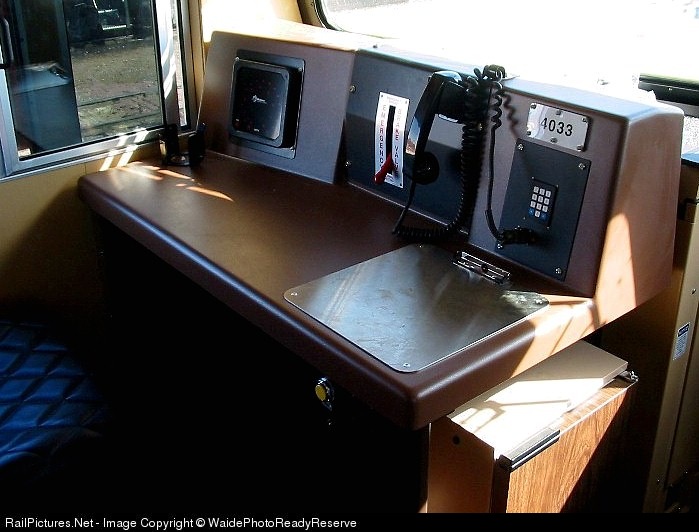
As a conductor or engineer, you want a pretty clear view of what is coming at you. Visibility is very important, but so is comfort, because the cab is a home away from home for many hours each day. The conductor needs certain things on his side of the cab, such as a speedometer, radio, desk for paperwork, an emergency brake, and a horn button. Now, my short experience has shown that generally, the GE locomotive have a little better visibility. This shows the conductor's side of a typical GE widecab locomotive. Specifically, this is a typical model of the Dash 9-44CW. However, even in more recent models, the area has evolved very little. The speedometer is that black square thing on the left. The emergency brake is that red lever in the center. To the right is the radio handset, radio keypad and the locomotive number. Down below the surface of the desk is the yellow horn button. You will notice that the speedometer, emergency brake, and radio keypad are designed to be right in front of the conductor, but they are not high enough to block the view out the front. The conductor can slouch a bit, and even put his feet up, and still have a decent view of what is to come. That is not to say I would ever slouch or put my feet up on the job! :) Also, having the radio down below the desk means that the wire is not in the way or your paperwork when you are trying to talk to the dispatcher and copy a track warrant.
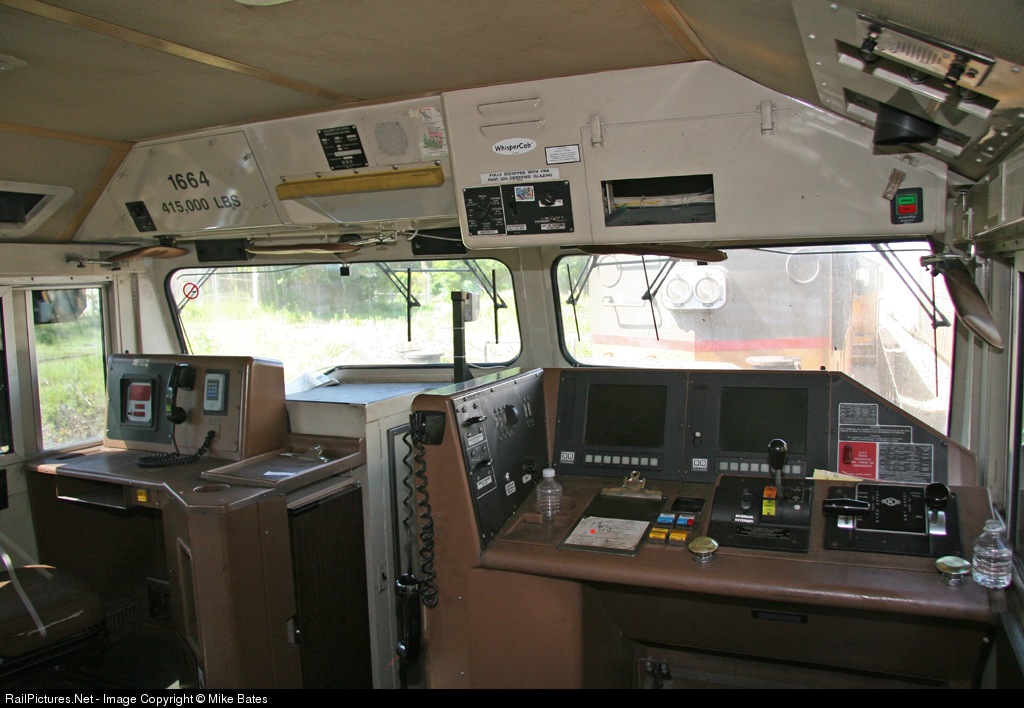
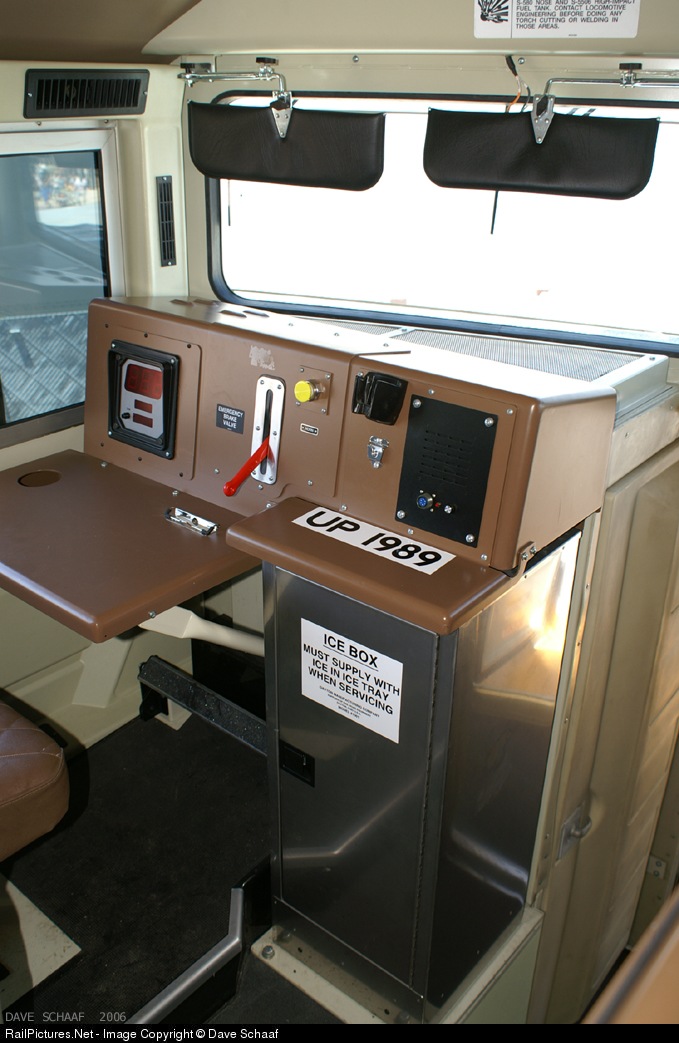
Now, with EMD locomotives, I think their earlier wide cab units had better visibility. Also, it seems to me that the conductor's visibility has gotten progressively worse with every model! An older, SD60M, had great visibility! The only problem with it was they put the emergency brake below the desk and the speedometer up in the ceiling above the desk. There is absolutely nothing to block the conductor's view, but that is not entirely a good thing. To see the speedometer, the conductor either has to stand up and take a step back or lean back really far in the seat and squint a little. While the visibility is great, it is still not the most practical design. With later models, things got better. To the left is a picture of the conductor's side on the SD70MAC, which has its pros and cons. The biggest pro is that the speedometer is in a place where the conductor can realistically see it and read it--right in front of him. One of the biggest cons, the speedometer is mounted on a panel the size of a country in Europe, so the only way you can see over it well is if you are sitting up straight all the time, and who does that?! The radio keypad is also on that surface, moved down form the ceiling, and the radio was moved up from under the desk, which is okay, but the wire can get in the way sometimes. Usually to solve that problem, the wire gets wrapped around one of the sun visors on the ceiling.
The newest EMD locomotives, the SD70ACe has solved a few problems and created a few more. Take a look. The speedometer panel has not gotten any smaller, but it has gotten lower, which seems to help with visibility. The emergency brake and horn have moved above the desk. The radio is also up top, but off to the right, where the wire does not get in the way of the paperwork. So several problems were solved. However, this is my least favorite cab honestly. The desk area is very small. That has to handle a signal awareness form, which you take notes on regularly, and track warrants, which you also write on regularly. Besides all that, it must also hold the general track bulletins, work orders, and any used track warrants and speed restriction forms you may have received. I usually end up with three or four piles of paperwork, and this desk gives you space for two. The visibility seems to have improved, however this cab has smaller windows, and you sit farther back from them, which means visibility over the desk is better, but not the visibility out to the track ahead. Having said all that, these are some of the quietest locomotive cabs around, unless you left the window open. With the doors and windows all closed up, you hardly feel like you are on a locomotive with a massive diesel engine roaring behind you. Isolating the cab from the noise and vibration was done very well, and that helps to make up for the other problems. The biggest problem with this cab is the fact that the desk does not continue to the right. There is nowhere to put your feet up!
Some locomotives are better than others, and generally speaking, cabs and locomotives have improved in comfort in newer models. However, the person designing locomotives is still sitting behind a desk, not in the locomotives he or she designs. As long as that is the case, there will always be things that bug the people who spend all day on the locomotives. What seems like a good idea on paper is not always a good idea on the road. Using locomotives regularly has started to change my opinion about them. I still think EMD builds prettier locomotives, with the exception of the SD70ACe. But given the choice, I would rather work on a product of General Electric. I like that spacious bottom step for giving hand signals to an engineer three locomotives away. It just makes work easier. I like having a desk in the cab big enough to spread out three or four piles or paperwork and put my feet up while we sit for hours in a siding. So I will take a GE to work with, but an EMD to photograph and play with.

First of all, before I get into everything I want to talk about, I want to open this particular series up to all of you. If you would like to see me to talk about something in particular when I write this series of stories and experiences, please feel free to email me, and I will do my best to put something together. If you have questions, again, please send me an email at ogden.bros.trains@gmail.com, and I would be happy to help. I would love to hear from you!
Today I want to talk about variations in locomotives. Now, I like to consider myself to be fairly observant, but sometimes I do not notice the little details. Well, at least not until they matter. As far as relatively modern diesel locomotives go, I would have told you as a railfan that I like those built by EMD better. The reason why was simple--looks. I simply think they are better looking diesels. I would not say I hated the locomotives built by General Electric, but I did think they were less attractive. As a railfan, where my only concerns were realistic modeling preferences and good photographs, that is all that mattered really. If it looked good in photographs I took, and it looked good on my model railroad, I was a happy foamer! Working for the railroad has made different things important, at least in daily operations.
For the last five days, I have been working a utility position in the yard at Glendive. The utility crew is responsible for putting locomotives on trains before the train crew gets there, so that their train is ready to go when they are. Glendive has a locomotive servicing and fueling facility. Because of this, nearly all the trains that arrive here have their locomotives taken off and brought to the roundhouse for servicing. The servicing can be extensive, making major repairs, or it can be as simple as topping off the fuel tank before continuing the trip. Almost every locomotive has a control cab, so in theory, an engineer could do all this moving by himself by changing which cab he operates form whenever he changes direction. While this is often possible, it is very impractical.
To make moving locomotives around the yard more practical, and faster, a conductor is also on the crew. Since most movements require the engineer to operate in reverse, usually with one or more locomotives between him and the back of the consist, the conductor is his eyes at the point, or leading end of the movement. The conductor can give him instructions over the radio, but most conductors prefer hand signals for their convenience. This means that the conductor must be in a place where he can be seen by the engineer. The best place for that is the bottom step at the leading end of a locomotive. There he is close enough to the side of the engine to be seen by the engineer in most situations, while still in a position to hang on during the ride. In such an operation, the size of that step makes a big difference!
Besides being required to ride equipment, the conductor climbs on and off equipment a lot. During one move, the conductor usually has to climb on and off of locomotives several times to line switches or couple locomotives to cars. This is another reason the size of the steps make a difference. Once a locomotive, or a consist of locomotives, is coupled to the train it belongs on, the air hoses must be coupled for the air brakes, the hand brakes on the locomotives must be set, and each locomotive needs to be electronically isolated from the others, for added safety. All of this requires more climbing on and walking around on locomotives. Doing all of this is where I started to notice some details that I had not noticed before. Lets take a look.
![]() |
| Image from www.bonanza.com |
![]() |
| Image from www.actionroad.net |
Now the steps are not the only issue I want to mention. I will not get into locomotive handling or response or anything like that because I am a conductor. I just do not deal with that kind of stuff. That is all up to the engineer. Maybe when I get to that point I will talk about my thoughts. I want to talk about the cabs though. I am not going to get into wide cabs versus standard cabs, but I do want to talk about visibility. Nearly all the trains we send out over the road have wide cab locomotives, so we are just going to go over those, from a conductor's perspective.
| Image from www.railpictures.net |
| Image by Mike Bates, www.railpictures.net |
| Photo from www.railpictures.net |
Some locomotives are better than others, and generally speaking, cabs and locomotives have improved in comfort in newer models. However, the person designing locomotives is still sitting behind a desk, not in the locomotives he or she designs. As long as that is the case, there will always be things that bug the people who spend all day on the locomotives. What seems like a good idea on paper is not always a good idea on the road. Using locomotives regularly has started to change my opinion about them. I still think EMD builds prettier locomotives, with the exception of the SD70ACe. But given the choice, I would rather work on a product of General Electric. I like that spacious bottom step for giving hand signals to an engineer three locomotives away. It just makes work easier. I like having a desk in the cab big enough to spread out three or four piles or paperwork and put my feet up while we sit for hours in a siding. So I will take a GE to work with, but an EMD to photograph and play with.
Tuesday, February 22, 2011
Alaska Railroading
I know you all just heard from me, but I thought I would share a few thoughts on railroading under the midnight sun and the northern lights. I spent two summers working in Anchorage, AK, as a bus driver and tour guide, and during my time there I had many opportunities to check out the railroad there. I thought I would talk about that a little today. First of all, let me cover some important background information. The Alaska Railroad is the largest railroad in the state, and is one of just two railroads in the state. The Alaska Railroad runs from Seward, AK, at the south to North Pole, AK, at the north. It runs through Whittier, Anchorage, Wasilla, Talkeetna, Denali National Park, and Fairbanks in that distance. It is one of the only railroads in the country that still operates both freight and passenger trains regularly.
The Alaska Railroad faces some unique challenges simply due to location. It is not connected to any other railroad in North America, although it does actually exchange cars with other railroads. This happens by the use of barges, which have railroad tracks laid on the deck. The barges arrive and depart form Whittier, AK, and go to either Prince Rupert, BC, or Seattle, WA. The Alaska Railroad sends cars to the lower 48 and Canada that way, and the receive cars from the lower 48 and Canada on those barges. Any equipment that is built outside of Alaska must arrive on that barge. Needless to say, this makes it impractical to ship equipment back and forth, unless it is loaded with cargo and making money. Because of this, the Alaska Railroad has gotten very good at keeping old equipment operating for a very long time. It was just over a year ago that they retired their last Rail Diesel Car (RDC), which had nearly a half century of service. Replacing equipment requires shipping out old equipment and bringing in the replacements. Doing that takes away from space on the barge which could be making money, so it is not worth it if old equipment can still be repaired.
The railroad serves many towns which are only accessible by rail, and some of which have so few residents you could count them on one hand! It is a lifeline to many of the people who live in the region known as "the Railbelt." Take the town of Sherman, for example. The population is two. The house is located along the railroad tracks, and there is a sign out front that reads,
"Sherman, Alaska
Town Hall
Pop. 2"
It is a husband and wife that live there. The nearest road to their house is just over 40 miles away. The Alaska Railroad delivers their mail, supplies, and any visitors. It also gets them to town when they need to go. When they need to get on the train, they simply go out to the tracks and flag the train down. Once on the train, they can ride into Talkeetna, which, at 800 people, is big enough to have whatever supplies they may need. This is not a young family either. They moved there nearly 50 years ago, and are now in their 80s, but love the slow paced, relaxing lifestyle. They are not unique. There are dozens of such towns along the railroad, which depend on the railroad for basic survival.
Winters in Alaska present interesting challenges, as the snow can get very deep and temperatures very low, depending on location. It probably will not surprise you to learn that the Alaska Railroad spends more money on snow management than any other railroad in the country. In the mountains, the snow can get as high as 500 inches! Avalanches present a constant danger, especially in the spring when the various layers of snow begin to thaw and shift. Short daylight hours make things even more challenging. In Anchorage, there are just over four hours of daylight in December, and in Fairbanks, there is only about 90 minutes. Besides the snow and darkness, it can be very cold. Anchorage and Seward, which are fairly close to the coast tend to be more mild in the winter, only getting to about -15 degrees. However Fairbanks can be nothing short of brutal, often dropping well below -45. Besides that, the moose tend to be a problem in the winter. Winter is mating season for the moose. The male moose get a bit feisty as they try to find mates. They get aggressive as they look for a female. It is not uncommon for them to believe that a locomotive offers competition in their quest. When a moose feels threatened, it charges, and if it feels threatened by a locomotive, it charges the locomotive, in an attempt to resolve the problem. Well, resolve the problem it does, although it creates quite a few others!
In the summer, railroading in Alaska gets a lot easier. The weather gets warmer, the moose calm down, and the sun comes out for more than 20 hours every day. The railroad also gets busier Tourists begin to arrive, and more passenger trains move. Freight traffic also picks up a bit as more stuff gets shipped. One of the biggest changes to the railroad is passenger service. While the Alaska Railroad does maintain passenger service throughout the year, there is considerably less in the winter. In the winter there is a weekly train from Anchorage to Fairbanks every Saturday, which returns to Anchorage every Sunday. Additionally there is a weekly train from Anchorage to Talkeetna and back every Thursday. In the summer, there are daily trains from Anchorage to Fairbanks, Seward, and Whittier, and from Talkeetna to Hurricane. The trains go from a couple of cars in the winter to 16-20 cars in the summer. Tour companies, including the one I worked for, send their guests on the train to Talkeetna, Denali Park, and Fairbanks. Because of this, I had a lot of opportunities to check out the trains while on the job!
The most frequent thing I did involving the railroad was pretty simple actually. I would shuttle people either from a hotel in Anchorage to the train station, or from the train station to a hotel. In the morning, I would pick people up at the hotel and drive them to the train, so they could ride the train to Denali. In the evening, I would wait around at the train station so I could drive people to their hotel who were coming in from Denali. It was a pretty simple assignment, but very often it meant spending an hour or more hanging around the train station, and having someone pay me to do it! I usually had my camera close at hand. One morning I had some time to kill after dropping everyone off at the train, so I pulled the bus into a parking lot near the tracks and waited for the train to leave. When it pulled out, I shot a video of the process, which you can see below!
In the video, you see that the train is in sections. Of course, it is operated by the Alaska Railroad. They own the locomotives and most of the passenger cars. All the blue and gold ones belong to Alaska Railroad. This train runs to Fairbanks. Since it serves Denali National Park, which is a very popular destination, other companies put their own private cars on the back of the train for their guests. They pay Alaska Railroad to pull their cars. In this video, five cars belonging to Holland America Tours are on the train. It is also common to see cars belonging to Princess Tours and Royal Celebrity Tours. They each have their own tour schedules, and that is what determines which cars, and how many of them end up on the back of the train. The Alaska Railroad adjusts their portion of the train depending on demand as well, so the length can vary quite a bit. The shortest I have ever seen this train is nine cars, and the longest is 23 cars. Typically it is right around 16-18 cars though. It was an easy assignment to shuttle people to or from the train, but it gave me a lot of opportunities to get pictures and videos. The Alaska Railroad was a unique operation. I really have only scratched the surface. In future posts, I will describe some of the more unique and interesting aspects of operations there, but it is just too much to do all at once!
For more videos of the Alaska Railroad, and others, check out our YouTube Channel! We are still adding videos to it, so check back often.
| Alaska Railroad route map www.alaskarailroad.com |
The railroad serves many towns which are only accessible by rail, and some of which have so few residents you could count them on one hand! It is a lifeline to many of the people who live in the region known as "the Railbelt." Take the town of Sherman, for example. The population is two. The house is located along the railroad tracks, and there is a sign out front that reads,
"Sherman, Alaska
Town Hall
Pop. 2"
It is a husband and wife that live there. The nearest road to their house is just over 40 miles away. The Alaska Railroad delivers their mail, supplies, and any visitors. It also gets them to town when they need to go. When they need to get on the train, they simply go out to the tracks and flag the train down. Once on the train, they can ride into Talkeetna, which, at 800 people, is big enough to have whatever supplies they may need. This is not a young family either. They moved there nearly 50 years ago, and are now in their 80s, but love the slow paced, relaxing lifestyle. They are not unique. There are dozens of such towns along the railroad, which depend on the railroad for basic survival.
Winters in Alaska present interesting challenges, as the snow can get very deep and temperatures very low, depending on location. It probably will not surprise you to learn that the Alaska Railroad spends more money on snow management than any other railroad in the country. In the mountains, the snow can get as high as 500 inches! Avalanches present a constant danger, especially in the spring when the various layers of snow begin to thaw and shift. Short daylight hours make things even more challenging. In Anchorage, there are just over four hours of daylight in December, and in Fairbanks, there is only about 90 minutes. Besides the snow and darkness, it can be very cold. Anchorage and Seward, which are fairly close to the coast tend to be more mild in the winter, only getting to about -15 degrees. However Fairbanks can be nothing short of brutal, often dropping well below -45. Besides that, the moose tend to be a problem in the winter. Winter is mating season for the moose. The male moose get a bit feisty as they try to find mates. They get aggressive as they look for a female. It is not uncommon for them to believe that a locomotive offers competition in their quest. When a moose feels threatened, it charges, and if it feels threatened by a locomotive, it charges the locomotive, in an attempt to resolve the problem. Well, resolve the problem it does, although it creates quite a few others!
In the summer, railroading in Alaska gets a lot easier. The weather gets warmer, the moose calm down, and the sun comes out for more than 20 hours every day. The railroad also gets busier Tourists begin to arrive, and more passenger trains move. Freight traffic also picks up a bit as more stuff gets shipped. One of the biggest changes to the railroad is passenger service. While the Alaska Railroad does maintain passenger service throughout the year, there is considerably less in the winter. In the winter there is a weekly train from Anchorage to Fairbanks every Saturday, which returns to Anchorage every Sunday. Additionally there is a weekly train from Anchorage to Talkeetna and back every Thursday. In the summer, there are daily trains from Anchorage to Fairbanks, Seward, and Whittier, and from Talkeetna to Hurricane. The trains go from a couple of cars in the winter to 16-20 cars in the summer. Tour companies, including the one I worked for, send their guests on the train to Talkeetna, Denali Park, and Fairbanks. Because of this, I had a lot of opportunities to check out the trains while on the job!
The most frequent thing I did involving the railroad was pretty simple actually. I would shuttle people either from a hotel in Anchorage to the train station, or from the train station to a hotel. In the morning, I would pick people up at the hotel and drive them to the train, so they could ride the train to Denali. In the evening, I would wait around at the train station so I could drive people to their hotel who were coming in from Denali. It was a pretty simple assignment, but very often it meant spending an hour or more hanging around the train station, and having someone pay me to do it! I usually had my camera close at hand. One morning I had some time to kill after dropping everyone off at the train, so I pulled the bus into a parking lot near the tracks and waited for the train to leave. When it pulled out, I shot a video of the process, which you can see below!
In the video, you see that the train is in sections. Of course, it is operated by the Alaska Railroad. They own the locomotives and most of the passenger cars. All the blue and gold ones belong to Alaska Railroad. This train runs to Fairbanks. Since it serves Denali National Park, which is a very popular destination, other companies put their own private cars on the back of the train for their guests. They pay Alaska Railroad to pull their cars. In this video, five cars belonging to Holland America Tours are on the train. It is also common to see cars belonging to Princess Tours and Royal Celebrity Tours. They each have their own tour schedules, and that is what determines which cars, and how many of them end up on the back of the train. The Alaska Railroad adjusts their portion of the train depending on demand as well, so the length can vary quite a bit. The shortest I have ever seen this train is nine cars, and the longest is 23 cars. Typically it is right around 16-18 cars though. It was an easy assignment to shuttle people to or from the train, but it gave me a lot of opportunities to get pictures and videos. The Alaska Railroad was a unique operation. I really have only scratched the surface. In future posts, I will describe some of the more unique and interesting aspects of operations there, but it is just too much to do all at once!
For more videos of the Alaska Railroad, and others, check out our YouTube Channel! We are still adding videos to it, so check back often.
Subscribe to:
Posts (Atom)