Showing posts with label Lake Shore Limited. Show all posts

Thursday, October 13, 2011

History of the Lake Shore Limited

Amtrak's Lake Shore Limited can actually trace its history to long before Amtrak had ever even been a thought.  The New York Central Railroad, which came to be over a century before Amtrak, started running a train named the Lake Shore Limited in 1897.  Similar to today's train, there was a separate section to Boston.  Additionally, there was also another section to St. Louis, from Chicago.  The Lake Shore Limited was the New York Central's first luxury train, however it is often forgotten about.  It paved the way for a much more famous train, known as the 20th Century Limited, which is the more remembered train.  Under the New York Central, the Lake Shore Limited operated until October 1956.  It was eliminated as part of a system wide reorganization project.

The observation car on the 20th Century Limited, seen at Englewood, IL,
in 1962.  Photo from www.railpictures.net.
Before the New York Central ran the Lake Shore Limited, they ran a train called the Exposition Flyer.  This train ran between New York and Chicago during the Chicago World's Fair, also known as the World's Columbian Exposition, which was held in 1893.  The Exposition Flyer made the trip in 20 hours, a considerable speed for its time.  When it began service, it was actually the fastest train in the world, for the distance it covered.  This train followed a route known as the Lake Shore Route, or the Water Level Route.  The route of the New York Central earned this nickname because as it went west, it first followed the Hudson River, out of New York, then the Mohawk River, then the Erie Canal, and then it followed the shores of Lake Erie and Lake Michigan to Chicago.  For a route that crossed the Appalachian Mountains, it was a considerably flat route, allowing trains to operate at higher speeds.  The geography of this route, and the relatively flat profile, is what have made this route an important route to this day.

Several years after the Exposition Flyer, the New York Central introduced the Lake Shore Limited.  This was their first luxury train, and though the schedule was slower than the previous Exposition Limited, it proved to be successful.  It 1897, when the train was inaugurated, it boasted a 24 hour travel time between New York and Chicago, and 26 hours between Boston and Chicago.  This train, while often forgotten, was an important train for the New York Central, because it led the way for the extremely successful 20th Century Limited, which was inaugurated five years later, in 1902.

Passengers relax in the lounge on the 20th Century
Limited
.  Image from www.answers.com.
The Lake Shore Limited began a race, with the rival Pennsylvania Railroad.  The race was never official, but there was a fierce competition between the two railroads to offer better, faster, and more reliable trains between New York and Chicago.  Other railroads also participated in this competition, but it was most fierce between the New York Central and the Pennsylvania Railroad.  When the New York Central inaugurated the 20th Century Limited, in 1902, the Pennsylvania responded by introducing the Broadway Limited, which also ran between New York and Chicago.  For decades, every time one railroad introduced a new train, or added new equipment, or shortened the schedule, the other railroad did the same.  The competition was incredible, and consequently by 1940, passengers had about 40 trains to choose from, on about a dozen railroads, all of which operated between New York and Chicago.

The 20th Century Limited was the last word in luxury and speed.  It was the most modern train on the New York Central system.  When it was introduced in 1902, it boasted a 20 hour schedule between New York and Chicago, which was four hours faster than the fastest train running at the time.  Just as with today's Lake Shore Limited, there was a connection to Boston.  The train was all first class, and it was such a big deal to travel on the train that celebrities traveled on the it just to be one of the people who did.  At Grand Central Terminal, in New York, the porters literally rolled out a red carpet for passengers boarding the train.  It featured a full service barber shop and secretary services.  It became one of the first trains to have a telephone on board, and when two way radios were made available, crews on that train were the first to get them.

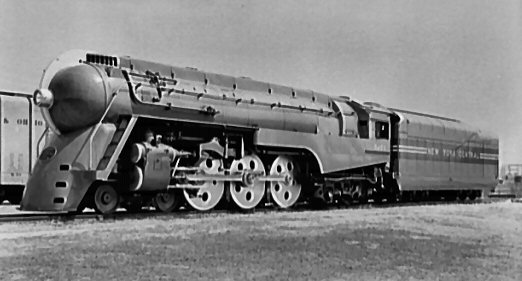
A New York Central 4-6-4 Hudson steam locomotive, on display at the
New York World's Fair.  This locomotive would have pulled the 20th
Century Limited
.  Photo from Wikipedia.
As time went on, the "Century" got faster.  That train always hat the newest, fastest locomotives available.  When new equipment was purchased, it was first assigned to the "Century."  The train was so fast, and so punctual, it was scheduled at some stations on the half minute.  It was said of the train that one could set their watch by the train passing through town.  Nothing was ever allowed to delay the 20th Century Limited.  Slower passenger trains, and freight trains were all out of the way well in advance of the "Century."  The fastest it regularly covered the mileage between New York and Chicago was 16 hours.  For a short time, it was scheduled as fast as 15:30, but that did not last long.  The "Century" grew so popular that it would sell out almost instantly.  To make it more available, the railroad began adding more sections to it.  That is, they would add another entire train, following on the same schedule, as a second part, or section, to the 20th Century Limited.  Even with a second section, the train sold out easily.  More sections were added as the demand was there, and consequently, the train ran with as many as seven sections at times, and still managed to sell out!  All the well known celebrities, politicians, and businessmen, who either already had made a name for themselves, or wanted to make one, traveled on the 20th Century Limited, because it was the chic, stylish way to go.  The train became so famous that it even played a central part in the Alfred Hitchcock film "North by Northwest," starring Cary Grant.

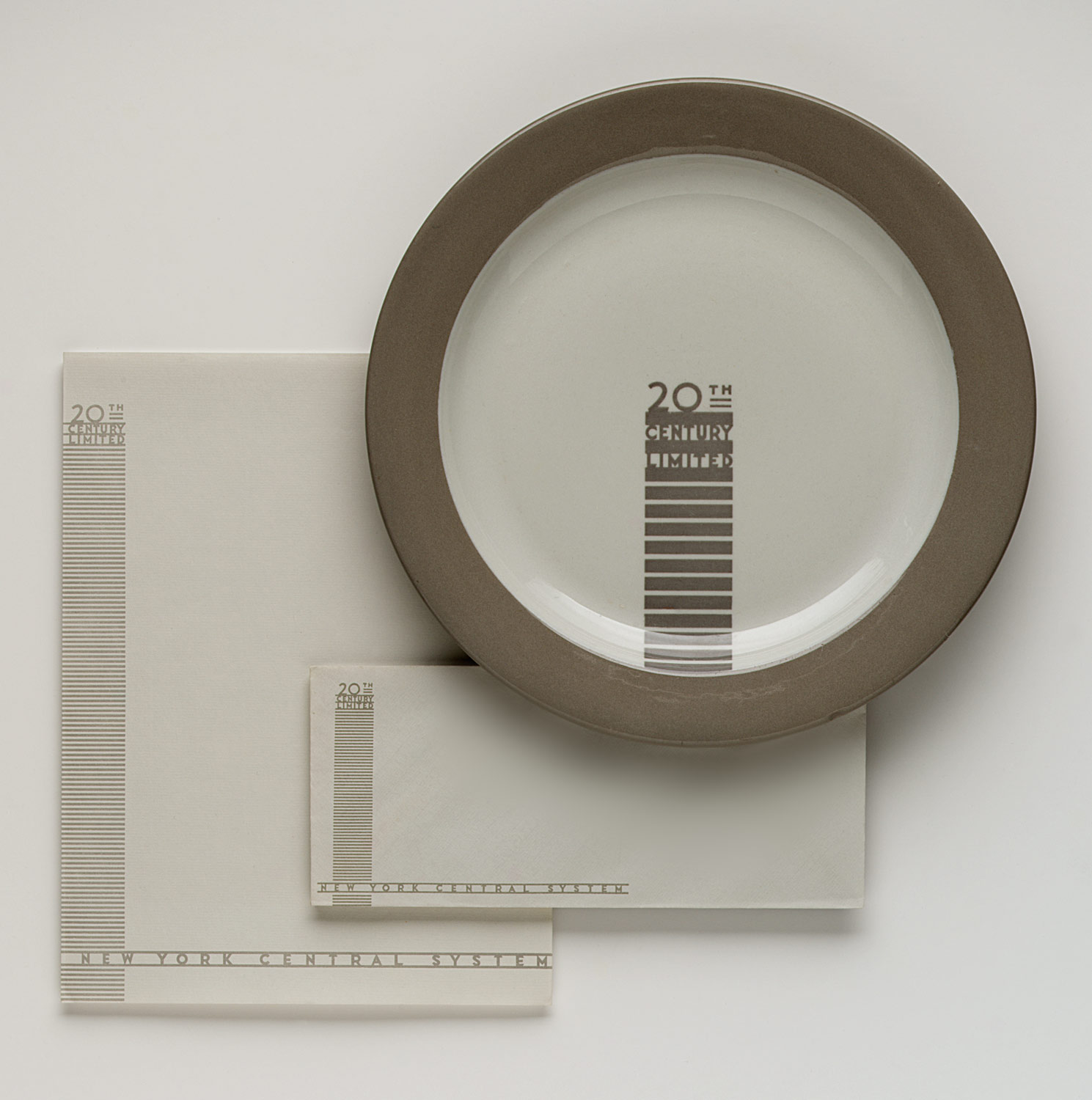
China used on the 20th Century Limited, after 1938.
Image from the Metropolitan Museum of Art.
By the late 1960s, passenger train ridership in the United States was declining.  While the 20th Century Limited was still a fast train, it was not fast enough to compete with jet airplanes.  Though the luxury never changed, most of the hype and fame associated with the train had faded into the past.  The train made its final run on 3 December 1967.  The Pennsylvania Railroad got the last hurrah, as their Broadway Limited, the primary competitor to the "Century," stayed in service until 1971, at which point, Amtrak took over its operation.  In 1999, the 20th Century Limited received some brief attention again when the US Postal Service issued a stamp commemorating the train.

New York Central's Lake Shore Limited stayed in service for more than half a century after the introduction of the 20th Century Limited.  At that time, one daily train to Chicago would not have been enough.  There were dozens of trains that operated the entire distance between New York and Chicago, and many more that operated on segments of that route.  When the "Century" was introduced, the Lake Shore Limited became secondary to it.  It continued to operate, but then the famous luxury train was the "Century."  It had led the way, as the premier train until 1902.  It was never as fast as the 20th Century Limited, operating at 21:30 between New York and Chicago, but it paved the way for the "Century."  Today Amtrak operates the train on much of the same route as the New York Central.  The most noticeable differences are at the ends.  The New York Central once used LaSalle Street Station, in Chicago, and Grand Central Terminal, in New York.  Today, Amtrak, rather ironically uses Union Station, in Chicago, and Penn Station, in New York.  Both are former terminals of the Pennsylvania Railroad, once the biggest competitor of the New York Central.  Today Amtrak operates the train between New York and Chicago in 21:30, and Boston and Chicago in 23 hours, which is similar to its predecessor's schedule.
Map of the New York Central Railroad.  Image from www.r2parks.net.

And lastly, I thought I would share this interesting promotional video.  It was made in 1935, by the New York Central, to promote the 20th Century Limited.  It has some very interesting historic footage of the train and the services offered, as well as some videos of the behind the scenes work that kept the train running.  I found the video one day while browsing YouTube.

Tuesday, October 11, 2011

Route Profile: Lake Shore Limited

Lately, all the Amtrak routes we have talked about have been long ones, some of the longest in the country in fact.  All of them have been at least part of three days, and two entire nights on the train.  Today, we are moving east and covering a shorter route.  The Lake Shore Limited is Amtrak's most popular train from the east coast to Chicago, operating daily between Chicago, New York, and Boston.  As this train heads west, a section leaves from Boston, and heads west across Massachusetts, and another section leaves Penn Station, in New York, and heads north initially.  The two sections meet in Rensselaer, NY, just across the river from Albany, and from there they operate as one train the rest of the way to Chicago.  Services available on this train include sleeping car accommodations, a full service dining car, and a cafe car.  Reservations are required on this train.

South Station platform area, Boston.
All photos by James Ogden, unless otherwise noted.
The Boston section of the Lake Shore Limited departs from Boston's South Station around lunch time, and then heads west.  The first stops are in the Boston suburbs of Framingham and Worcester.  After the train leaves Worcester, the stops become farther apart, the next one being Springfield, in the middle of the state.  Springfield is a brief smoking stop typically, and some people transfer to trains headed south, to Connecticut.  From there the train crosses the Connecticut River, and then starts up into the mountains.  As the train crosses western Massachusetts, it crosses over the Berkshire Mountains.  While the Berkshires are not nearly as large as the Rocky Mountains, there are still some dramatic views to be seen.  Both sides of the train will have views periodically.  Here the views are often seen through the trees.  Being in New England, the entire place is covered in trees.  It makes for a gorgeous ride in September and October, when many of the trees are changing color for the fall.  After a brief stop in Pittsfield, MA, the train crosses into New York, and heads to Rensselaer.  Typically the Boston section arrives in Rensselaer before the New York section.

The Hudson River, in the winter, clogged up with ice.
The New York section of the train departs from Penn Station, in the heart of Manhattan, in the middle of the afternoon.  Once the train slips away from the platforms, it will spend the first few minutes of the trip underground.  When the train emerges from the tunnels, it is on the west side of Manhattan, and on the left side of the train is a view of the Hudson River.  Shortly after the river appears, the George Washington Bridge can be seen, connecting Manhattan and New Jersey.  The train follows the river north, all the way up the west side of Manhattan.  The train will slow down to cross the swing bridge over the Harlem River, where it enters the Bronx, near Spuyten Duyvil.  Here it enters tracks operated by the Metro-North Railroad, one of the New York commuter railroads.  The Lake Shore Limited will run through most of the commuter stations, only stopping in Croton-Harmon and Poughkeepsie, before arriving in Rensselaer.  For the 141 miles between Manhattan and Rensselaer, the train follows the Hudson River.  A seat on the left side of the train affords the best views of the Hudson River and the valley.  During this part of the trip, one of the notable landmarks the train passes is the United States Military Academy, easily visible across the Hudson River, on the hill, a few minutes after the Croton-Harmon station stop.

A frozen Lake Michigan, on a chilly January morning.
Once both sections of the train have arrived in the Rensselaer station, there is some switching to be done.  Typically the New York section pulls in on track two, since that is one of the longest station tracks.  The Boston section, which usually arrives on the Main Track, then pulls away from the platform and into the yard area.  The dual mode, diesel/electric locomotive is removed from the New York section, and then the Boston section is backed down on the New York section, making one longer train.  Air hoses, communications lines, and electrical jumpers are all reconnected, air tests are completed, and then the train is ready to depart west.  If you are on the train when this switching is done, do not be alarmed if power goes out.  This is part of the routine, and it comes back on after a few minutes, when all the appropriate connections between cars are made.

Once the Lake Shore Limited leaves the Rensselaer station, it starts to head west.  Right outside of the station, it crosses the Hudson River, and then continues west to the next stop, in Schenectady, only a short distance away.  Schenectady is home to General Electric, and their neon sign is plainly visible from the train station.  In the winter months, it is usually dark by the time the train gets to Schenectady.  In the summer, it will still be daylight though.  As the train heads west across the state, towards Buffalo, it follows the Mohawk River and the Erie Canal.  At one time, the Erie Canal was a major transportation link between Albany and Lake Erie.  As important a link as it once was, it was made obsolete surprisingly fast as the railroad was built between Albany and Buffalo.  The railroad proved to be a faster means of transportation than the canal, and consequently everything that once traveled on the canal soon switched to the railroad.  Today, Interstate 90 also follows that route.  Between the railroad and the highway, very little traffic is left for the canal, and most of it is recreation.

The Chicago skyline, visible across a railroad yard.
After a near midnight stop in Buffalo, the train continues west into a small part of Pennsylvania, along Lake Erie.  The train stops in Erie, PA, which is where the locomotives pulling it were actually built.  If you happen to be awake during this part of the trip, there are some views of the lake on the right hand side of the train.  In the summer months, the eastbound train will pass through Erie in the early morning daylight.  The locomotive factory can also be pretty easily spotted, also on the right hand side of the westbound train.  The train crosses into Ohio and makes several more stops in the dark hours of the early morning, in Cleveland, Elyria, Sandusky, Toledo, and Bryan, and then heads into Indiana.  For those who happen to wake up during the night, in Ohio, there are some more views of Lake Erie, especially in the Sandusky area.  Once the train crosses into Indiana, the dining car will be open for breakfast, which is served on a first come, first served basis.  At that point, people on the train start waking up, and the train comes to life, so to speak.

In Indiana, the train makes only a few stops.  The first one is in the small town of Waterloo, which is near Fort Wayne.  After a very brief stop in Waterloo, the train stops in Elkhart and South Bend.  South Bend is, of course, home to the Notre Dame Fighting Irish, although there will be little evidence of that at the railroad station.  South Bend is the last stop before the train arrives in the Windy City.  Between South Bend and Chicago, the train will cross into the Central Time Zone.  An announcement will be made, and at that point, passengers will need to adjust their watches one hour.

The coach yards, in Chicago.  The Lake Shore Limited
arrives from the top of the picture, where the dark tower
are, and proceeds through the middle of these yards to
Union Station.
After the train leaves South Bend, it goes through the industrial towns of Gary and Hammond, Indiana.  While these towns can hardly be considered scenic, it allows for an unusual and interesting glimpse into industrial America, and into our past.  These towns were once large, successful places.  They thrived on the steel industry.  Steel was produced in mills visible from the train, and the steel produced in those towns once drove the economy of the entire world.  Steel from those mills once built railroads, airplanes, ships, and automobiles.  Many people, rich and poor, and countless famous people, once sailed, rode, or flew on that American steel.  What is visible from the train today is very different.  Most of the steel mills are quiet, producing nothing but an eyesore.  Only a few still operate, and at a considerably slower production rate than they are capable of.  Many jobs, that once drove America, are simply gone, and the people who held them have moved on too.  That part of the trip is an interesting glimpse into the past, and an ugly reminder of all the jobs that have moved out of the country.

As the Lake Shore Limited gets away from the steel mills of Gary and Hammond, suburban Chicago begins to develop around the train.  Lake Michigan is visible periodically on the right hand side of the train.  Well kept suburban homes make way for more apartments and condos, and pretty soon, the suburban areas have turned to urban sprawl.  The train rides on an embankment through the urban areas, and the view is of many roofs, seeming to go on forever in every direction.  The Chicago skyline is visible through buildings, bridges, and trees.  As the train nears the end of the line, it slows down to a crawl.  It crosses the lift bridge over the Chicago River.  At that point, the Amtrak coach yards and engine facility are visible on the right.  At the same time, there is a brief view of the Chicago skyscrapers.  By that point, the train is right in downtown Chicago.  Within another minute, the train is in complete darkness, as it enters a tunnel under the downtown area of Chicago.  The tunnel is short, and within another minute, the train has made its final stop, at Union Station, in Chicago.

The Loop, in Chicago.
From Union Station, passengers can go upstairs to the street.  The Chicago River is right next to the station, and just across the river, and about a two minute walk, is the Willis Tower.  The entire Loop neighborhood of Chicago is within easy walking distance, and even Lake Michigan is only about fifteen minutes away.  There are lockers in the station for luggage, if Chicago is only a short layover for another train.  For passengers traveling in First Class on their next train, luggage can be checked in the station in the Metropolitan Lounge.  For those looking for a meal, typically food is considerably cheaper outside of Union Station.

Wednesday, September 7, 2011

Prototype Information: Amtrak Equipment

Today I am going to stray from the ordinary Wednesday posts a bit and talk about Amtrak equipment.  As some of you may have noticed, yesterday we launched our new series profiling Amtrak routes, and we thought it would be a good idea to talk about the different equipment Amtrak uses and the amenities offered by each.  We will not be talking about the specifics of every piece of equipment here, because there are some cars that are very route specific, such as the Pacific Parlour.  For such route specific cars, we will talk about them when we profile their route.  Today we just want to talk about the different equipment, and the differences between a cafe car and a dining car, for example.

Amfleet cars in Huntington, WV, on the Cardinal.
Photos by James Ogden, unless otherwise noted.
Amtrak has two general types of equipment they use, depending on the route.  Typically eastern routes, which serve New York, use single level equipment.  This is due to restrictions imposed by the tunnels leading into Penn Station in New York.  Most of these single level cars are called Amfleet cars, and are easily distinguishable by their tube shape.  Amfleet cars include coaches and cafe cars.  For single level sleepers, Amtrak uses newer cars, called Viewliners.  On long distance trains, these can usually be found with Amfleet cars, and are distinguishable by their boxy shape and two rows of windows.  Single level dining cars are typically much older than Amtrak, and are known as Heritage equipment.  Some Amtrak diners were built as long ago as 1948.

Superliners in Glenwood Springs, CO, on the California Zephyr.
On western routes, where the New York tunnel restrictions have no influence, Amtrak typically uses bilevel equipment, called Superliners.  Superliners come in coaches, sleepers, cafe/lounge cars, and dining cars, and a transition sleeper, which is typically used as the crew quarters.  From the exterior, Superliners are easily distinguished because they have two levels, and just one center door, in the lower level of the car.  Some California routes use bilevel cars modeled after the Superliners, which look very similar.  Those can be distinguished from Superliners by the paint scheme usually, and because they typically have two sets of doors, at either end of the lower level.

On the Northeast Corridor, which runs from Boston to Washington, DC, Amtrak has electric trains.  The regional trains on that route use Amfleet cars, hauled by electric locomotives.  The high speed trains, known as the Acela trains, are trainsets with an aerodynamic locomotive at each end and single level high speed rail cars between them.  We will talk more about the specifics of the Acela equipment when we talk about the northeast corridor routes.  Outside of the electrified Northeast Corridor, Amtrak pulls the trains with diesel locomotives.

Interior of an Amfleet coach, on the Cardinal.
On Northeast Corridor regional trains, and on long distance trains that serve New York, Amtrak uses single level equipment, because of restrictions imposed by the tunnels under the Hudson River and the East River, which allow for access to Penn Station, in Manhattan.  Amfleet cars can be found on all the Amtrak trains that serve New York.  Typically shorter distance, regional trains, including the Northeast Regional service, Empire Service, and Keystone Service, will all have several Amfleet coaches, an Amfleet cafe, and very often an Amfleet business class car.  The layout in a coach or business class car is similar.  There are rows of seats for the length of the car.  There are overhead luggage racks running the length of either side of the car, above the seats.  At one end there are a couple of restrooms and a larger luggage rack.  Doors at either end of the car allow for access to cars ahead and behind.  The doors to exit the cars at stations are located at either end of the car as well.  Coaches have two seats on either side of the aisle, while business class cars typically have two seats on one side of the aisle, and just one seat on the other side.  In both coach and business class, the seats are roomy.  They are wide and offer considerably more leg room than someone may be accustomed to if they fly a lot.  On coaches that are used on long distance routes, there is even more leg room available, as there are fewer seats in each coach.

Amfleet cafe car exterior.
Photo by Jeffery Tritthart.
Available on www.railworksamerica.com
On all single level trains, Amtrak also operates an Amfleet cafe car.  The cafe cars are distinguishable from the outside because they look like typical Amfleet cars, but they are missing a pair of windows on either side, right in the center of the car.  On the inside, this is where the food service counter is located.  There are a few configurations for cafe cars, but they all have a food service counter at the center of the car.  This is where you go to get your food.  They have hot and cold snacks and beverages available.  This food is what you might compare to airplane food.  The hot stuff is all frozen and the microwaved to order.  While the food is good, it would not be considered gourmet by most.  Also, on long distance trains, with a dining car, it is more expensive to eat an entire meal in the cafe car than in the dining car.

Food serving area in an Amfleet cafe car.
Photo from www.nationalcorridors.org.
Also inside the cafe car is a dining area.  Usually, on either end of the serving area there are tables, with seats that face each other across the table.  Each table can accommodate up to four people.  The tables are available to anybody, and a walk through the cafe car will often reveal that people also use the tables to play card games, write, or just socialize with other passengers, besides eating of course.  It is also not uncommon for the Conductor to make an office out of one table.  On some trains, where there are not enough business class passengers to necessitate an entire car, the cafe car will have a small business class section on one end.  Other cars, typically used on long distance routes, will have a small lounge, with an informal seating area and some smaller tables, in one end of the cafe car.  Of course, passengers do not have to stay in the cafe to eat and can bring food back to their coach seat or sleeper room as well.

Amfleet cafe and Viewliner sleeper, in Huntington, WV, on the Cardinal.
On long distance trains serving New York, you will also find sleeping cars and dining cars.  Single level sleeping cars are almost always Viewliner cars, which were built for Amtrak in 1995 and 1996.  The original intention was to build Viewliner coaches, sleepers, diners, and lounges, but due to limited funding, Amtrak was only able to order 50 sleeping cars.  They replaced many older, Heritage sleepers.  Viewliners are recognizable for their boxy shape and for having two rows of windows.  The two rows of windows allows passengers in the upper and lower berths in each room to have a window.  On every sleeping car there is a shower.  It is a community shower, so long, hot showers are usually frowned upon, as it wastes the water carried on the car, and it means fewer people get to use the shower.  There is also an attendant on each sleeper, who will configure the rooms for sleeping or for sitting, and who keeps the shower tidy and the snacks stocked.  As you might have guessed, there is also a small, self serve, snack counter on each sleeper.  Usually this is stocked with fresh fruit, cookies or crackers, juice, coffee, and tea.  In all sleeping car accommodations, meal service in the dining car is included in the ticket price.

Viewliner Roomette, in the night tine configuration,
seen from above, on the Lake Shore Limited.
Inside a Viewliner sleeping car, there are several room options available.  The smallest, and usually the cheapest, is called a roomette.  A roomette can accommodate up to two people.  The room is very small, but it is adequate for two people.  The daytime configuration has two wide seats which face each other.  At night, the two seats fold down to become the lower berth, and the upper berth pulls down, out of the ceiling.  Inside the room, there is also a toilet, sink, and luggage rack and wastebasket.  In the roomette, the toilet and sink are not in a separate room, so someone may have to leave the room if you are travelling with someone.

If you are looking for larger accommodations, a Viewliner Bedroom might be the way to go.  This is larger than a roomette, and usually costs a little more.  A bedroom can also accommodate two people, but gives everyone a little more space.  During the day, a bedroom has two seats next to each other.  These convert to the lower berth at night, and again, the upper berth pulls out of the wall.  The bedroom has the same features as a roomette, but also includes an in room shower.  A Bedroom Suite, which can accommodate up to four people, is created by combining two Bedrooms.  Since it is a combination, it has four berths, two upper and two lower, and two sinks, toilets, and showers.  An handicapped accessible bedroom is also available, which accommodates two people, and features the same amenities as a Viewliner Bedroom.  An accessible bedroom  is designed for easier access and more space inside, for easier mobility.  All rooms have 120 volt electrical outlets.

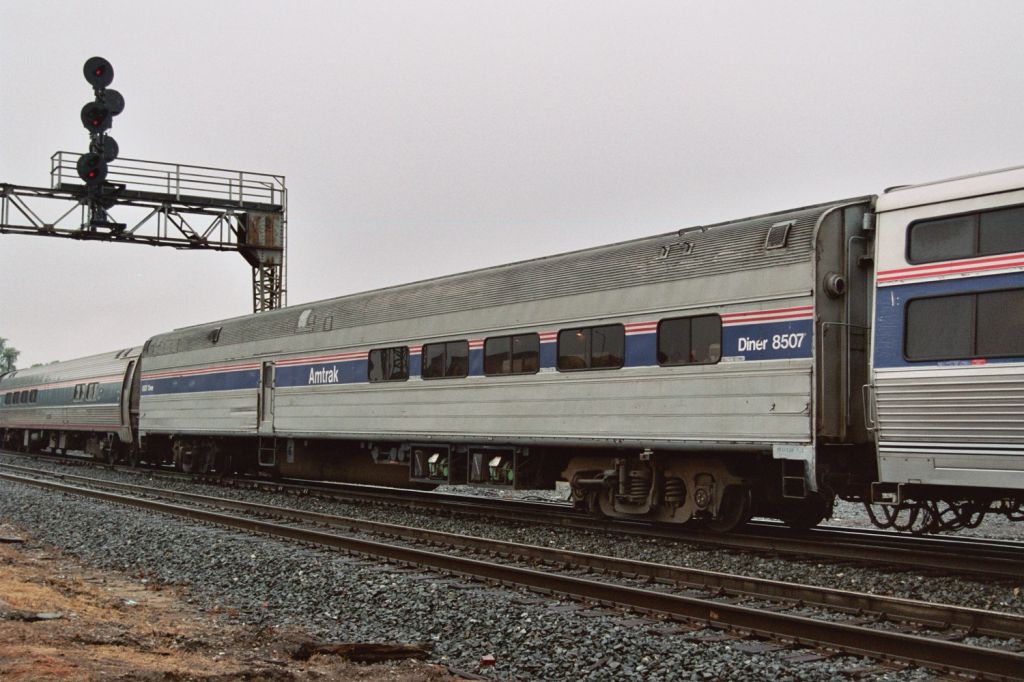
Amtrak Heritage dining car, with an Amfleet cafe on the left and a
Viewliner sleeper on the right.
Photo from www.railroadfan.com
Single level dining cars are some of the oldest passenger cars still running on the Amtrak system, and as such are known as Heritage cars.  They all date back to before Amtrak, some built as long ago as 1948.  They were all built in a time when passenger trains were operated by what we now know as freight railroads.  At one time, private railroad companies ran all the trains in the country, whether they were freight or passenger. Many Amtrak trains take their names from their previous, privately operated counterparts.  Amtrak serves three meals a day in the dining cars, provided that the train is running for all the meals.  The dining car offers sit down meal service, similar to a restaurant.  Due to limited seating, dinners are served by reservations.  Breakfast and lunch are served on a first come, first served basis, but if the dining car gets crowded, the attendants may take your name and call you when a table becomes available.  The tables each seat four people, and because of this limited seating, passengers travelling alone or in a group of less than four may be required to sit with other passengers on the train.  This is a great opportunity to meet and talk to some fellow travelers.  Meal service in the dining car is included in the ticket price for sleeping car passengers.  For coach passengers, meals are available at an additional cost, although it is typically cheaper to eat a full meal in the dining car than in the cafe car.

Superliner coach, during a snowstorm, in
Denver, CO, on the California Zephyr.
On western routes, and a few eastern routes that do not go to New York, Amtrak uses Superliner equipment.  Superliners are all bilevel cars, with the majority of the accommodations on the upper level of each car.  The functions of coaches, diners, sleepers, and cafe cars is basically the same, although the interior arrangements are a little different.  Boarding and disembarking the Superliner equipment is handled through a door at the center of the car, on the lower level.  Bathrooms, showers, changing rooms, and a luggage rack can also be found on the lower level of each Superliner.  There is a set of stairs in the center of the car for access to the upper level.  The upper level is where the majority of the accommodations are found. On the upper level there are doors on each end of the car for access to other cars on the train.

Superliner coaches have seating on a small part of the lower level, and on the entirety of the upper level.  Just like with the Amfleets, the coaches feature wide seats with ample legroom.  Coaches have two seats on each side of the aisle that runs the length of the car.  There are overhead luggage racks above the seats on either side, and a larger luggage rack at the bottom of the stairs, on the lower level.

Superliner dining car interior, on the California Zephyr.
Superliner dining cars have all the dining seating on the upper level.  This is the only car which passengers cannot access the lower level, as it is where the kitchen is located, and it is only accessible to crew members.  For passengers who cannot make it up the stairs to the upper level, the car attendant will bring meals from the dining car back to their seat or sleeper accommodation.  Just like on the Heritage diners, breakfast and lunch are served on a first come, first served basis, and dinner is served by reservation.  The dining car attendant will announce when he or she will be coming through the train to take reservations, and passengers should speak to him or her as they walk through if they want to have dinner in the dining car.  Just like on the Heritage diners, if the dining car fills up during breakfast or lunch, one of the attendants will take down names and call people back to the dining car as tables open up.  Again, due to limited seating, passengers traveling alone or in groups of less than four may be asked to share the table with other passengers.

Superliner lounge, on the California Zephyr.  On the lower
level is the cafe area.
Superliner cafe cars are a bit different than their Amfleet counterparts.  They have the same menu as the Amfleet cafe cars, but they are also the lounge cars, and as such, are easily recognizable by their large windows.  The lower level of the car is where the food service area is located.  Also on the lower level, there are tables and seats, similar to the dining car and Amfleet cafe cars.  Each table can seat four people, in seats that face each other across the table.  On the upper level of the cafe car is the lounge area.  The lounge features large windows, which curve up onto the roof of the car.  On the upper level, there are more tables at one end of the car.  The rest of the car is lounge seats, which face the windows, and small tables between them.  Some of the seats swivel, while others are fixed in place.  This is the car to be in on most western routes, as it affords the best views of the scenery.  Of course, as the train gets closer to scenic areas, the lounge car fills up, so it is best to get there early to grab a seat, if possible.

A Superliner Roomette, in the daytime configuration, on the Empire
Builder
.
Sleeping car accommodations on Superliner equipment is similar to those of Viewliner sleepers.  The smallest room available, and usually the cheapest, is a roomette.  On Superliners, roomettes can accommodate two people.  Their daytime configuration has two wide seats that face each other.  At night, the seats fold down to make the lower berth, and the upper berth pulls out of the ceiling.  Superliner roomettes feature a small closet, wastebasket, and a small luggage rack.  There is a community bathroom on the upper level, and bathrooms and showers on the lower level of the car.

A little more space can be found by booking a Superliner Bedroom, which also accommodates two people. In addition to the features of a roomette, a bedroom also features an in room bathroom and shower.  The daytime configuration is two seats, side by side, and a chair across the room.  The seats fold down to become the lower berth at night, and the upper berth pulls out of the ceiling.  A Bedroom Suite is made by combining two Superliner Bedrooms, and can accommodate up to four people.  A bedroom suite features two bathrooms and two showers, as well as two upper and two lower berths.  It allows for a little more space for those travelling in a larger group together.

Superliner sleepers also have a Family Bedroom, which can accommodate up to four people, although two berths are smaller and designed for use by children.  A family bedroom does not have a bathroom or shower in the room, but they are available just down the hall, on the lower level.

Superliners also have a handicapped accessible bedroom, which can accommodate two people.  It has an entrance placed for easier access and a little more space inside for moving around.  The accessible bedroom is on the lower level, and it features an in room toilet, but the shower is located just down the hall from the room.

Each sleeper has an attendant who can reconfigure the rooms for daytime or night time use.  There is a community shower on the lower level of each Superliner sleeper, and bathrooms on both the upper and lower level.  Additionally, in the center of the upper level, there is a small, self serve snack bar, which usually has fresh fruit, cookies or crackers, juice, coffee and tea.  End doors on the upper level allow passage into adjoining cars on the train, and the center doors on the lower level allow boarding and disembarking.

For more information on Amtrak accommodations, visit www.amtrak.com.  They have a a "Plan" tab on their website, which has virtual tours of all the sleeping car accommodations, and other important travel planning information.  If you are thinking about travelling, try the train.  It is a quiet and relaxing way to go, and a pleasant change from the fast paced way of life so many of are so accustomed to.

Superliners getting ready to depart on a snowy morning in Salt Lake City, UT, before heading east, towards Chicago, on Amtrak's California Zephyr.

Tuesday, August 16, 2011

Coming Home

The Sunset Limited snaked its way through the urban sprawl known as Los Angeles, carefully tiptoeing its way around skyscrapers, city streets, and palm trees. As the train found a way east through the concrete jungle, home was only five days, three trains, and 4,000 miles away. Eventually the buildings got further apart, the carefully irrigated grass turned to dirt, and palm trees became windmills. Los Angeles and the Pacific Ocean were behind me, the train was crossing another desert. The sun set when we were near Arizona, it was dark by the time the train pulled into Yuma, right on schedule.

I woke the next morning to one of the most beautiful sunrises I have ever seen, over the New Mexico desert. I wandered over to the dining car for breakfast. I ordered the scrambled eggs, which is not my usual breakfast choice. I always get the french toast, because it is amazing, but I decided to try something different this time. The eggs were delicious as well, but I still prefer the french toast. There were only four of us in the diner at that time of the morning, so we all sat together. I was traveling the furthest out of the four of us.

That morning the train crossed the Rio Grande from New Mexico into Texas, stopping in El Paso shortly after. El Paso is only feet from the Mexican border; another city, Juarez, lies right across the river from El Paso. You can see both cities from the train, and there is a vast difference between the two. Juarez is basically a dump, while El Paso is a very clean and modern looking city. El Paso is also crawling with border patrol vehicles. It was kind of an eye-opener to see the two cities, there's no wonder why everyone wants to come to this side of the border.

The train spent the next two days crossing Texas. There was nothing but desert that whole day. The train stopped in Alpine and Del Rio before reaching San Antonio. The desert was pretty...for the first hour or so. After that, it got boring. Real boring. This was even more of a desert than I had seen on the Southwest Chief. This desert had the cracked dirt, animal bones, vultures, cactuses, the whole works. And it lasted all day with no break. However, a cool family sat with me in the lounge car. They got on at Alpine, which is kind of near Big Bend State Park. They had been camping there when their car broke down. That is usually a death sentence in that park, but they were lucky enough to be in one of the only places with cell phone service in the whole park. They managed to get out of the park and get to the train station at Alpine. The ticket agent felt bad for them and sold them seats on the Sunset Limited even thought the train was sold out. They were getting off at San Antonio, which was the same day, so they just sat in the lounge since those were the only available seats on the train. They had two young boys, both 4, who were crazy. They actually reminded me of an awesome 3 year old that I know who is a handful by himself, but here there were two of them! They were a lot of fun.

The train made it to San Antonio right on time. The Sunset Limited would continue on to New Orleans, and the Texas Eagle would originate here to go to Chicago. That is the route I was taking. You can book it as the Texas Eagle all the way to Los Angeles, which is what I did. The train splits in San Antonio, but not the same way the Empire Builder or Lake Shore Limited split. The last two cars on the Sunset Limited, a coach and a sleeper, were uncoupled from the train at San Antonio. When the Sunset Limited left, the Texas Eagle trainset backed onto the coach and sleeper to haul them to Chicago. In Spokane and Seattle, the trains split into two sections that go two different directions. But here, they pulled two cars off one train and stuck them on another train.

The Texas Eagle would sit in San Antonio all night and leave in the morning, so I got off and wandered around the city a bit. I found the Alamo, which was not far from the train station. The Alamo is not actually the name of the place. I forget the name, it was a long Spanish name that I couldn't possibly remember, mostly because I don't speak any Spanish. It earned the nickname Alamo after it was a mission, there are a few conflicting stories as to how it earned that nickname. But the name has stuck, and that's what everybody knows it by at this point. I also walked over to the famed Riverwalk in San Antonio. I was a little disappointed though. I had heard all about how great and wonderful it was and how it's a must-see in San Antonio...it was a sidewalk next to a tiny river. That's all. Nothing special. After that, I went back to the train so I could sleep for the night.

I woke up the next morning just before the Texas Eagle left San Antonio. Two people from the national park service got on board there to narrate the ride to Fort Worth. This is considered the scenic area of Texas, but honestly I don't know what scenery they are referring to. But maybe that's because New Hampshire is a forest, like all of eastern Texas. It was just trees. I didn't think it was anything special, but that may be because that's what I live in. Scenery or not, the narration was interesting. They talked about the different towns along the route and how they got started. They also talked about things I had only learned about in school, like cowboys and the Chisholm Trail. It was all very interesting. The train left Texas at Texarkana. The station there is on the Texas/Arkansas state line, and in the schedule it is listed as being in both states.

I woke up the next morning in St. Louis. In its day, this was the second biggest railroad town in the country, second only to Chicago, the Texas Eagle's destination. We spent the day crossing Illinois, arriving in Chicago right on time. I had eight hours before the Lake Shore Limited went anywhere, so I checked my suitcase to Boston and walked around the city. My first stop was the Willis Tower, formerly the Sears Tower. The Willis Tower is only a few short blocks from Union Station. There was a three hour wait to get to the top, but I had the time, so I waited in line. I finally got to the top and I could see for miles. There were these glass boxes on the side of the building that you could stand in and look down. It was a little scary, but kind of cool. After the Willis Tower I walked down to Lake Michigan and just sat there and enjoyed the view and the breeze. The lake is about a mile and a half from Union Station. When it was time, I walked back to Union Station to get on the Lake Shore Limited, the last train on my trip.

The Lake Shore Limited, with Amtrak's Phase 2 heritage locomotive leading, left Chicago about half an hour late. They held the train for the California Zephyr, which was running very late, arriving about when the Lake Shore Limited was supposed to leave. We didn't lose any more time by the time we got to Albany. In Albany, everyone going to Massachusetts got off the train. Because of track work, Amtrak was running buses between Albany and Boston. This was actually a good thing, because the buses made less stops and ran faster than the train, so I ended up getting to Boston a little ahead of schedule. I claimed my baggage and got on the Red Line to Alewife, where my parents were waiting for me. They drove me back home to Nashua, and the first thing I did was jump in the shower. That is the biggest disadvantage to riding the train. It had been about a week since my last real shower, and despite it being midnight, I took one anyway.

It was a great trip. But it is nice to be home. I have a bed, which doesn't move or make noise. I have a shower. I also have over 2,000 photos to go through. All the photos I have shared, and plenty more (but not all 2,000) can be seen in a Facebook photo album, viewable here.

Wednesday, July 6, 2011

Holy Toledo!

I am writing this in Chicago. I just got off the Lake Shore Limited and I have some time to kill before I board the Empire Builder for St. Paul.

I left Nashua on Saturday evening and spent the night in Boston at my younger brother's apartment. He doesn't live far from South Station, where train 449, the Lake Shore Limited, departed Sunday right on time at 11:55am. The train dashed across Massachusetts, arriving at Albany almost 40 minutes early. This gave us about a 2 hour layover there, so I got off the train with my camera and watched the action as the northbound Ethan Allen Express to Rutland, southbound Adirondack from Montreal, and the New York section of the Lake Shore Limited all arrived at Albany and did their switching duties.

Trains going to Manhattan must be electrically powered, so at Albany all southbound trains exchange their P40 or P42 diesel for a P32 dual-mode locomotive. On the outside, these locomotives are virtually identical to the diesels, but they have retractible third rail shoes. They are powered by their prime movers until Manhattan. Once there, instead of going to Grand Central Terminal, the trains instead use an old freight branch down Manhattan's west side. This is not in a tunnel and therefore it is not required to be electrified. Finally, the train arrives at the old Pennsylvania Railroad tracks leading into Penn Station. These tracks are electrified with overhead catenary and top-running third rail. The dual-mode locomotives don't have pantographs, so they use the top-running third rail into Penn Station. The retractible third rail shoes allow the locomotives to use both top-running and bottom-running third rail.

After these two trains cleared Albany, the Boston section of the Lake Shore Limited backed towards the New York section, making a 13 car train. I boarded the train, and we departed immediately after the southbound Maple Leaf arrived from Toronto. We crossed the mighty Hudson river and snaked our way through Albany and headed west. The dining car opened for business, but filled up quickly, and I was not able to make a reservation in time. I instead went to the Cafe car and got a turkey sandwich for dinner. It was good, but it definitely wasn't the diner. I went back to my coach and went to sleep.

I woke up after a solid 8 hours of sleep. I looked out the window, checked the schedule, checked the time, and thought to myself, "Holy Toledo, we're still on time!". Toledo is a smoking stop, so we sat there for a couple minutes. I like to get out and take a photo of the train at smoking stops, but the person in the aisle seat next to me was still asleep so I stayed put.

I got to know the people I was sitting with. They were a family traveling back to their home in Minnesota, they had been visiting family in northern New Hampshire. They had five young daughters, and they were all fairly well-behaved, which is impressive on such a long rail trip. They are boarding the Empire Builder here in Chicago, so who knows, I might sit with them all the way to St. Paul.

After waking up, I made my way to the diner. Breakfast is unreserved, so I just walked in and picked a seat. I ordered french toast, and a couple minutes later a heaping pile of the stuff was set in front of me. It was filling but very delicious. I went back to my coach to watch Indiana go by. After South Bend, we changed to Central Time. As we got closer to Chicago, the corn plants gave way to steel plants, county roads turned into congested interstates, and grain elevators turned into high-rises. The train slowed down to snake its way through steel plants, factories, intermodal yards, and countless other rail lines, all radiating around Chicago and feeding this capital of industrialization with raw materials to turn into everything from refrigerators to lolipops. Finally we arrived at Chicago Union Station, where I am sitting now.

Well, right after I typed that last paragraph, my laptop battery died and I was not able to find a place in all of Chicago Union Station with both an outlet and wireless internet. So I will just continue where I left off and post it all as one post.

We left Chicago from the less-crowded north gate, because the Empire Builder goes north to the twin cities before going west to Seattle and Portland. However, because of the flooding in North Dakota, that day's Empire Builder wasn't going past St. Paul, and I took the train that far. The train was two locomotives coupled back-to-back, 2 coaches, a lounge, and 2 more coaches. I sat in the lounge car the whole way.

The ironic part is that the Empire Builder does not follow the original route between Chicago and the twin cities. Great Northern Railroad built west from the twin cities, so their Empire Builder left Chicago on Chicago, Burlington, & Quincy tracks with CB&Q power. Today's Empire Builder follows the original Milwaukee Road route to St. Paul. That route got bought out by Soo Line in the 1970s and later by the Canadian Pacific. CP owns the line now.

The train pulled into St. Paul at about midnight, an hour and a half behind schedule. I didn't mind the delay, because my bus didn't leave until 8:00am so I had some time to kill. I walked from the St. Paul train station to the Minneapolis bus terminal. It was a nice night, but a long walk with a suitcase. Taxis there are expensive, the bus system doesn't run at night despite the website saying it does, and none of the transportation hubs in the area are connected very well. The bus depot was about 6 miles from the train station, mostly through University of Minnesota's campus in St. Paul. The bus depot is over the river in Minneapolis and then a short walk through downtown, which is a very clean and modern-looking city. The light rail system there does run during the night. The city was also silent at night, quieter than Nashua on a regular night, and this was the fourth of July. It was a little strange.

I got to the bus depot at about 3:15am. The place opens at 5am, so I had some time to kill. It started storming after I got there, but there is a roof over the sidewalk in front of the bus depot, so I was fine. It was about 80 degrees all night. I was the first one at the depot, but a few other people came along before 5am. Most of them were quite...interesting. Later on I'll do a blog post about the interesting people I meet on this trip. When I finally got on the bus, it was a long ride to Fargo and then another long ride to Glendive. It was a very beautiful ride though. The trees of Minnesota gave way to the plains and farms of North Dakota. I never imagined a place so empty yet so beautiful. Unfortunately, I do not have any photos of the area because the bus windows were dirty, but I am planning on driving out there and taking some photos of the scenery. It was really breathtaking.

I finally arrived in Glendive, safe and sound albeit and bit tired and dirty. The first thing I did was take a shower, because my last one had been 2 days before. That's really the biggest disadvantage of taking the train. But everything else more than makes up for it. I slept in pretty late too, I had been awake since Toledo about a day and a half before.

Today James and I drove to Miles City to see what there is to see there. But that's a story for another time. I'll keep you all posted about what adventures I go on out here in the middle of nowhere.