Showing posts with label History. Show all posts

Saturday, April 4, 2015

Boston, Concord, & Montreal Railroad

I've made some progress on the model railroad, but before I get into that, I promised in my last post that I would explain my fictional railroad, so I thought I'd take the time to do that today.  I consider it a semi-fictional railroad.  Let me explain what I mean by that.  In the mid-19th century, when small railroads were starting to consolidate into larger ones, the Boston, Concord, & Montreal railroad was formed out of several of the small railroads in Massachusetts and southern New Hampshire.  When it was formed, tracks existed between Boston and Concord (New Hampshire), and the plan was to continue building north.  The railroad built north through New Hampshire's lakes region and into the foothills of the White Mountains to a small town called Woodsville, on the Connecticut River and the border with Vermont.  They also built a branch out of Woodsville into the White Mountains which connected with the Portland and Ogdensburg, another big railroad of the day.  P&O was eventually consolidated into Maine Central, and BC&M was consolidated into Boston & Maine, and plans to continue the line to Montreal were abandoned.  Canadian Pacific built tracks south to Woodsville, so the line eventually reached Montreal, and they were used as B&M's main route to Montreal.

Boston & Maine later came under the control of the New Haven Railroad, which wanted to control the larger railroads in New England, consolidate them into one company, and electrify the important routes.  They experimented with third rail electrification near Hartford; however, it led to many accidents and the state of Connecticut banned the use of third rail electrification within its borders.  This forced the New Haven to look into overhead catenary, which at the time was only used on streetcar and interurban lines, and only with low voltage DC power.  New Haven did extensive research and developed a high voltage AC system and strung wires along part of their main line out of New York.  The tests were successful, and wires were extended to New Haven and along several branch lines.  New Haven was also responsible for stringing catenary through Boston & Maine's Hoosac Tunnel.  However, New Haven came under new management, and the plans to electrify all the busy routes in New England were dropped.

All of that being said, I am still modeling the present day.  I wanted to give some background information, which will tie in here.  My version of the BC&M is a "what-if" situation: What if the BC&M was never bought out, and survives today as a Class 2?  This led me to a few conclusions.  First is that the railroad completed their line to Montreal.  I don't know what route they were planning on building, and I don't know that the railroad itself had any plans either, so I will use the existing former CP route between Woodsville and Montreal as BC&M's main line.  The second conclusion is that for a while in the early 20th century the BC&M was under the control of New Haven.  Since I like the idea of electrification, I used this as an excuse to have catenary on my railroad.  Since the Boston to Concord corridor is fairly heavily populated, and at the time had a lot of rail traffic,then in my world the route between the two cities was electrified by New Haven, and that the wires survive today and the BC&M still uses them.  However, I don't plan on modeling today's amount of rail traffic on the line.  Today, the line barely exists between Concord and Plymouth, NH, and between Plymouth and Woodsville the tracks are gone.  There is no direct rail connection between Boston and Montreal anymore.  However, since in my world it is all run by one railroad, none of the abandonments happened, and the route is still the main line between the two cities, and therefore has much more traffic on it today.  Finally, since the area today is ripe for a commuter rail service, I will model a fictional commuter service to Montreal, which of course will also use the catenary.

However, most of that does not have to do with this model railroad, except that I am modeling a branch of the BC&M.  The branch will not be electrified, I will use diesels to run the trains.  When (if) I ever get the chance to build a basement empire, I will model a much larger BC&M and have electrification on the layout.

When we put together the maps section in our resources page, I will include a map of the BC&M for reference.  In the meantime, this scan of on old Boston and Maine timetable will give you an idea of the route I am talking about.  It is the one on the top of the page, the Canadian Pacific route to Montreal. Canadian Pacific tracks began at Woodsville.

Finally, here are a couple of paint schemes I designed for the railroad.  I used a GP38-2 and a SD40-2 to design the paint scheme, but I am not sure yet what I will use for motive power.


Sunday, April 13, 2014

Seward Depot

There are two passenger depots in Seward, AK, but the original depot is no longer used by the Alaska Railroad. The original depot was built at milepost 0, the southernmost point on the Alaska Railroad. It was built before Anchorage had even been founded, and Seward was the location where people began their trip to Fairbanks and the interior of Alaska. When the railroad was completed, a trip to Fairbanks took two days by train, with an overnight layover in Curry. Curry no longer exists as anything more than a spur track, but that is a story for another day. The current Seward depot is pretty nondescript. It is a small wood frame building next to an asphalt platform at the end of the track. The current end of the track is at milepost 1.6.

At 5:36pm, on March 27, 1964, south central Alaska experienced a major earthquake. At the time, it was the most powerful earthquake ever recorded, measuring at 9.2 on the Richter scale, and lasting around four minutes. The epicenter was east of Anchorage, so while there were effects statewide, the majority of the damage was at the south end of the railroad. One of the consequences of the earthquake was major elevation changes in areas near the ocean, including in Seward. Prior to the earthquake, the railroad continued south from the location of today's depot, along the shore line, and then around to the location of the original depot. Along the way there was a yard, some oil storage facilities, and numerous docks and piers.When the earthquake occurred, the soft silt and mud beneath all that gave way and slipped into Resurrection Bay, taking the railroad, piers, and oil facility with it. In addition, the earthquake generated tsunamis that affected Alaska, but also traveled out into the Pacific Ocean, reaching places as far away as California, Hawaii, and even New Zealand. The tsunamis reached Seward shortly after the earthquake and washed many buildings and facilities near the shore into the ocean. In addition to all this, the destroyed remains of the oil facility caught fire, and the fire was then spread throughout the town by the tsunami.

Despite all the destruction in Seward, and the fact that the old depot is located right next to the shore, it still stands. The mile and a half of track between it and the new depot were never rebuilt, which is why the railroad no longer goes to milepost 0. Today the old depot houses some of the offices of the Alaska Sea Life Center, but they have left the exterior almost exactly as it would have been while serving the railroad. There are some exhibits in there, and visitors to the Alaska Sea Life Center can usually visit those exhibits during normal business hours. Anyway, several days ago I was in Seward on a coal train and the hotel we stayed in was right around the corner from the old depot. It was a gorgeous day, so I decided to go for a little walk and take some pictures while I was at it.


The front of the old depot.

North end of the old depot. The concrete building in the background is the main part of the Alaska Sea Life Center.

South end of the old depot, the concrete porch is newer.

Former track side of the old depot.

Track side of the old depot. The parking lot is where the south end of the yard would have been located.
With the exception of a dock missing in the foreground, the view from the old platform is unchanged.

Tuesday, November 5, 2013

Raymond Loewy

Raymond Loewy was an industrial designer who would be celebrating his 120th birthday if he were still alive today. While he was not a railroad man, we have chosen to talk about him because his industrial design work did have an influence in the railroad industry.

Loewy was born in France on November 5, 1893, and he was educated at the University of Paris. Most of his design work however was in the United States. In the railroad industry, he had a close relationship with the Pennsylvania Railroad, beginning in 1937. His best known railroad designs were for their passenger locomotives. He is most often connected to the GG1 electric locomotive, although it should be noted that he did not actually design the locomotive. He suggested that the locomotive body  be welded, to improve the overall appearance, and he designed the pinstripe paint scheme that many of them wore, highlighting the shape and contours of the locomotive.

PRR K4 Pacific #3768
Image from Wikipedia.
Loewy did design a number of locomotives for the Pennsylvania Railroad. In 1938, one of his earliest locomotive designs was a streamlined shroud for K4 steam locomotive #3768. For some time, this locomotive pulled the Broadway Limited. Like most steam locomotives that wore streamlined shrouds, the metal casing covered many of the mechanical components of the locomotive, making access for maintenance and repairs difficult. Eventually the railroad determined that the shroud proved to be too much trouble, and it was removed from the locomotive.

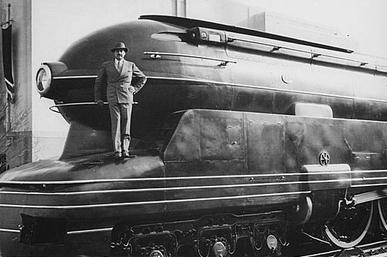
Loewy poses on the S1 Class locomotive.
Image from Wikipedia
In 1939, the Pennsylvania Railroad completed the experimental S1 class locomotive. Only one locomotive was produced, and it too featured a streamlined shroud, designed by Loewy. The S1 was originally intended to replace the Pennsylvania's fleet of aging K4 locomotives. The mechanical aspects of the locomotive were designed as a joint effort between the Pennsylvania Railroad, Lima Locomotive Works, American Locomotive Works, and Baldwin Locomotive Works. The Pennsylvania Railroad had hoped it would have the same performance and success as their GG1 locomotives. In the end however, it proved to be too big. It was the longest rigid frame steam locomotive ever built, and it had trouble negotiating some of the curves on the PRR. There were also problems with wheelslip and clearances. The locomotive was scrapped in 1949, and the railroad began to focus more on the T1 class steam locomotives.

A T1 class locomotive at the Baldwin plant, prior to
delivery to the PRR.
Image from Wikipedia.
In 1942, the Pennsylvania Railroad introduced its last steam locomotive, the T1 class. The T1 class locomotives were designed to be fast passenger locomotives. While very impressive locomotives technologically, they proved to be difficult to maintain. They were designed to operate at speeds up to 100 mph, although high speeds cause excessive wear and tear on valves, resulting in higher maintenance costs. They were so powerful that if the engineer was not careful, violent wheelslip could occur even at 100 mph. The T1 class was said to be "free steaming" locomotives, meaning the boiler was capable of producing more steam than the locomotive consumed at any throttle setting. The streamlined shell of the T1 class locomotives became known as a "Sharknose," and was designed by Loewy. The shroud on the T1 class left more of the running gear exposed, and allowed slightly better maintenance access than streamlining had on earlier locomotives.

After the T1 class locomotives, the Pennsylvania Railroad began to shift its focus to diesel, and eventually all passenger trains were pulled by diesel locomotives. Loewy redesigned many of the railroad's Baldwin diesels, and gave them a "sharknose" appearance similar to that of the T1 class steam locomotives. Besides locomotives, Loewy also did other design work for the Pennsylvania Railroad, which included marketing materials, passenger car interiors, and several station.

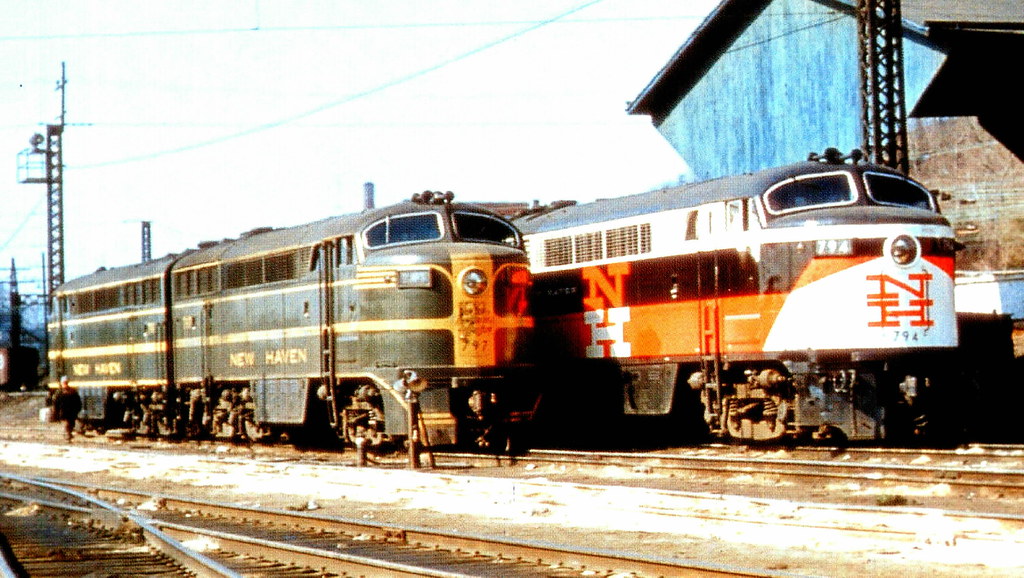
New Haven C-Liner locomotives.
Image from Flikr user torinodave72
Outside of the Pennsylvania Railroad, Loewy did design work for other railroads and other locomotive builders. In the late 1940's, Loewy worked with Fairbanks-Morse in the design of some of their new diesel locomotives, including the "Erie-built," the "C-Liner," and several others. In 1949, he also designed the Norfolk & Western Railway's new Roanoke, VA, station, which is now the home of the O. Winston Link Museum.

The railroad industry made up only a small portion of Loewy's work. Within the transportation industry, he also did extensive design work for Studebaker, designing a new corporate logo and some of the elements of their automobiles. He also designed the TWA logo in 1959 and the interior of Air France's Concorde in 1975. NASA's Skylab station was also a Loewy design. Outside the transportation industry, he also did work for Macy's, Saks, Sears-Roebuck, and many other firms. He also redesigned the Coca-Cola bottle and later designed their first steel soda cans. The Air Force One livery and the Coast Guard's "racing stripe" service mark were also Loewy designs. For a full list of his designs, please visit http://en.wikipedia.org/wiki/Raymond_Loewy#Loewy_designs.

Image from Google
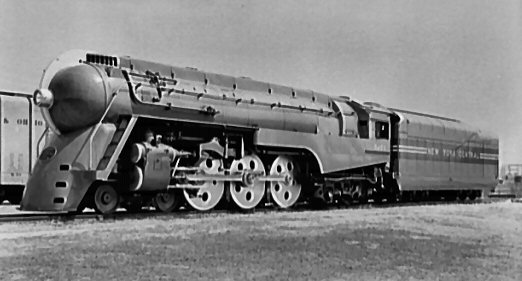
Google has honored the work of Raymond Loewy with the Google Doodle on the left. It is designed to resembles Loewy's K4 class locomotive design, using the locomotive wheels to spell out Google.

Wednesday, May 29, 2013

Steam Locomotive Restoration

In late 2011, the Jansen family, which owns Lynden Transportation, purchased a steam locomotive from the estate of Monte Holm, a former resident of Moses Lake, WA. Mr. Holm had purchased the locomotive as scrap in 1964, from the Alaska Railroad. It stayed on his property, in Moses Lake, until 2011. When the Jansen family purchased the locomotive, #557, it was donated to the Alaska Railroad, with the understanding that it would be restored and returned to service within the next eight years. Shortly thereafter, it was moved from Moses Lake, first to Seattle, then to Whittier, AK, by barge, and finally to Anchorage.

#557, all photos by James Ogden.
The 557 spent some time in Anchorage, for the Alaska Railroad's annual open house and for some inspections. During that time, a group was organized to restore the locomotive, and preparations were made for yet another move, this one relatively short, to Wasilla, AK. The newly formed Engine 557 Restoration Company began work once the locomotive was in its new home, in a nondescript warehouse, near the railroad, in Wasilla. Work finally began in the middle of 2012, with a group of dedicated volunteers.

Since I first became aware of this project, over two years ago, I have been following progress on the locomotive. I had wanted to get involved, but being in Montana, it would have been a long commute to make it to the work sessions every week. Since moving to Alaska, I have been out to work on 557 at least once a week.

Boiler Measurements
The 557 restoration project is still in the disassembling stage. The entire locomotive has to be carefully dismantled so that it can be inspected, cleaned, repaired, and restored. Parts must be inspected, cleaned, and measured as they are removed, and carefully cataloged, so they can be located and reattached later. The most important part of the dismantling of the locomotive is the measurements of the boiler. The entire boiler and firebox must be measured for thickness, to ensure that corrosion has not eaten away too much metal, and it will be able to stand the 225 psi operating pressure when it is fired up for the first time again. This has been a very time consuming part of the project, because of the number of measurements that must be taken. Some of them are in tight spaces, such as the bottom of the boiler. A few even have to be taken on the inside of the boiler, because other parts are riveted to the outside, making the actual boiler plates inaccessible except on the inside. The firebox must also be measured for thickness inside and out. While this is a time consuming part of the project, it is also a one person job, because there is only one ultrasound device to measure with, and some of the locations needing to be measured are so cramped that more than one person would simply be impossible. Measuring the locomotive has been my project for several weeks now, and I hope to be finishing up by this weekend.

Main Rod
Other people have been working on other parts of the locomotive. The connecting rods and drive rods have all been sandblasted and polished over the last few weeks. Any imperfections in them have been either buffed out or filled and reshaped. The bearings in them have received a lot of attention, as they will be responsible for transferring the tractive effort to the wheels.

Additionally, the cab had a bit of a rust problem, particularly around the bottom. The sheet metal and angle irons in the cab have been patched or replaced, depending on the severity of the rust. Everything that gets replaced gets weatherproofed and sealed up, to prevent corrosion and help the locomotive last as long as possible.

The tender has seen much less action than the locomotive, so far. The tender is in fairly good shape, but still needs some work. Some preparations have been made to life the body of the tender off its trucks, so the trucks can be removed and rebuilt. The Alaska Railroad has all the facilities to rebuild the trucks, and will be doing that. The old brass journal bearings will be replaced with new, Timken roller bearings, for improved reliability and better operation. The body of the tender needs a thorough cleaning, inside and out, and some fresh paint. There is surprisingly little rust on the tender, which should make restoring it considerably easier.

#557's Tender
Currently the Alaska Railroad is optimistic that the 557 will be ready for operation in 2015. This largely depends on the number of volunteers available to work and the number of financial or in kind donations the locomotive receives. The current plan is to have the locomotive operate a few times a week, during the summer, on a route from Anchorage, to Portage, a distance of about 50 miles. The train will turn on the wye in Portage, and return to Anchorage, stopping in Girdwood to take on more water. Of course, all these plans are dependent on getting the locomotive operational before then. We are still in the dismantling stage, and reassembling the locomotive will take quite a bit longer than taking it apart!

For more information on the project, check out John's Alaska Railroad website.
Donations can be made through the Alaska Community Foundation, instructions can be found at http://www.alaskarails.org/pix/former-loco/557/support/donate.html.
If you are interested in working on the project, the person to contact is Pat Durand. He can be reached at sewtrain557@gmail.com.

Monday, May 20, 2013

Piedmont Ghost Town

(This blog post was received recently from Steven, in a handwritten letter. The photos came shortly afterwards, after he had a chance to go take a few. All the text and photographs included are from Steven.)

Muddy Creek Campsite Marker
All Photos by Steven Ogden.
 Located in the southwest corner of Wyoming, lies a town called Piedmont, whose history is closely tied to the history of the transcontinental railroad. Piedmont was settled by the Byrne and Guild families. Mrs. Byrne and Mrs. Guild were sisters, and they named their new town after their Italian hometown, which means, "foot of the mountains." Located near the Uinta Mountains, the town is appropriately named.

Before the railroad came through, the area was an important stop on the California Trail. Fort Bridger, about 12 miles east of Piedmont, was the first supply point west of Fort Laramie, several hundred miles to the east. The Oregon Trail left the California Trail about 100 miles east of Fort Bridger, but many wagon trains going to Oregon continued to Fort Bridger for supplies, before turning towards Oregon. At this junction, a few miles past Fort Bridger, and close to Piedmont, Brigham Young, the leader of the first wagon train to the Salt Lake Valley, made an arrow out of rocks, pointing the way for the wagon trains following his, so they would know which way to go. There was a good camping site on the Muddy Creek, just a few miles north of Piedmont, where almost every wagon train and handcart company going to California and the Salt Lake Valley camped. Later the campsite became a Pony Express station, where the rider would exchange his tired horse for a fresh one, and keep riding.

Cabin Remains
Piedmont was settled in the mid 1860's, before the railroad came through. It served several purposes. First, it served as a base camp for the workers who built the railroad grade in preparation for the track to be laid. Since it was located near the Uinta Mountains, which had good timberland, railroad ties were made there and sent to where the track was being laid. The railroad rented Piedmont in 1868, a year before arriving at Promontory Point. Going west out of Piedmont, the railroad climbed a steep, eight mile grade, to get around the Aspen Mountains. Piedmont became a helper base, where helper locomotives were put on the rear of westbound trains, to get them over the grade.

Moses Byrne, one of the original settlers, saw some opportunity with the timberland and the railroad so close. He built charcoal kilns and began making charcoal in Piedmont. The finished charcoal was shipped by rail to the smelters in Salt Lake City, to fire the foundries there. The charcoal industry and the railroad kept the town pretty busy, and Piedmont quickly became a typical western frontier town, with a general store, hotel, train depot, and several saloons.

Charcoal Kilns in Piedmont, WY.
In early May of 1869, Thomas Durant, the Vice President of the Union Pacific Railroad, was traveling on his recently completed railroad, to Promontory Point, for the Gold Spike Ceremony, which was scheduled to take place on May 7, 1869. When his town arrived in Piedmont however, they found the track blocked by angry railroad workers. The railroad owed them over $200,000 in back wages, and they had decided they would get their money, even if it disrupted the Gold Spike Ceremony. Thomas Durant wired the railroad's headquarters for the money, and when it arrived, the disgruntled workers let him continue west. As a result, the Gold Spike Ceremony, marking the completion of the transcontinental railroad, happened three days later than planned, on May 10, 1869.

Butch Cassidy, a famous train robber, met up with some of his gang in Piedmont, in 1896. They boarded a train there and rode to Montpelier, Idaho. They robbed the bank in Montpelier, and then took the train back to Piedmont. There are two stories about the events after this. One story says that Butch Cassidy traveled by rail to New York, where he used the money to hire a lawyer for one of his friends. According to the other story, the money is still buried somewhere near Piedmont.

At the turn of the century, the railroad and the charcoal business were still what kept Piedmont alive. However, in 1901, the Union Pacific opened a tunnel through the Aspen Mountains, eliminating the steep, eight mile grade, and bypassing the town of Piedmont. With the railroad gone, there was no way to ship the charcoal to Salt Lake City, and the charcoal industry quickly fell apart. The other businesses in town soon closed their doors, with the general store closing last, in the 1940's.

Piedmont Today
Piedmont today is one of the most accessible ghost towns in the area. It is on a dirt road, but it is easy to drive because it was built on the original railroad grade. There is a monument near the road, marking the location of the former town.

Descendants of the Guild family live near Piedmont. They own a large ranch and live just a few miles south of where the town once stood. Many of the Piedmont buildings are still there, although there have been no efforts to preserve them. Many of them are on the Guild ranch. The kilns, however, have been preserved and are on public property. The cemetery, which lies south of the town site, is also accessible. The Muddy Creek campsite, where many wagon trains have spent nights, is on the county road into Piedmont, and the foundation for the Pony Express station is still visible.

The fort, at Fort Bridger, has been preserved, and is actually open for tours during the summer. Fort Bridger is probably the best place to visit, to learn more about the area, as it is still an active community and is just a few miles off Interstate 80.

Friday, April 6, 2012

Photo of the Week: 4/6/2012

Last spring, you may remember that the entire Midwest seemed to be flooded.  While the Forsyth Sub and the Glendive area did experience some flooding, it was minor compared to what was experienced in other areas, such as Minot, ND.  Various washouts kept things moving slowly on the Forsyth Sub.  I was still in training, and I decided to take advantage of all the time off we were getting between trips.  I decided to visit my grandparents, who live in a Long Island suburb of New York.  Being a last minute trip, flights could not be found for even a slightly reasonable price, so I decided to take Amtrak.  When I arrived at the depot in Williston, ND, the ticket agent began to explain that there would likely be delays because of the flooding, and then started a surprisingly elaborate description of how all the water was effecting the railroad.  I stopped her and explained that I was employed by the BNSF, and I understood exactly why Amtrak would be delayed.  She looked relieved that I was not complaining to her!  A few minutes later the Empire Builder pulled into the station, and I boarded.  The next morning, we had a service stop in St. Paul, MN, and I decided to step off the train and take a look around.  I had been there before on a few occasions, but they were all after dark.  This was my first daylight visit.

What I found in St. Paul was a former Milwaukee Road Skytop lounge car, coupled to a full length dome car.  I knew they were there, but had never gotten a good look at them, so I took the opportunity!  The Skytop cars have always intrigued me, because they are so unique, and an icon of the Hiawatha trains that the Milwaukee Road once ran across the country, between Chicago and Tacoma, WA.  These care are available for charter, and one day I'd like to do just that!  Here they are, with another private car, idling at the St. Paul depot.  The Empire Builder was behind me.


I think some preparations were being made to move the car, because there were some people working on and around it, and it was connected to power.  I do not know what the plan was for it though.  I do regret that I did not ask one of those people if I could see the interior of the car.  I keep telling myself that someday I will get to charter and ride these cars, although that day may be a while in the future still!

We would love to see your pictures!  If you have any pictures you would like featured on Photo of the Week, please email it to us with your name, a brief description of the photo, and of course, the photo itself, in 800 x 600 or larger resolution.  We will let you know if your photo is chosen, and you will receive full credit for your submission.

Thursday, October 13, 2011

History of the Lake Shore Limited

Amtrak's Lake Shore Limited can actually trace its history to long before Amtrak had ever even been a thought.  The New York Central Railroad, which came to be over a century before Amtrak, started running a train named the Lake Shore Limited in 1897.  Similar to today's train, there was a separate section to Boston.  Additionally, there was also another section to St. Louis, from Chicago.  The Lake Shore Limited was the New York Central's first luxury train, however it is often forgotten about.  It paved the way for a much more famous train, known as the 20th Century Limited, which is the more remembered train.  Under the New York Central, the Lake Shore Limited operated until October 1956.  It was eliminated as part of a system wide reorganization project.

The observation car on the 20th Century Limited, seen at Englewood, IL,
in 1962.  Photo from www.railpictures.net.
Before the New York Central ran the Lake Shore Limited, they ran a train called the Exposition Flyer.  This train ran between New York and Chicago during the Chicago World's Fair, also known as the World's Columbian Exposition, which was held in 1893.  The Exposition Flyer made the trip in 20 hours, a considerable speed for its time.  When it began service, it was actually the fastest train in the world, for the distance it covered.  This train followed a route known as the Lake Shore Route, or the Water Level Route.  The route of the New York Central earned this nickname because as it went west, it first followed the Hudson River, out of New York, then the Mohawk River, then the Erie Canal, and then it followed the shores of Lake Erie and Lake Michigan to Chicago.  For a route that crossed the Appalachian Mountains, it was a considerably flat route, allowing trains to operate at higher speeds.  The geography of this route, and the relatively flat profile, is what have made this route an important route to this day.

Several years after the Exposition Flyer, the New York Central introduced the Lake Shore Limited.  This was their first luxury train, and though the schedule was slower than the previous Exposition Limited, it proved to be successful.  It 1897, when the train was inaugurated, it boasted a 24 hour travel time between New York and Chicago, and 26 hours between Boston and Chicago.  This train, while often forgotten, was an important train for the New York Central, because it led the way for the extremely successful 20th Century Limited, which was inaugurated five years later, in 1902.

Passengers relax in the lounge on the 20th Century
Limited
.  Image from www.answers.com.
The Lake Shore Limited began a race, with the rival Pennsylvania Railroad.  The race was never official, but there was a fierce competition between the two railroads to offer better, faster, and more reliable trains between New York and Chicago.  Other railroads also participated in this competition, but it was most fierce between the New York Central and the Pennsylvania Railroad.  When the New York Central inaugurated the 20th Century Limited, in 1902, the Pennsylvania responded by introducing the Broadway Limited, which also ran between New York and Chicago.  For decades, every time one railroad introduced a new train, or added new equipment, or shortened the schedule, the other railroad did the same.  The competition was incredible, and consequently by 1940, passengers had about 40 trains to choose from, on about a dozen railroads, all of which operated between New York and Chicago.

The 20th Century Limited was the last word in luxury and speed.  It was the most modern train on the New York Central system.  When it was introduced in 1902, it boasted a 20 hour schedule between New York and Chicago, which was four hours faster than the fastest train running at the time.  Just as with today's Lake Shore Limited, there was a connection to Boston.  The train was all first class, and it was such a big deal to travel on the train that celebrities traveled on the it just to be one of the people who did.  At Grand Central Terminal, in New York, the porters literally rolled out a red carpet for passengers boarding the train.  It featured a full service barber shop and secretary services.  It became one of the first trains to have a telephone on board, and when two way radios were made available, crews on that train were the first to get them.

A New York Central 4-6-4 Hudson steam locomotive, on display at the
New York World's Fair.  This locomotive would have pulled the 20th
Century Limited
.  Photo from Wikipedia.
As time went on, the "Century" got faster.  That train always hat the newest, fastest locomotives available.  When new equipment was purchased, it was first assigned to the "Century."  The train was so fast, and so punctual, it was scheduled at some stations on the half minute.  It was said of the train that one could set their watch by the train passing through town.  Nothing was ever allowed to delay the 20th Century Limited.  Slower passenger trains, and freight trains were all out of the way well in advance of the "Century."  The fastest it regularly covered the mileage between New York and Chicago was 16 hours.  For a short time, it was scheduled as fast as 15:30, but that did not last long.  The "Century" grew so popular that it would sell out almost instantly.  To make it more available, the railroad began adding more sections to it.  That is, they would add another entire train, following on the same schedule, as a second part, or section, to the 20th Century Limited.  Even with a second section, the train sold out easily.  More sections were added as the demand was there, and consequently, the train ran with as many as seven sections at times, and still managed to sell out!  All the well known celebrities, politicians, and businessmen, who either already had made a name for themselves, or wanted to make one, traveled on the 20th Century Limited, because it was the chic, stylish way to go.  The train became so famous that it even played a central part in the Alfred Hitchcock film "North by Northwest," starring Cary Grant.

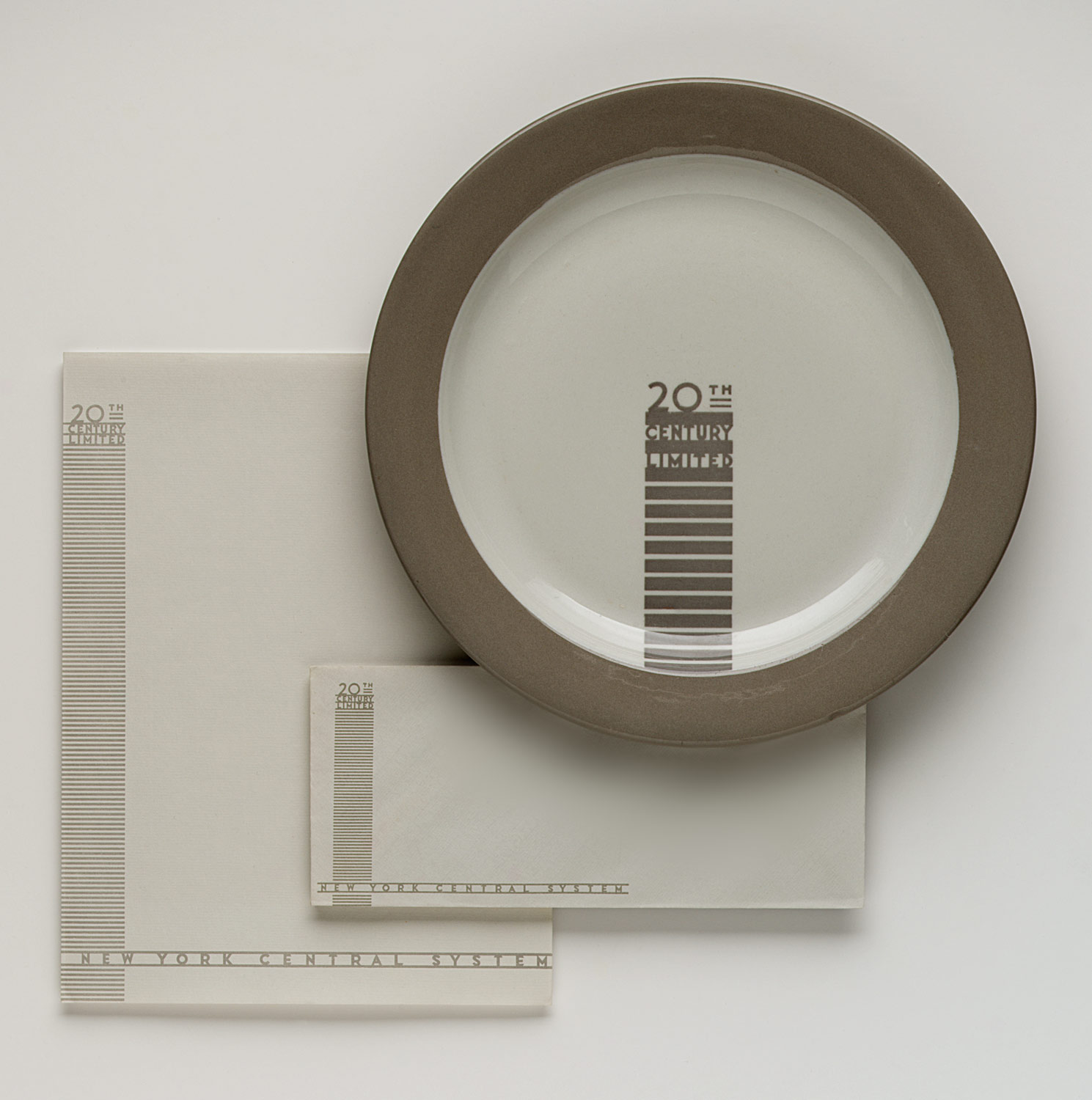
China used on the 20th Century Limited, after 1938.
Image from the Metropolitan Museum of Art.
By the late 1960s, passenger train ridership in the United States was declining.  While the 20th Century Limited was still a fast train, it was not fast enough to compete with jet airplanes.  Though the luxury never changed, most of the hype and fame associated with the train had faded into the past.  The train made its final run on 3 December 1967.  The Pennsylvania Railroad got the last hurrah, as their Broadway Limited, the primary competitor to the "Century," stayed in service until 1971, at which point, Amtrak took over its operation.  In 1999, the 20th Century Limited received some brief attention again when the US Postal Service issued a stamp commemorating the train.

New York Central's Lake Shore Limited stayed in service for more than half a century after the introduction of the 20th Century Limited.  At that time, one daily train to Chicago would not have been enough.  There were dozens of trains that operated the entire distance between New York and Chicago, and many more that operated on segments of that route.  When the "Century" was introduced, the Lake Shore Limited became secondary to it.  It continued to operate, but then the famous luxury train was the "Century."  It had led the way, as the premier train until 1902.  It was never as fast as the 20th Century Limited, operating at 21:30 between New York and Chicago, but it paved the way for the "Century."  Today Amtrak operates the train on much of the same route as the New York Central.  The most noticeable differences are at the ends.  The New York Central once used LaSalle Street Station, in Chicago, and Grand Central Terminal, in New York.  Today, Amtrak, rather ironically uses Union Station, in Chicago, and Penn Station, in New York.  Both are former terminals of the Pennsylvania Railroad, once the biggest competitor of the New York Central.  Today Amtrak operates the train between New York and Chicago in 21:30, and Boston and Chicago in 23 hours, which is similar to its predecessor's schedule.
Map of the New York Central Railroad.  Image from www.r2parks.net.

And lastly, I thought I would share this interesting promotional video.  It was made in 1935, by the New York Central, to promote the 20th Century Limited.  It has some very interesting historic footage of the train and the services offered, as well as some videos of the behind the scenes work that kept the train running.  I found the video one day while browsing YouTube.

Thursday, October 6, 2011

History of the Southwest Chief

Today's Southwest Chief is a combination of two trains formerly operated by the Atchinson, Topeka, and Santa Fe Railroad; we'll call it Santa Fe or ATSF for short. The trains were known as Super Chief and El Capitan, and both made the same fast run from Chicago to Los Angeles on Santa Fe's main line, along with slower trains making the same route but with less fanfare, lower fares, and more stops. The route that Amtrak follows today is the same route Santa Fe used.


On May 12, 1936, Santa Fe inaugurated an all new train, the Super Chief. This was the first diesel powered, all-Pullman train in the United States. Many railroads did not dieselize until after World War 2. The Santa Fe only had one trainset at first, and operated it once a week on a 40 hour schedule between origin and destination. About a year later, Santa Fe re-equipped the train with lightweight cars and new diesels and more trainsets, and inaugurated it once again. The inaugural run was completed in 36 hours and 49 minutes, a record which stands to this day. Before the war, Santa Fe ran this train nonstop between Kansas City, MO and Barstow, CA, with the exception of crew change points and servicing stops. During the war, the schedule was relaxed and passengers could get on or off at some of the bigger cities along the route, and after the war the schedule was relaxed again to allow passengers to get on and off at all the stops. The train was designed for celebrities traveling to Los Angeles, and earned the nickname "Train of the Stars."

In 1938, El Capitan started running once a week in each direction as an all-coach version of the Super Chief. El Capitan ran the same 40 hour schedule as the Chief, but made more stops because it was a coach train. Because of the extra speed and the Super Chief-style luxury, the fare was higher than any other train on the route, with the exception of the Super Chief itself. Also in 1938, the Super Chief began running twice a week. El Capitan followed suit in 1946, and the Super Chief was upgraded to daily operation the same year.

Photo from www.bcoolidge.com.
In 1952, Santa Fe announced plans to upgrade the Super Chief with bilevel cars from the Budd Company, as well as full length domes for El Capitan. Upon delivery of these cars in 1955, they switched trains, and the bilevel coaches went on El Capitan and the Chief got the dome cars. In 1958, the two trains started running as a combined train during off-peak seasons, they ran under the Super Chief name, number, and schedule. Both trains, however, continued to receive the same hype and luxury they always had right up until May 1, 1971, when Amtrak took over passenger service on the line.

Amtrak acquired the Super Chief and El Capitan equipment and ran both trains under their original names. In 1973, Amtrak dropped El Capitan, and in 1974 Santa Fe asked Amtrak to stop using the names Super Chief and Texas Chief, another former Santa Fe train that Amtrak took over, because Santa Fe felt that the Amtrak trains didn't live up to their original names, and the trains didn't deserve the names anymore. Super Chief and Texas Chief were renamed Southwest Limited and Lone Star. In 1984, Santa Fe allowed Amtrak to use the Chief name again, and the Southwest Limited became the Southwest Chief, and it runs under that name to this day.

Photo by Steven Welch.
El Capitan may have been discontinued in 1973, but its legacy lives on. The bilevel cars originally used on that train were used by Amtrak on many western routes, and when Amtrak needed new cars for their western routes they designed the Superliners, which were based on El Capitan's bilevel design. The original bilevels were slowly phased out of service, and today the only ones still running can be found on Amtrak's Coast Starlight. The Coast Starlight operates between Seattle and Los Angeles, and features a "Pacific Parlour" car, originally an El Capitan lounge car.  One of these cars even made an appearance in the popular 2003 film The Italian Job.

Saturday, September 24, 2011

Prototype Railroading: History of Air Brakes

First of all, I apologize for missing this post on Wednesday.  I was in Forsyth, and normally I would have written a post before leaving, but on Tuesday I got busy with some household projects and completely forgot about it.  Actually, it is okay though, because I really had nothing to write about then anyway.

Today I thought I would talk about air brakes on trains, because I get asked a bit how they work, and trying to explain it makes them sound way more complicated than they really are.  Today we will talk about how they came to be, and in a future post, we will talk about exactly how they work.

Air brakes have not always existed on trains.  Over a century ago, in the middle of the 1800's, trains were stopped by turning a hand brake wheel on each car.  This is where the job of the Brakeman was invented.  Typically there would be two brakemen on a train, one on the engine and one on the caboose.  When the engineer needed to slow a train down or stop it, he would communicate his intentions using whistle signals.  When they brakemen heard the signal indicating that the engineer wanted brakes, the brakemen would go to work, starting at each end of the train and working towards each other.  They would walk on the roofs of cars, and turn each brake wheel as they went along.  When the train was slowed sufficiently and the brakes needed to be released, the engineer would sound a different whistle signal, and the brakemen would walk across the tops of the cars and release the brakes they had applied.  It was a simple system, but it was obviously lacking a few safety features!  At one time, a brakeman was considered the deadliest occupation in the United States.

George Westinghouse is the man who invented the railroad air brake.  Besides the development of the air brake, he is also well known for his pioneering work in the electrical industry.  He recognized that relying on brakemen to stop a train was a very primitive and dangerous system, and he began to work on a system that would allow the engineer to directly control the brakes on the train.  Doing so would eliminate for people to be walking on the roofs of train cars while moving, and it would allow the train to stop faster, if the engineer could control all the brakes on the train at the same time.

The very first air brake system was a little different than the air brakes of today.  The basic operation of air brakes requires that compressed air be forced against a piston, which in turn transmits that pressure to a brake shoe, generating friction and stopping a train.  Early air brake systems worked on that system, known as a straight air system.  A pipe ran the length of the train, and on each car there was a brake cylinder.  When compressed air was applied to that pipe, it put pressure on each brake cylinder in the train, applying the brakes on every car.  When the pressure was released, the brakes released.  This offered a huge advancement over the hand operated brakes, but there were still some pretty critical flaws.  The biggest flaw with the straight air system is that if cars somehow separate, the pressure is lost in the brake pipe, and brakes release.  When cars are not coupled, or a train splits in two, there would be no air brakes available.

A few solutions were offered to fix the problem of losing brakes when uncoupled.  In some countries, vacuum brakes were introduced.  Vacuum brakes required that a negative pressure be maintained to release brakes.  If the brake pipe became separated, due to the train splitting in two, pressure would be restored in the pipe and the brakes would all fully apply.  Vacuum brakes had the disadvantages of requiring much larger equipment to generate enough braking force, and being very slow to apply and release.  A more popular option was the train air brakes, or automatic brake, which is still in use today on almost every railroad in the world.  Automatic brakes work by requiring each car on the train to have a compressed air reservoir, which is filled up by an air compressor on the engine.  The brakes are still applied by air pressure acting on the brake cylinder, but that air comes from the reservoir on the car.  The brake pipe has constant pressure in it, and a valve ensures that the pressure in the reservoir and the pipe always stay equal.  When the engineer needs to make a brake application, he lets some air out of the brake pipe, making the pressure less than that of the reservoir.  Air is let out of the reservoir and into the brake cylinder, applying the brakes, until the pressures again reach equilibrium.  When the engineer wants to release the brakes, air is added to the brake pipe, making the pressure higher than the reservoir.  The brakes release, and the reservoir pressure increases until equilibrium is reached again.  Whenever the pressures are at equilibrium, the brakes continue doing what they are doing, but when brake pipe pressure is higher, they release, and when brake pipe pressure is lower, the apply.  Next week we will cover in detail exactly how this happens.

As with the other systems, there are advantages and disadvantages to the automatic brake system.  One of the biggest advantages is if a train splits in two, or the brake pipe becomes separated, the brakes fully apply and the entire train comes to a stop.  There are two major disadvantages, although with proper training one can be eliminated.  One disadvantage, which is simply unavoidable, is that having an air reservoir on each car means it takes a considerable time to fully pressurize the brake system.  On a long train it can take eight to ten minutes, even on a good day.  In extreme cold weather, it can literally take hours.  Also, pressure can only be restored to the system when the brakes are released.  Consequently, if an application is made, and then released, it takes a minute for the pressure to restore throughout the system.  If another application is made before pressure is fully restores, there is less pressure available, and therefore less braking ability available.  This is called fanning the brakes, and if done repeatedly it can lead to a complete loss of pressure, and a loss of brakes.  With proper training, fanning of the brakes can be avoided, as can any serious consequences of this disadvantage.

Next week we will talk about how exactly the brakes work.  How exactly they work is actually considerably simpler than it sounds so far.  Basically the thing to remember is that the pressures constantly try to equalize.  When the pressure in the brake pipe is higher than the reservoir, then the brakes release.  When the brake pipe pressure is lower than the air reservoir, then the brakes apply.

Thursday, September 22, 2011

History of the California Zephyr

The California Zephyr's history actually goes back before the California Zephyr was inaugurated. Back in the 1930s, the Chicago, Burlington & Quincy Railroad, or CB&Q, ordered some all-new, diesel powered, all stainless steel passenger trains from the Budd Company. Boston & Maine had a similar trainset, more info on these trains here. To help promote this new service, they needed a new, modern name for these trains. Borrowing from Greek mythology, they used the name of Zephyrus, god of the west wind, and called their trains "Zephyrs." They liked the name so much they even stuck it to their other trains that didn't use the shiny new stuff.

After World War 2, the CB&Q launched a new Zephyr, the greatest Zephyr of them all. The California Zephyr was launched on March 20, 1949 and ran on CB&Q tracks from Chicago to Denver, where it was handed over to the Denver & Rio Grande Western Railroad (DRGW) which handled it from Denver to Salt Lake City, and there it was handed over once more, this time to the Western Pacific Railroad (WP) which brought the train to Oakland, with a ferry connection to San Francisco. The train's christening was no small ceremony, on March 19 the train was brought into San Francisco itself where the mayor of the city and the president of the Western Pacific Railroad attended the inauguration.


The train was billed as "the most talked about train in America" and "a vacation unto itself." It was also nicknamed "The Silver Lady" because of the stainless steel finish on the all-Budd consist. The ownership of the train's equipment was split by all three railroads and pooled together. One sleeper was owned the the Pennsylvania Railroad, because they operated a through sleeper off the California Zephyr to New York, so it was possible to travel from coast to coast without ever getting off your train. The California Zephyr ran a baggage car, three vista dome chair cars, a vista dome dormitory-buffet-lounge car, two 10-6 sleepers, a 48-seat diner, a 16 section sleeper, a 10-6 sleeper going to New York, and a vista dome dormitory-buffet-lounge-observation. The only change made to the consist was a 6-5 sleeper added in 1952. The train was short but did its job. It was billed as a "cruise train" and had no coach section. The train sported five domes for all the amazing scenery it goes through in Colorado and Feather River Canyon in California. Zephyrettes, special train hosts assigned specifically to the California Zephyr, served all the customer's needs while on board the train.

The California Zephyr, however, was short-lived. In March of 1970, the CB&Q, Northern Pacific, Great Northern, and Spokane Portland & Seattle Railroads merged to form Burlington Northern (BN). BN operated passenger trains, including the California Zephyr, until Amtrak took over 13 months later in 1971. However, WP had been petitioning with the ICC to stop running their end of the California Zephyr. ICC finally agreed , and the California Zephyr departed Oakland for the last time on March 20, 1970. BN only ran the train for three weeks. BN and DRGW continued to run their portions, but under a new name and only three times a week and without all the hype. BN called it California Service and DRGW called it Rio Grande Zephyr and extended their portion from Salt Lake City to Ogden, where it was scheduled to meet Southern Pacific's City of San Francisco. When Amtrak was formed in 1971, this operation was also killed off as BN gave up their passenger trains to Amtrak.

DRGW, however, held on to their passenger trains, one of only a few railroads that did. Amtrak inaugurated a new train, the San Francisco Zephyr, which ran over BN tracks from Chicago to Denver, Union Pacific's Overland Route through Wyoming instead of Colorado, and then Southern Pacific's route to California. This train ran three times a week. DRGW continued to run its Rio Grande Zephyr, still using original California Zephyr equipment, every day except Wednesday from Denver to Ogden. In 1983, the DRGW finally decided to give up their train, and two months later, Amtrak launched a new California Zephyr, which ran on the BN to Denver, the DRGW to Salt Lake City, WP to the middle of nowhere in Nevada where it crossed over to the SP to California, avoiding the original Feather River Canyon route. Amtrak even found one of the original Zephyrettes and invited her on board for the inaugural run. In October of 2000, Amtrak finally upgraded the California Zephyr to daily service, and it has remained unchanged since then.

Some California Zephyr cars still exist today. Many were handed over to Amtrak in 1971, but Amtrak has replaced them with Superliners. Most of the cars were scrapped but some found their ways to museums and private collections. Five still operate as private cars today, dome-observation "Silver Solarium," dome-coach "Silver Lariat," sleepers "Silver Rapids" and "Silver Quail," and a dome-lounge that has been renamed "Sierra Hotel." I have never seen these cars, but three of them often operate together.

Unfortunately, I'm having trouble with the vintage photos I want to share, so to see them please click here go to this article on the website.

Thursday, September 8, 2011

History of the Empire Builder

On Tuesday, we talked about Amtrak's Empire Builder. Today, we are going to talk about how that train came to be, which takes us back to the late 1800's, long before anyone had ever thought of Amtrak. The Great Northern Railway was created by tycoon James J. Hill from the St. Paul and Pacific Railway, and several other railroads he owned at the time. The railroad was headquartered in St. Paul, and James Hill had a dream of connecting that city with the Pacific Ocean. His dream was realized on January 6, 1893, in Scenic, WA, when the countries northernmost transcontinental railroad was completed.

James J. Hill, circa 1890.
Image from Wikipedia.
James Hill became known for keeping the work on the railroad going, even against obstacles. His goal was the shortest, straightest, and flattest route possible to the Pacific Ocean. He had no interest in developing Rocky Mountain scenery, he just wanted to develop a railroad to the Pacific. He did a lot of the route planning himself, and even rode the proposed routes on horseback. If an area the railroad was expanding to did not have enough industry, Hill would buy out a company and bring the industry in, just to generate rail traffic and produce business for the line. He let nothing stop him, and he refused Federal money, and only accepted a few land grants. The Great Northern was the only transcontinental railroad built without any Federal financial support. Because of Hill's attitude and ruthless expansion, he became known as the Empire Builder. Hill died in 1916, and never saw the launch of the train named for him, the Empire Builder.

The Empire Builder Solarium observation car, idles in
Shelby, MT. Photo from www.gngoat.com.
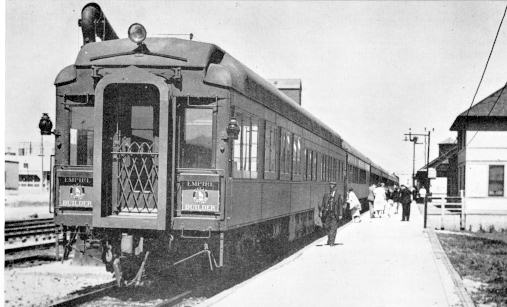
On June 11, 1929, the Great Northern decided to launch a new premier train, and they chose to name it the Empire Builder, in honor of James Hill. The train displaced the Oriental Limited as their premier train, and it operated between Chicago and Portland and Seattle, using Chicago, Burlington, and Quincy trackage between Chicago and Minneapolis. The train was a 14 car train, pulled by a 4-8-4 steam locomotive. For World War 2, the service was altered to accommodate the higher demand for the railroad. After the war, in 1947, the train was re-equipped for the first time.

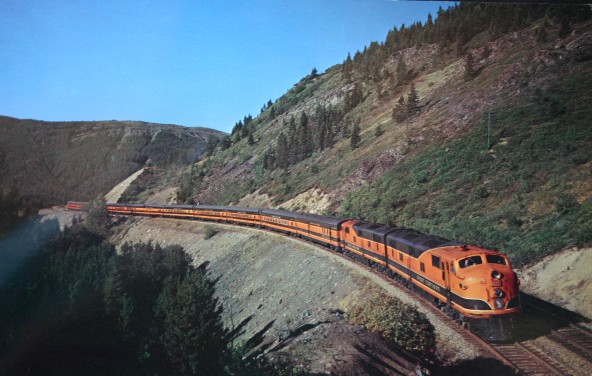
The 1947 Empire Builder, near Glacier
Park, MT. Photo from www.gngoat.org
In 1947, the Great Northern gave a new look to the Empire Builder. It was re-equipped with new, streamlined passenger cars, and the steam locomotive was replaced with a pair of shiny new diesel locomotives. This is when unveiled its famous orange and green paint scheme, which became a trademark of the Great Northern. The diesels and cars were all painted to match, and they really stood out in the new Empire Builder paint scheme. The new diesels were streamlined to match the new passenger cars. Diesel was still new. Premier trains got diesels first, and the steam locomotives kept pulling the less well known trains and the freight trains. In addition to being new power, diesels were a status symbol for the railroads.

The Empire Builder, after the 1955 addition of the dome
care. Photo from www.greatnorthernempire.net.
In 1951, the Empire Builder was re-equipped once again. A new set of diesels was assigned to the train, and in 1955, dome cars were added to the passenger cars. The Empire Builder boasted more seats under domes than any other train. Several coach dome cars were added, and one full length dome car was added for the First Class passengers. The train featured food service in three cars, including the dining car, the full length dome, and the coffee lounge car, better known as the Ranch car. The Ranch car featured a western themed decor, with a variety of options for dining, from light snacks to entire meals. There was bar seating, table seating, and lounge seating. The full service dining car served three meals per day, all cooked to order. In the full length dome, First Class passengers could order food and drinks while enjoying the view of the scenery under a large, glass dome. Attendants were happy to deliver food to any sleeping car accommodations or coach seats as well.


Drawing of the interior if the Ranch car, taken from a Great Northern
publication entitled, "The Ranch."
The entire train had a western theme in the artwork. Many of the cars were decorated with northwestern Indian artwork. Some, like the Ranch car, had a western, ranch theme. With the hide seats and wooden partitions, the ranch car was supposed to make passengers experience the areas of North Dakota and Montana that they were travelling through, and looking at outside the windows. The dome cars gave passengers some spectacular views as they traveled along the Mississippi River, through the Rocky Mountains, over Stevens Pass, and through the Columbia River Gorge.

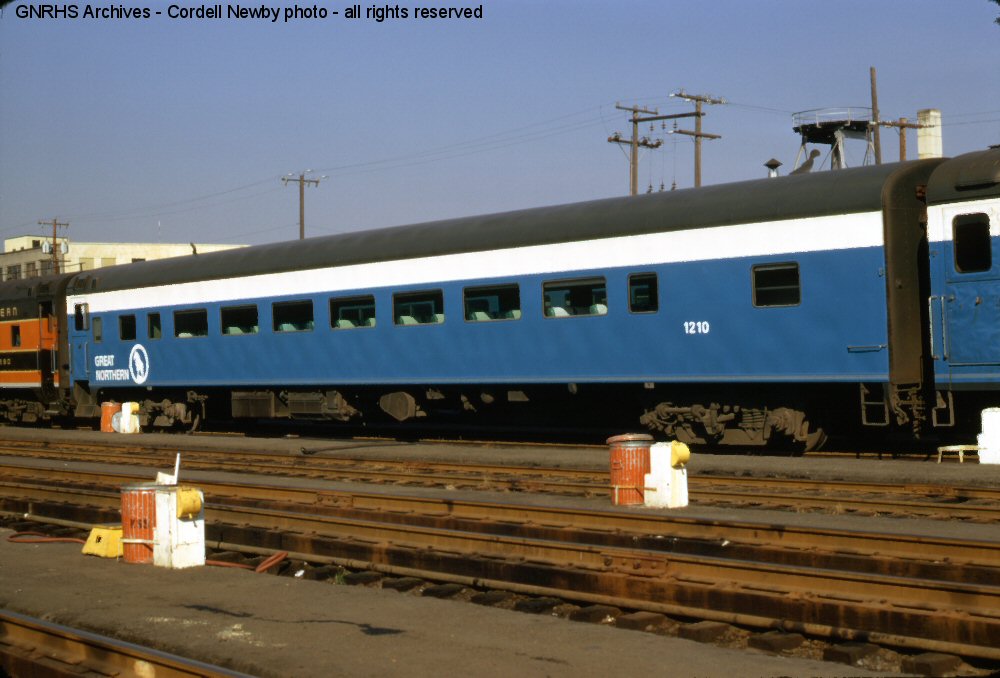
An Empire Builder coach in the "Big Sky Blue" paint
scheme. Photo from GN Historical Society archives.
Train travel during this time was often viewed differently than it is today. Many people have heard the phrase, "Getting there is half the fun." Railroads went to great lengths to ensure that the trip would be as much a part of the experience as the destination. Rail travel was stylish, and celebrities rode well known trains, because they wanted to be associated with that train, and all the style and luxury that went with it. The Empire Builder, in its day, was one of those trains.

In its later years, the Great Northern decided to change the company image a bit. Passenger trains, including the Empire Builder, were painted in what became known as the "Big Sky Blue" paint scheme. This lasted for a few years, until the Great Northern Railway ceased to exist.

A former Great Northern sleeping car, from the Empire
Builder
, in the Burlington Northern "Hockey Stick" paint
scheme. Photo from www.rrpicturearchive.net.
In 1970, just over a year before the creation of Amtrak, the Great Northern Railway merged with the Northern Pacific Railway, the Chicago Burlington & Quincy Railroad, and the Spokane, Portland, and Seattle Railway, to form the Burlington Northern Railroad. The Burlington Northern continued to run the passenger trains of all four of its predecessors for thirteen months, until Amtrak was created, on May 1, 1971, and took over most passenger operations nationwide. During the time Burlington Northern ran passenger trains, they were repainted again, to a paint scheme known as the hockey stick scheme. When Amtrak was created, on 1 May 1971, they took over all of the Burlington Northern passenger trains, including the Empire Builder. Since Amtrak took over, new equipment has been introduced, and the route has been changed a few different times. While they still run a train known as the Empire Builder, it has changed quite dramatically since it was the pride of the Great Northern.
Photo of the Empire Builder in Montana. Photo is from the rear cover of a Great Northern publication entitled, "Great Domes on Great Northern's Greatest Train." This booklet was published in 1955 when the GN introduced dome cars to the Empire Builder.

Tuesday, August 30, 2011

Introducing: Historical Posts!

Yup, it's about time we add a historical section to the blog! I've been doing some brief history stuff in the Photo of the Week posts, but nothing major. James and I both thought of similar ideas at about the same time, we we decided to combine them. James wanted to do Amtrak route profiles every week, where we would pick an Amtrak route that we've ridden, write about the route, the scenery along the way, what to look for, etc. I was thinking of doing a history post every week but do a week-to-week theme, and I was thinking of starting with passenger trains.

So what we are going to do is, well, both. However, that calls for a pretty big post. So since it is kind of a two part thing, we will split it into two posts. We are not using Tuesdays or Thursdays for anything permanent yet (I've been using them to talk about my July adventure, but that is over now), so we will do it then. On Tuesday we will talk about the Amtrak train and what you'll see along the way and everything, and then on Thursday we will talk about the history of that same train, what railroad started it, what equipment it ran, how it changed over the years, and how it became what it is today. The same person will write both posts, and whoever is more familiar with the route will write the post.

As far as the website is concerned, keep your eyes out for another preview bubble appearing on the home page and a new section to the "Prototype Railroading" section. On the website, the two posts will be added as one article and there will be only one list with each week's articles together as one article. Just a reminder, the website is a great place to look for a past article that you can't find, and it is also a great place to just browse through articles we have written. They are sorted out by category.

Today is Tuesday, and I have to let you down. We are not posting one this week. We will start next week, with the beginning of September, so look for the new posts!

Just a reminder, here is an updated blog schedule.
Sunday: off day (extra posts will go up Sundays)
Monday: Modeling (product reviews, tutorials, etc.)
Tuesday: Amtrak route profile
Wednesday: Prototype posts (mostly James' stories from BNSF, but other prototype posts too)
Thursday: History of Tuesday's Amtrak train
Friday: Photo of the Week
Saturday: Slang

Friday, July 29, 2011

Photo of the Week: 7/29/2011

Today's photo comes from last week in Sacramento. I woke up in the train station at about 5:30 in the morning. Funny thing is, the train isn't due into Sacramento until 6:35am. So the train had some time to kill, and some other trains came and went during that time. I took the time to step off the train, get a few photos, and stretch my legs. Here is this weeks photo:


This is my train, the Coast Starlight, train 11, in Sacramento. This is about the halfway point on the train's trip from Seattle to Los Angeles. I was not riding the train the whole way, I got on in Portland and got off in Davis, one stop past Sacramento.

The Coast Starlight is the only train on Amtrak's system that runs the ex-Santa Fe bilevel cars. These cars were built by Budd in the 1950s for Santa Fe's El Capitan, an all-coach version of the Super Chief (now operated by Amtrak as the Southwest Chief) from Chicago to Los Angeles. Budd built coaches, diners, and lounges with enormous windows for Santa Fe. Amtrak acquired the cars in 1971, and used them as the basis for today's Superliners. The Superliners, which include sleepers, run most of Amtrak's western routes. They are slightly taller than the old Santa Fe cars, most of which have been retired. However, Amtrak held on to the lounge cars, refurbished them, renamed them "Pacific Parlours" and put them in service on the Coast Starlight as first-class-only lounge cars. Features on these cars include free WiFi, wine tasting, and of course, exclusivity on a usually sold out train. I, however, rode coach and didn't have the opportunity of riding a Pacific Parlour. There is, however, a standard Superliner lounge car for the coach passengers, so I didn't miss out completely.