Several months ago, Walthers released their Metroliner models. Even though I have little desire to eventually model the Northeast Corridor, this was an intriguing model to me. I was curious to see how it had turned out. I was curious to see how well they had hidden the motor, and how well the models ran. I was also curious to hear the sound. Electric model sound is somewhat of a rarity in the hobby, as most modelers choose subjects that use either steam or diesel locomotives. While I have heard plenty of electric locomotives in the "real world," I was curious about how one might sound in the layout room. Despite all of this curiosity, I initially chose not to buy any Metroliners, on account of the price and my disinterest in actually modeling a railroad where they operated.
All photos by James Ogden.
Several weeks ago, I got an email from Walthers, indicating that the Metroliners were on sale. The catch was that you had to buy four of them, but in packages of four, they were going for about half price. Despite not wanting to model a railroad on which they operated, I could not resist. I took the plunge and bought a four-pack of Amtrak Phase 2 Metroliners. Four-packs of different paint schemes came with different combinations of cars. I chose Amtrak Phase 2 primarily because I liked the consist it offered. In that particular package there were two coaches, a parlor, and a snack bar coach. I ordered the set, and approximately one week later they arrived at the door.
Upon arrival, I opened the box and did a quick inspection of the cars through their individual boxes. I was headed to the Northern Lights Model Train Club that evening anyway, so I decided to do the bulk of the inspection and operating there. The club has much more space to run on!
I ordered a set of cars that were all equipped with DCC and sound from the factory. These are equipped with Tsunami decoders, from SoundTraxx, which are specifically designed for this model. Like most decoder equipped models, the cars were all programmed to respond to address 3 initially. The cab ends of all cars, regardless of specific type, are programmed as the front. As such, if you intend to run several cars together, they will need at least some minor programming to respond in unison when facing in opposite directions. Since I had four cars, I chose to run them with two facing forward and two facing back. To facilitate this, I set up a consist, and programmed two of them to run in reverse within the consist. This was the extent of the programming I did. After that, I placed them on the layout, in the staging yard, and ran them out to the main layout.
Right off the bat, I was impressed with how smoothly the cars operated together. I had done nothing to attempt to speed match them, but they were pretty well matched right out of the box. One would think this is normal--they each have the same decoders and electronics--but it is not always the case. I noticed some minor surging between cars at very low speeds. Once the speed was above a crawl however, the cars ran very smoothly together.
The prototype Metroliners had a headlight on each end, and markers on the A end. Because the headlight function on most DCC decoders allows for two outputs, instead of three, Walthers chose not to light the "B" end headlight. Instead, they chose to light the "A" end, or cab end, marker lights. When the car is operated forward, that is with the cab leading, the cab end headlights come on. When the car is operated in reverse, the marker lights on the cab end light up.
In addition to headlights and markers, the cars also have lighted number boards, lighted interiors, and a Mars light, activated by functions one, five, and six. There are also typical sound functions, such as the horn, coupler noise, brake squeal, cooling fans, and air compressor. Note that the prototype had no bell, and so the model has no bell sound. As one would expect from a SoundTraxx product, the sound quality was excellent. The cars were a little loud for my taste, but the sounds were clear and responsive to throttle inputs. The sound volume can easily be adjusted to the desired levels.
The cars were nicely detailed from the factory. The underbody matched photographs I looked at, and the model came equipped with finer details, such as grab irons and rooftop electrical details. The only disappointment I had in the details were the pantographs. There are a couple of different types of pantographs featured on the cars, but I was disappointed that they were plastic. They were clearly not designed to collect current from an overhead catenary, and that is just fine. In HO scale, that is not usually reliable or practical anyway. But, during the models' life on a layout, chances are the pantographs would be handled a bit. They are fairly fine details, and I think they would hold up better if they were metal, instead of plastic. Other than that though, I felt as if the model was nicely detailed. While it looked out of place on the club layout, which is set in fiction but represents Alaska, they are nice looking models.
Overall, I think this is a fine model. For those who model the Northeast Corridor, particularly in the 1970's and 1980's, these would be a great addition to the fleet. They fill a noticeable void, and are a major improvement to the Metroliners offered by Bachmann many years ago. However, being as these only operated under catenary in the northeast, these models fill a very specific place. I think most modelers, like myself, will find that these probably do not fit well on their layouts. They are lovely models, but if you do not model the area they ran, they will always look a bit out of place. To be honest, I was surprised that Walthers would pursue such a model. Surely other Amtrak models would have been applicable to more modelers.
Manufacturer: Walthers Proto
Paint Schemes: Penn Central, Amtrak Phase 1, Phase 2 (Phase 1 cars come numbered, others come with number decals.)
Cars: Snack Bar Coach, Parlor Car, Coach
MSRP: $169.98 with DC, $259.98 with sound and DCC
To view more photos, please visit out Facebook page.
Today we are going to take a look at a recent release by Athearn, in their Genesis product line. I actually preordered this locomotive, and the model I got was Union Pacific #3985. This happens to be the one that is preserved by Union Pacific as part of their steam program, although it has been laid up for some time. The reason for the lay up in unclear, although there are a number of rumors that speculate on some major mechanical issue. However, the HO scale counterpart operates very well!
UP #3985, at the Northern Lights Model Railroad Club. All Photos by James Ogden.
Athearn's Genesis line of products are generally high quality models, and the Challenger locomotives are no exception. They are offered in three road names and undecorated. In addition to Union Pacific, for which there are five road numbers to choose from, they are also available in Denver & Rio Grande Western and Clinchfield Railroad. DRGW and Clinchfield are each available with one road number. All models come factory equipped with DCC and with Tsunami sound, by SoundTraxx.
Exterior
The exterior of the locomotive is primarily black, but features numerous separately applied detail parts. The model includes numerous pipes and hoses, as well as all the grab bars and hand rails found on the prototype. The wheels are all metal, as are the various side rods, connecting rods, and valve gear. All the drive wheels actually provide pulling power and electrical pickup. The locomotive includes crisp, clear lettering, and includes some of the smaller lettering, such as the builders plate, and various other data and information, all of which is readable. The locomotive features an LED headlight and even has lighted number boards. The pilot comes with a non operating, scale size coupler, but a replacement coupler pocket, with an operating coupler, is also included in the box.
Cab and Firebox detail.
The tender also features a high level of detail and equally crisp lettering. The tender also has numerous separately applied detail parts including hand rails, grab bars, and piping. The tender also features metal wheels, which also serve as electrical pickup. The locomotive and tender together have at least 15 axles with electrical pickup, making this a very reliable locomotive, even on dirty track. There is a rear headlight on the tender, which functions automatically when the locomotive moves backwards. The tender is connected to the locomotive with a drawbar, which is permanently attached to the locomotive. Additionally, there is a small bundle of jumper wires that connect the locomotive to the tender.
Tender Detail
Overall, the engine and tender feature a high level of detail and an excellent paint job. Additionally, the model comes with a small bag of additional detail parts which can be applied by the modeler.
Operation
The Challenger models are dual mode, and can be operated on a DC system or on a DCC system. Some of the sound functionality is reduced when operating on a DC system, since there would be no way to activate many of the sounds without DCC functions.
When the locomotive is placed on the tracks, it immediately begins making sounds, although the number of sounds coming from a stationary, idling steam locomotive are considerably less than a diesel locomotive. Once the locomotive starts moving, the sound picks up dramatically as the locomotive begins to work. This particular locomotive sounds like it is chuffing very quickly when it moves, but that is due to the two sets of cylinders. The exhaust chuffs would be twice as frequent when compared to a simple steam locomotive.
Running Gear and Firebox detail
The locomotive operates smoothly at low speeds, although there seemed to be a slight delay in the response time. It was almost as if the decoder had to think about what it was told to do. Besides the short delay, the locomotive operated very smoothly and very well. The decoder can sense how hard the locomotive is working and adjusts the sound effects and volume accordingly. When the locomotive is pulling a heavy train up a hill, the chuffing becomes noticeably louder and sharper. When the locomotive is headed downhill with the same heavy train pushing it, the chuffing becomes much quieter and the locomotive sounds like it is drifting.
The one thing that really stands out about this locomotive is the pulling power it can achieve. I brought it in to the local model railroad club the day it arrived to take it on a trial run. The club layout includes some grades, one of which is pretty near three percent. Towards the end of the evening, I decided to couple all the cars I could find together and see what the locomotive could pull. Originally, I found 58 cars, coupled them all together, and began pulling. About halfway up the hill, the locomotive pulled the coupler and coupler box right off one of the freight cars. I decided to try with the remaining 57 cars, and the locomotive successfully pulled them around the layout numerous times. It slowed down dramatically for the big hill, and the chuffing became very loud and sharp, but it never stalled. In fact this locomotive by itself out pulled three locomotives that another member had brought in that same night. I was astonished at the pulling power of this locomotive. I have never had a locomotive that could pull as much as this Challenger can.
Sound
The sound decoder for this locomotive came factory installed. Athearn contracted the sound to SoundTraxx, which makes some very good mobile DCC decoders. The decoder equipped in this model is no exception. The decoder is located in the tender, as is the speaker. The quality of the sound is very high, and the number of effects are also very high. Besides the obvious sounds, such as the exhaust chuffs, air brakes, and horn and bell, the locomotive also features some of the less obvious sounds, such as the blower, injector, and the dynamo that powers the headlight. Not all sounds are used though. For example, the decoder comes with the sound of coal being shoveled into the firebox. This one can be activated by the user, but comes deactivated, because these locomotives were converted to oil. Currently, UP 3985 burns oil when in excursion service.
Overall I am very pleased with this model. While I do not usually model Union Pacific steam locomotives, I must admit that the quality of this model makes UP steam a tempting prototype! The model looks great, performs (and pulls) exceptionally, and sounds impressive doing it. Besides that they have a reliable Athearn drive system, with outstanding electrical pickup.
Manufacturer: Athearn Genesis
Part Numbers:
G97223 (UP Black #3707)
G97224 (UP Black #3710 w/ Smoke Deflectors)
G97225 (UP Grey/Yellow #3977 w/ Smoke Deflectors)
G97226 (UP Black #3982 w/ Smoke Deflectors)
G97227 (UP Black #3985)
G97228 (DRGW #3800)
G97229 (Clinchfield #675)
MPRP: $599.98 http://www.athearn.com/Search/Default.aspx?SearchTerm=Challenger+ATHG&CatID=THLS
Bonus! I took a couple of videos of this locomotive pulling its 57 car train.
This first video is coming off a grade, over the trestle by a glacier on the Northern Lights Model Railroad Club layout.
The second video is on more or less flat track, across a drawbridge.
Pacific Western Rail Systems recently announced the release of working air brake hoses in HO scale, from their sister company, North American Railcar Corporation. These are aftermarket detail parts than can be added to a modeler's existing fleet of freight cars, passenger cars, or locomotives. They also announced that they are currently developing a similar product for all other scales, although in the announcement email I received, it sounded as if N scale may be next. Currently, there is no timeline for future releases in other scales.
Several years ago, Steven and I talked about the possibility of making some sort of working brake hoses, using magnets, but we never gave it much thought, and never tried anything. Since then I had thought very little about having working air brake hoses on models, because it is something that has never before been available, and I suppose I had figured it never would be. However, when I received notification of this, I decided I would have to give it a try, and see if it really worked as well as the video that was in the email.
The brake hoses come in packages of ten pairs. Each hose is rubber with a small magnetic cube on the end. One side of the magnet is red, to identify the top. Other than that, the metal is bare and unpainted, and the rubber hose portion is black. The key to making the brake hoses couple properly, regardless of what direction the car is facing, is to make sure that the red side of the magnet is facing up. Once installed, the magnet can be painted or blackened with a permanent marker.
In HO scale, brake hoses are pretty small. This makes installation a bit tricky. Actually, the first installation is so tricky that I wondered if it was really worth all the trouble. It does get easier after a couple of them though. Besides the air hoses, some wire comes in the packaging, which can be used to form a brake pipe, to which the rubber hose can be attached. The wire would simulate the brake pipe on the car. In order to install the wire brake pipe on most cars, the trucks will need to be removed temporarily.
Once the brake pipe is in place, and the glue has had some time to dry, the brake hose gets glued to that. Out of the package, the brake hoses are not all a uniform length. Pacific Western Rail Systems recommends, in their tutorial, that the brake hoses all be trimmed to 3/8 inches. Cars with longer drawbars or draft gear may require brake hoses longer than this to navigate curves though. Once the brake hoses are trimmed to the proper length, they can be glued to the wire brake pipe, or even the coupler box. PWRS recommends using a 3/16 inch spacer to ensure that the brake hoses do not hang too low and hit switch points, frogs, or guardrails when uncoupled.
Once I had a pair of cars fitted with the hoses, I was excited to see if they were worth all the trouble to get them on. Once the glue dried, I placed the two cars on the layout, coupled them together, and then decided that they are indeed worth the trouble of getting them attached properly! It is amazing how such a small detail really adds to the overall appearance. I plan to buy more of them in the future and continue installing them on my freight cars.
Overall I am very satisfied with the brake hoses. I have big plans to install them on everything, although it will be quite some time before that happens! They add quite a lot to the overall appearance of the car and especially to several cars coupled together.
PWRS does provide a written and video tutorial on installation, however it is only available on their website. It is located on the same page as the brake hoses are sold from.
The air brake hoses will be available to the public beginning on Monday, April 1, 2013.
Manufacturer: North American Railcar Corporation
Item Number : 11-AIR-10H
MSRP: $24.98 for 10 pairs
Available April 1, 2013, currently taking reservations.
Reserve and order through Pacific Western Rail Systems.
Today I want to talk about a product from InterMountain Railway. Several months ago I found their ES44DC locomotives for sale, with DCC and sound, and I decided to buy one, because their prototypes are becoming more and more frequently seen on today's railroads. I had never purchased an InterMountain product before, so I decided to start with just one, until I decided if I liked their locomotives or not. By the time I decided to buy one, they were out of stock at InterMountain, so I did some searching online and found that they are still readily available through other hobby retailers. I eventually purchased two ES44DC locomotives, but for this I will be talking specifically about the BNSF 7661. InterMountain is currently taking reservations on the next release of these models.
Exterior:
BNSF 7695, with the gold logo
The first model I purchased was in a trial paint scheme the BNSF used, where the swoosh logo was in gold, instead of the more common black. That one looked good, and the paint quality was high, but having never seen the prototype, I wondered how a more common paint scheme would look. So I bought a second ES44DC, in BNSF's Heritage II paint scheme. I have seen that prototype paint scheme lots of times, and I can say it was very accurately represented on the model. The paint is smoothly and evenly applied, with all the lines and writing being very crisp and clear. Logos, numbers, and warning labels present and accurately applied. I was able to read most of the warning labels under magnification.
Lighted number board on 7695
The level of detail is great on these models. They come with all the grab irons, handrails, and end details in place, although they all seem to be made of plastic. I have found the end handrails to be slightly brittle and had one break on me after using the locomotive for several weeks. In the packaging, there are foam strips that fit between the body of the locomotive and the side handrails, to protect them from bending or breaking. This is something I wish all locomotive manufacturers would do! On the ends, one noticeably absent detail is the train air brake hose. The MU hoses and MU jumper cables are present, but for some odd reason, the brake pipe, which is the biggest, is missing on both ends. On the rear end, the model even features spare knuckles molded into the plastic. The trucks and under frame feature a high level of detail, most of which is molded onto the model. Cables, hoses, pipes, valves, brake cylinders, springs, and even fuel gauges are all present.
BNSF 7661
This model features working headlights, ditch lights, and even number lights. On the models I purchased, the ditch lights and number lights are separate DCC decoder functions and can be operated independently of other locomotive lighting. Additionally, the ditch lights flash alternately for several seconds after blowing the horn on the model. Headlights are directional, and when the locomotive operates in reverse, the ditch lights are automatically turned off with the front headlights. On the prototype, the number lights would be used to identify the train. Many railroads today simply use the train's lead engine initials, number, and direction to identify trains, instead of assigned train numbers.
BNSF 7695
Interior:
The ES44DC model does feature a cab interior, molded in a cream colored plastic. It is hard to see much through the windows, and so the cab lacks a lot of details. It does include a control stand and seating, although the seat arrangement in my models does not match what BNSF has on their Evolution Series diesels. There is no interior lighting in the cab. Despite the lack of interior detail, it is enough to be convincing to the outside world.
Operation:
The model will operate on both DC and DCC layouts, however on DC layouts, not all of the sounds will be available, and they will all be automated. On a DCC layout, the locomotive operates very smoothly. The slowest speed is a little faster than I would like, but it is still comfortably within the safe coupling speed range. The motor is quiet, though not completely silent. However, it really is only noticeable when the sounds are muted. The model operates smoothly through its entire speed range, which exceeds the scale speed range of the prototype. I coupled both of my ES44DC locomotives together and placed them in a consist, without taking the time to match speeds, and they still operated quite smoothly, without jerking or fighting each other at low speeds. Starts and stops are also smooth, without any sudden jumping or lurching to a start or to a stop.
BNSF 7661 Rear End
Sound:
The ES44DC features a factory installed SoundTraxx Tsunami DCC decoder, which has all the appropriate sounds for a GE Evolution Series diesel. When placed on the rails, the locomotive goes through an engine start up procedure, and then it idles until it is moved. From the factory, the sound is setup for automatic notching, which means the engine will rev up automatically as the operator increases the throttle setting. This can be changed so that the user can manually change the engine notching. From the factory, the volume is quite loud on these models, and I found it necessary to turn the volume down a bit, especially with two of them on the rails at once!
Besides the basic engine noises, these models also have dynamic brake sounds, air dryer sounds, radiator fan sounds, coupler sounds, brake squeal and release sounds, and several whistle and bell sounds to choose from. Out of the box, all of these sounds are setup to be manually activated, however they can be set to come on automatically, or in the case of the air dryer, randomly. The dynamic brake sound can also be setup to force the engine sounds to idle or to a specific throttle notch. A list of what functions control which sounds is included with the model, as well as a list of the available bell and whistle sounds, and how to change them.
Two ES44DC's coupled
Overall, I am very pleased with these models. They represent the latest products from General Electric's Evolution Series design quite well. They run reliably and smoothly, and they look and sound great at the head end of a model freight train. I anticipate I will purchase more of these, and the ES44AC locomotives from InterMountain in the future.
Manufacturer: InterMountain Railway Co.
Part Number: 49721S-01
MSRP (no sound): $179.95
MSRP (w/ sound): $259.95
Available in the following paint schemes:
BNSF Gold Wedge
BNSF Heritage II
Canadian National
CSX Future Blue
GE Demonstrator
Norfolk Southern http://www.intermountain-railway.com/ho/loco/holoces44dc.htm
Back in 2006, Walthers came out with a model of a Long Island Railroad 28-1 heavyweight parlor car, and I wanted one. However, I didn't buy one, saying I would wait until they came out with another run. It's been 6 years, and they haven't done that yet. First they went out of stock on the Walthers website, then they disappeared from ebay and discount train websites, and the pile of them at the train store I go to on Long Island slowly got smaller and smaller until they disappeared there too. It's been a few years since I've seen one now, and at this point I'll buy the first one I come across. When Walthers announced a model of Long Island Pullman-Standard coaches, I knew I would have a very small amount of time to get my hands on one. I never pre-ordered one, and as soon as they were delivered they went out of stock. However, I was on Long Island recently, and the train store there had three of them, and I am now the proud owner of one, which sits proudly in my display case.
This model may be out of stock, but I am going to review it anyway. Other paint schemes are still in stock, and they are identical models except for the paint scheme applied to them. I'm not breaking our rule against reviewing out of production models, I'm only bending it.
This model is a great example of all the newest and best features of Walthers passenger cars. In past years, their passenger cars were great, but recently, the quality has gotten better. This car has all the staples of a typical Walthers car, with an accurate paint scheme, a full set of number decals, working diaphragms, a fully detailed interior, Proto-MAX knuckle couplers, and free rolling trucks. However, this car also features a chrome-plated exterior to give it a metallic shine, and all the wire grab irons come factory applied and painted where applicable, saving the modeler the trouble of installing and losing them himself.
The car weighs in at 6.35 ounces, a little short of the NMRA recommended 7 ounces for this car. However, if it is run with identical passenger cars, the weight should not be a problem as long as all the cars are the same weight. The trucks are free rolling, but a little graphite on the end of the axles goes a long way with all Walthers passenger cars. The interior is correct for cars of other paint schemes; however, the Long Island rebuilt these cars to carry 144 passengers, so the interior is not correct for this particular paint scheme. The car features full underbody details, and because of this Walthers recommends not running the car on any curves tighter than 24" radius.
Overall, I like this car. It is a great model of a Long Island passenger car, and I am glad I added it to my collection. I wish I had the money to buy all three they had in the store, but it is an expensive car, and where I don't model the Long Island Railroad, it really is not worth having more than one. If I did model the Long Island, I would most likely not model the era this car ran in. However, it still looks great in the display case, and I can use it as a private car on the end of an Amtrak train.
This week, I thought I would do something a little bit different. We have done several product reviews in the past, but they tend to be locomotives and rolling equipment. Model railroading encompasses more than locomotive and freight cars, so I thought I would do some equipment that makes it operate. Today I want to talk about a DCC sound decoder, which I rather like. SoundTraxx offers a wide range of DCC decoders for mobile and stationary applications. I have known about them for quite some time, but because of the price, I have been hesitant to purchase any of their products. Recently, I found a distributor offering a kit to upgrade Athearn's recent P42DC locomotive models to DCC and sound. These kits featured the TSU-1000 decoder, which is part of SoundTraxx's Tsunami line of products. The decoder in the kit was programmed with modern sounds from General Electric's FDL-16 prime mover.
The Tsunami line of products is SoundTraxx's line of sound decoders. They offer both sound and non sound decoders for stationary and mobile use, although they are best known for their sound decoders. The TSU-1000 is a one amp DCC sound decoder, and they offer different options for the sounds programmed onto the decoder, which encompass a variety of steam and diesel sounds. They generally specify the prime mover programmed onto the decoder, and then several options for horn, bell, and other sounds are also programmed onto the decoder, allowing the user to customize the sounds to match the prototype.
When my kits arrived, I discovered a few things about SoundTraxx decoders. When one purchases a decoder from SoundTraxx, that is all they purchase. Even if it is a sound decoder, it typically does not come with a speaker, baffle, or harness for easy installation. The distributor that sold me my decoder kits had included all of those additional parts, which is a good thing because I would have not known that they are not included. While a complete package, including all the required parts would be nice, I can see the benefits to not including them also. It does allow the user to buy speakers and other parts specifically suited for the locomotive in which the system will be installed. It also gives the buyer the option of finding the parts from another supplier, possibly at a lower price. I can appreciate these benefits, but I would also think that a first time buyer with limited electronics experience may want something that includes everything.
Assembly of all the parts was not difficult. It does require some basic soldering skills and some patience, but it was not difficult. Assembling the baffle is a simple matter of gluing a couple of plastic parts together. Once assembled, the speaker can simply be pressed into the baffle. The speaker must be soldered to the leads that come from the decoder. All the decoder leads must also be soldered to their appropriate location within the locomotive. The decoder does come with a diagram, which shows where each wire should be connected. Additionally, NMRA compliant 8-pin plugs are available, and the decoder leads could be soldered to that instead, if the user wanted an installation that could be easily removed in the future. I tried this method on one decoder, but found it difficult to solder the wires to the tops of the pins. On the second decoder, I connected it directly to the locomotive.
Once everything is assembled, it must somehow all get inside the locomotive. With any sound decoders, this can be a little tricky. It always seems as if there are about a thousand miles of wire, and finding a place for the speaker, where it will not cause other problems can also be challenging. Fortunately, Amtrak units are car body type engines, and while space is not ample, it is not too cramped inside either. Before I closed up the locomotive, I set it on the tracks to test everything.
When the locomotive is placed on the tracks, the decoder goes through a start up sequence. It produces sounds that sound like a locomotive starting up and then idling. I was actually quite impressed with the sound quality, although I did find the default volume level to be a bit loud. That is easily adjusted, and can be adjusted on the main track if your DCC system allows main track programming. After I got the volume turned down a little, I pulled out the cheat sheet, included with the decoder, and tested the various sound functions. The only one I really did not like was the horn. There was another cheat sheet with the various horns on the decoder, and instructions on how to change the horn sound, so I changed it, and tested it again. Then I throttled up slowly, so I could hear when the decoder went to the next notch of power. Overall, I was impressed with the sounds.
I have a DCC system that allows programming on the main track, provided the DCC decoder in question can be programmed on the main track. I find this feature very handy, and I am not sure I would ever buy a system without it. Every decoder I had used previously had been fully programmable, as far as I was able to tell, on the main track. I tried to change the address on this newly installed decoder, and found that it would not accept the new address. Having never run into this problem before, I looked through the documentation included with the decoder, and found nothing. There were several references to a complete decoder manual online, and so I checked that out, and then found that SoundTraxx decoders cannot have their address reprogrammed on the main track. Most other things it seems are programmable on the main track, although there are a few things that SoundTraxx decoders will not accept unless it is moved to a programming track.
Overall, I am happy with the pair of decoders I purchased. Eventually I would like to put sound in all my engines, because I like what it adds to operations. I do plan to purchase more decoders from SoundTraxx, though I will probably purchase the speakers elsewhere to save a little money. I do think the decoders are a good purchase, and a good value. The sound quality is high, yet the price is comparable to most other sound decoders. I have three SD70MAC's, and I am eager to try the TSU-1000 with the EMD 710 prime mover sounds next.
A while ago I bought a brick storefront for Main Street on the Lakes Region Model Railroad. The structure was made by Smalltown USA, a division of Rix Products, the company that also makes the Pikestuff corrugated metal buildings that I like. The structure is still on my workbench because it still needs detailing, but I feel that it is complete enough to write a review of it. My structure, Marcee's Flowers, is a small structure, but Smalltown USA also has some larger structures to choose from, and all of their structures fit the "Main Street" theme.
I assembled the structure following the kit's instructions almost exactly. The first thing I did was look over the pieces and make sure they were all there. The ends of the wall pieces were molded with a slight angle, which needed to be filed down. I used 200 grit sandpaper to do this, and touched it up with a needle file. I also added bracing using square styrene tube from Evergreen Scale Models, to give the joints extra strength.
The walls are molded as one piece each, so the doors and window frames and sills are all molded in place. I left the walls the color they were molded in, but I carefully brush painted the door and window trim with Polly Scale CSX Blue to make them stand out. If you are feeling ambitious, you could also paint the sills gray to simulate stone, but I am not that good with a paintbrush. I also simulated mortar by rubbing spackle over the wall pieces and rubbing off the excess, leaving white lines between the bricks.
The kit came with window inserts and signs. They simply glue in from behind the window opening. They have signs printed on them, and the windows are blacked out. Since I wanted to change the name of the store and add an interior, I discarded these and instead glued plastic overhead projector sheets behind the window openings to simulate clear glass in the windows. I plan on printing custom signs and gluing them into place as well.
The kit comes with a surprising amount of details, considering its simplicity. It was easy to assemble and looks great. If it weren't for my wanted to add an interior and lighting and new signs, I could have had this whole kit assembled and on my layout in an afternoon. Best of all, the kit was only $13.98, and Smalltown USA has many similar kits to make a full Main Street scene easy and affordable. I will definitely be buying more of these in the future.
I walked into my hobby shop to buy some styrene, and I saw a display of MTH box cars in B&M blue, which would fit well in the Lakes Region Model Railroad. I walked out with a slightly emptier pocket than I had planned on, as well as my first MTH car, which I will review today. My car is B&M 74007, a 40 foot PS-1 box car. I was impressed with the car before I even took it out of the box.
Appearance:
The paint is very smooth and the logos and lettering is very crisp. All the lettering is legible. The car features raised rivet details and weld lines on the sides. The doors open and close easily. The car has an interior, but the floor is covered by a bare metal weight. The ladders and other side details are plastic and molded into the side of the car. The car has a full underbody, including a full set of separately applied brake rigging.
Operation:
The car looks good, but runs better. The wheels are the most free-rolling wheels I have ever seen, I thought my desk was level until I set this car on it! The car comes with Kadee #58 couplers. It weighs in at 3.52 ounces, which is only slightly lower than the NMRA recommended 3.75 ounces for the car's length.
I have to admit I was a little disappointed. I had heard nothing but excellent things about MTH products up to this point. The free-rolling wheels and the brake rigging are both excellent, but I was expecting separately applied wire ladders and grab irons and see through etched metal walkways, both of which would better reflect the car's $19.95 price tag. I do think it is a good car despite these letdowns, I just think it is a little overpriced. I would buy another one if the price were lower.
Available roadnames: Baltimore & Ohio, Bessemer & Lake Erie, Boston & Maine, Chesapeake & Ohio, Great Northern, Milwaukee Road, New Haven, New York Central, Norfolk & Western, Northern Pacific, Pennsylvania, Santa Fe, Southern, Southern Pacific, Union Pacific, Western Maryland.
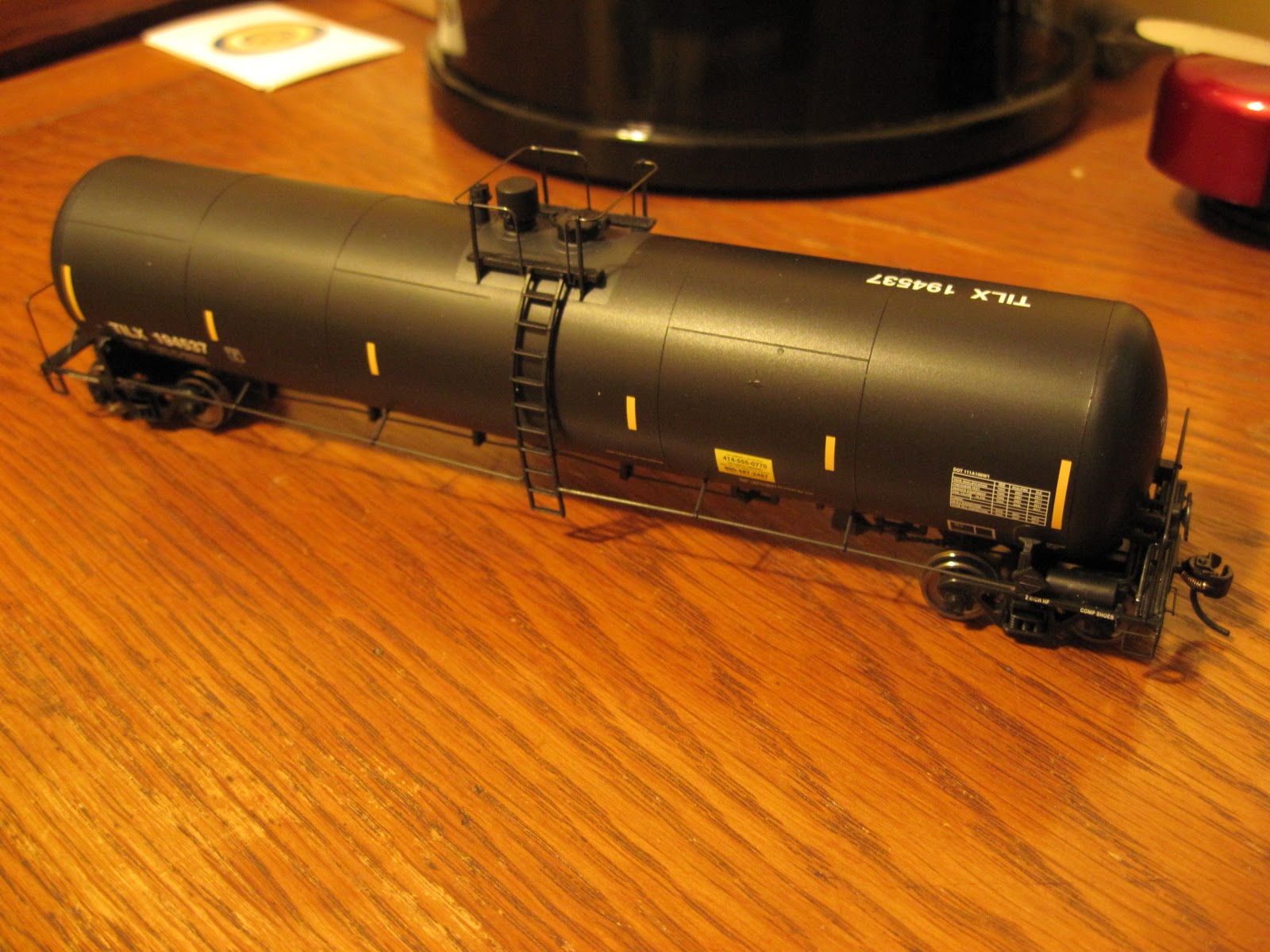
I recently bought my first tank car, a Walthers Platinum Line model of a Trinity 30,145 gallon tank car, commonly marketed as an ethanol car because that is one of the most common products these cars carry. However, they are not strictly for ethanol use, and can be seen all over the country carrying all sorts of different chemicals. I don't really know enough about tank cars and what they carry to say much more than that, so instead I'll review the car. The road number that I bought is no longer available, but the model hasn't changed since then.
Appearance:
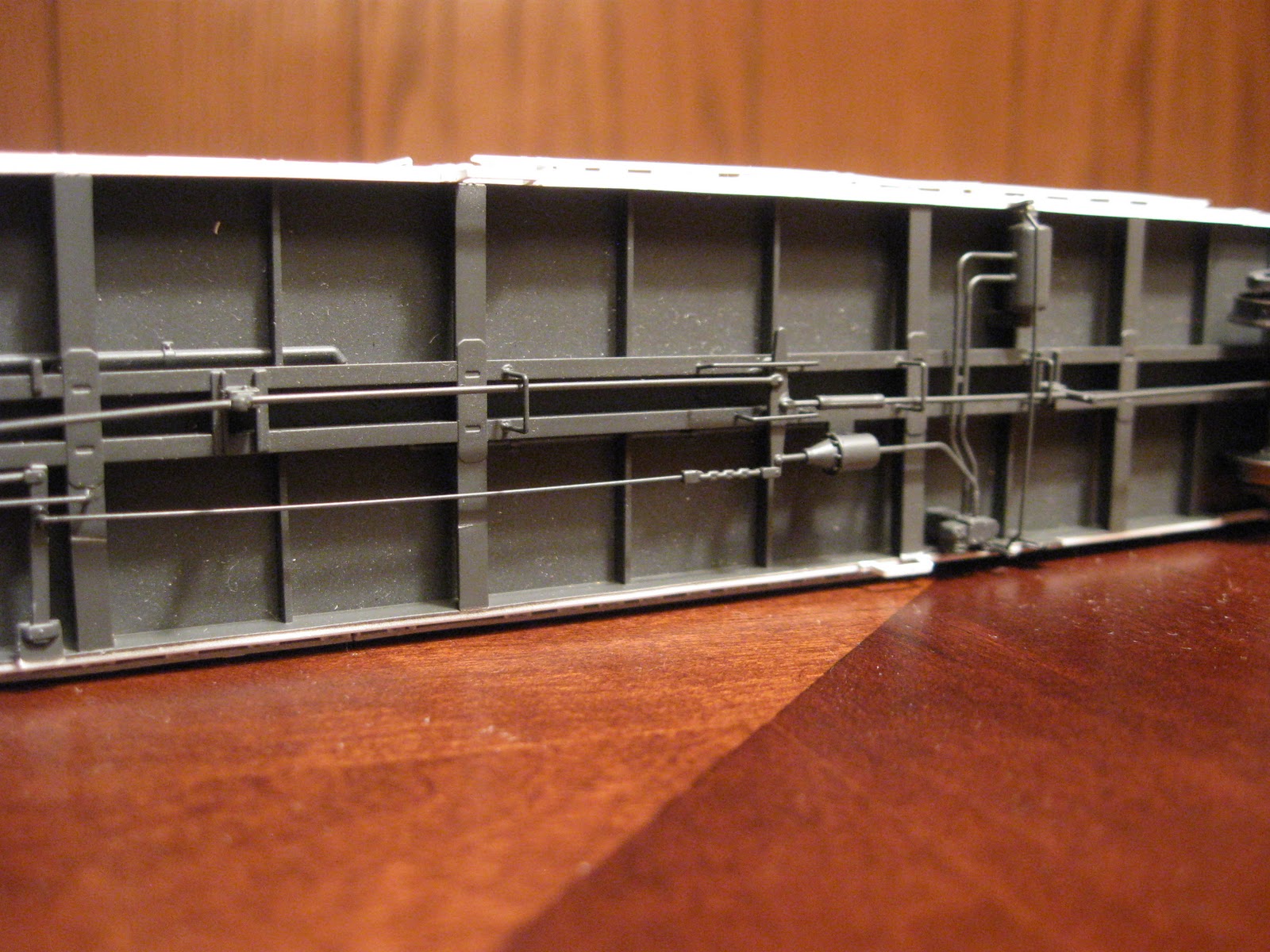
The car features an accurate paint scheme with clean paint and crisp lines. All the tiny lettering can be read. The model includes the reporting mark and number on the top of the car at the B end, just like the real thing. The walkways appear to be etched metal and are see-through. The bolt details on the roof hatch and the weld lines on the car body are present. The brake rigging and other underbody details are all present. The car has yellow conspicuity markings.
Operation:
The car comes with Proto-Max knuckle couplers and metal wheels. The car weighs in at 4.41 ounces, a bit shy of the NMRA recommended 4.875 ounces. I'm not sure how you could add weight to a tank car, but if you are running a unit train of these cars and they are all the same weight, then it shouldn't be a problem.
There is one letdown with this car. All tank cars have placards that tell you what chemical is inside the car. You may have seen these on chemical trucks on the road as well. They are small, diamond shaped, and they have a number and a color. The number corresponds to a certain chemical, and the color refers to how hazardous it is. It also usually has a picture or two describing why the chemical is hazardous. On the model, these placards are there and they are blank. That is good, but the model doesn't come with any decals to put on the placard. Highball Graphics has a decal set with three different placards available, but there are more chemicals than that. I may be blowing this out of proportion a bit, but I just don't like the idea of delivering empty tank cars to the factories on my layout!
Except for the placards, I like this model. I would buy more in the future to build up my tank car fleet. I have several industries in mind that need tank cars, and so far this one car represents my entire tank car fleet.
Manufacturer: Walthers
Price: $39.98
Available Road Names: North American Ethanol (NAEX), Global Ethanol (TILX), Renewable Products Marketing Group (NATX), Abengoa Bioenergy (GATX), Midwest Ethanol Transport (MWTX), Trinity Industries Leasing (TILX), Undecorated
This week we are handling our product review a little differently. Usually we just review one model at a time, but recently two companies have produced models of Trinity's modern 64-foot refrigerator cars. ExactRail has produced multiple runs of these popular models, under their Platinum Series line, and BLMA Models has produced these cars in both HO scale and N scale. I recently purchased one from each company. I have some equipment already from ExactRail, and I have been quite satisfied with their products in the past. I had never purchased anything from BLMA Models before, but I have heard good things about them, so I decided to purchase one of these cars from them as well, and see one of their products in person. I am quite satisfied with both models, but before we jump to that, and other conclusions, we should talk about the models a bit!
ExactRail reefer model. All photos
by James Ogden.
Exterior:
Both models are excellent representation of the modern reefers that can be found on today's railroads. The paint quality is very good. While the cars are basically white, the logos and lettering is all crisp and clear. At first glance, the models appear to be identical. They are extremely similar. Under close inspection, one can notice a few small differences throughout both cars. The ExactRail model tends to have more of the very smallest writing, and the smaller writing on the ExactRail car tends to be slightly clearer than on the BLMA car. Other than that, and a few extremely small variations in the placement of certain warnings, the paint and lettering on the cars is basically identical.
BLMA reefer model.
Both cars feature an impressive amount of separately applied details, including grab bars, brake rigging, railings, hoses, and various other parts. Upon close inspection I was able to find exactly one detail part molded on the ExactRail car which had been applied separately on the BLMA car. Additionally, both cars feature prototypically accurate refrigeration machinery. Both cars have a see through metal walkway for machinery access. The ExactRail walkway has slightly smaller holes than the one on the BLMA car. While both walkways look excellent, I would say it is the most noticeable difference between the two cars. Additionally, the ExactRail car also features safety chains on either side of the walkway. The refrigeration units are slightly different on the two cars. This is not unusual to the prototype though, as there were several phases of these reefers, and through different construction contracts, it is quite possible that otherwise identical cars could end up with very slightly different refrigeration units. The BLMA model did some minute writing and warnings on the "A" end, with the refrigeration unit, that were not present on the ExactRail model. On the "B" end of the cars, the only difference was in the hand brake chains. For the extremely detail oriented modelers, the BLMA model had a more accurate hand brake chain.
The "B" ends, side by side. The BLMA model is on the left.
Both cars featured a well detailed under body, complete with brake gear and rigging. These parts were separately applied on both cars. On the BLMA model, the entire under body was modeled in a flat black, while on the ExactRail car, the under body was a very dark grey. Both cars come with Kadee couplers, and feature air hoses mounted beside the couplers. The BLMA model had plain black air hoses, while the ExactRail model had painted and molded glad hands on the end of the air hoses. The trucks were very accurately modeled, even featuring the car initials and number stamped on them. On both models, they did even match the actual car initials and number. On both models, the end caps on the roller bearings was modeled in blue. While this is accurate for a new bearing cap, it is unlikely that many blue ones would be found on the prototypes because as the cars run, they get dirty. It looks good on the model, but it may not be the most realistic feature. If any weathering is done to the cars, the end caps will likely be covered by that anyway. The only difference between the trucks was only noticeable from the bottom. The ExactRail trucks feature brake shoes and brake beams inside the trucks, which is not modeled on the BLMA car. This is a detail that is not even very noticeable on the one to one scale, especially as a train passes by!
The "A" ends, with the BLMA model on the left.
Operation:
These cars operate well out of the box. While the couplers are not mounted in a box that can swing, both manufacturers used couplers with a long enough shank to make these cars able to navigate a curve as tight as an 18 inch radius. Both cars rolled smoothly, easily, and quietly. I did find that the BLMA car rolled slightly better, although it was only noticeable when I was trying to take pictures. The surface I was using to photograph the cars was a few tenths of a degree off level, and that was enough to send the BLMA car rolling. While the ExactRail car also rolled with ease, it was able to stand still on its own on the same surface.
Door area detail on the BLMA model.
Overall I am very impressed with both cars. They will look great operating together, and it would take a careful look to find the differences in them. I will have no problems running them right next to each other on the same train. Because the cars are such accurate models, they are very similar, and thus choosing which one is better really is a matter of opinion. Personally, I like the ExactRail car better, and the only reason is purely a matter of preference. I like that it has slightly smaller holes in the walkway deck and safety chains. I am very pleased with both cars though and would not hesitate to buy more of them from either manufacturer. Both companies managed to exceed my expectations with these cars. I think they are an excellent value, especially considering the level of detail offered.
Under body details on the ExactRail model.
*Note: Typically Steven and I only write reviews on cars that are currently available from the manufacturer, however we made an exception with this review because the ExactRail cars are still available at many local hobby shops and online retailers nationwide. They are extremely popular and sold out at ExactRail completely within just a couple of weeks, however it is rumored that there may be yet another production run. The BLMA car shown in the photos is no longer in production, however BLMA has announced another run of these popular models with a CEFX reporting mark. They will be nearly identical to the model shown in the photos. If you are interested in either of these cars, contact your local hobby shop.
Manufacturer: BLMA Models
Retail Price: $32.95 each, available individually or in packages of 6, 12, or 24.
Product Numbers: 52901-52924
*Note: These cars are currently not in production. Pre-orders are due Dec. 31, 2011, and cars will ship in the spring of 2012.
Manufacturer: ExactRail
Retail Price: $32.95 each
Product Numbers: EP-81050-25 to EP=81050-42
*Note: These cars sold out at ExactRail very recently and are still available through local hobby shops and online retailers. Contact your hobby shop for availability information, and let ExactRail know if you would like to see another run of these cars.