Showing posts with label Walthers. Show all posts

Wednesday, December 2, 2015

Product Review: Walther Metroliners

Several months ago, Walthers released their Metroliner models. Even though I have little desire to eventually model the Northeast Corridor, this was an intriguing model to me. I was curious to see how it had turned out. I was curious to see how well they had hidden the motor, and how well the models ran. I was also curious to hear the sound. Electric model sound is somewhat of a rarity in the hobby, as most modelers choose subjects that use either steam or diesel locomotives. While I have heard plenty of electric locomotives in the "real world," I was curious about how one might sound in the layout room. Despite all of this curiosity, I initially chose not to buy any Metroliners, on account of the price and my disinterest in actually modeling a railroad where they operated.

All photos by James Ogden.
Several weeks ago, I got an email from Walthers, indicating that the Metroliners were on sale. The catch was that you had to buy four of them, but in packages of four, they were going for about half price. Despite not wanting to model a railroad on which they operated, I could not resist. I took the plunge and bought a four-pack of Amtrak Phase 2 Metroliners. Four-packs of different paint schemes came with different combinations of cars. I chose Amtrak Phase 2 primarily because I liked the consist it offered. In that particular package there were two coaches, a parlor, and a snack bar coach. I ordered the set, and approximately one week later they arrived at the door.

Upon arrival, I opened the box and did a quick inspection of the cars through their individual boxes. I was headed to the Northern Lights Model Train Club that evening anyway, so I decided to do the bulk of the inspection and operating there. The club has much more space to run on!

I ordered a set of cars that were all equipped with DCC and sound from the factory. These are equipped with Tsunami decoders, from SoundTraxx, which are specifically designed for this model. Like most decoder equipped models, the cars were all programmed to respond to address 3 initially. The cab ends of all cars, regardless of specific type, are programmed as the front. As such, if you intend to run several cars together, they will need at least some minor programming to respond in unison when facing in opposite directions. Since I had four cars, I chose to run them with two facing forward and two facing back. To facilitate this, I set up a consist, and programmed two of them to run in reverse within the consist. This was the extent of the programming I did. After that, I placed them on the layout, in the staging yard, and ran them out to the main layout.

Right off the bat, I was impressed with how smoothly the cars operated together. I had done nothing to attempt to speed match them, but they were pretty well matched right out of the box. One would think this is normal--they each have the same decoders and electronics--but it is not always the case. I noticed some minor surging between cars at very low speeds. Once the speed was above a crawl however, the cars ran very smoothly together.

The prototype Metroliners had a headlight on each end, and markers on the A end. Because the headlight function on most DCC decoders allows for two outputs, instead of three, Walthers chose not to light the "B" end headlight. Instead, they chose to light the "A" end, or cab end, marker lights. When the car is operated forward, that is with the cab leading, the cab end headlights come on. When the car is operated in reverse, the marker lights on the cab end light up.

In addition to headlights and markers, the cars also have lighted number boards, lighted interiors, and a Mars light, activated by functions  one, five, and six. There are also typical sound functions, such as the horn, coupler noise, brake squeal, cooling fans, and air compressor. Note that the prototype had no bell, and so the model has no bell sound. As one would expect from a SoundTraxx product, the sound quality was excellent. The cars were a little loud for my taste, but the sounds were clear and responsive to throttle inputs. The sound volume can easily be adjusted to the desired levels.

The cars were nicely detailed from the factory. The underbody matched photographs I looked at, and the model came equipped with finer details, such as grab irons and rooftop electrical details. The only disappointment I had in the details were the pantographs. There are a couple of different types of pantographs featured on the cars, but I was disappointed that they were plastic. They were clearly not designed to collect current from an overhead catenary, and that is just fine. In HO scale, that is not usually reliable or practical anyway. But, during the models' life on a layout, chances are the pantographs would be handled a bit. They are fairly fine details, and I think they would hold up better if they were metal, instead of plastic. Other than that though, I felt as if the model was nicely detailed. While it looked out of place on the club layout, which is set in fiction but represents Alaska, they are nice looking models.

Overall, I think this is a fine model. For those who model the Northeast Corridor, particularly in the 1970's and 1980's, these would be a great addition to the fleet. They fill a noticeable void, and are a major improvement to the Metroliners offered by Bachmann many years ago. However, being as these only operated under catenary in the northeast, these models fill a very specific place. I think most modelers, like myself, will find that these probably do not fit well on their layouts. They are lovely models, but if you do not model the area they ran, they will always look a bit out of place. To be honest, I was surprised that Walthers would pursue such a model. Surely other Amtrak models would have been applicable to more modelers.

Manufacturer: Walthers Proto
Paint Schemes: Penn Central, Amtrak Phase 1, Phase 2 (Phase 1 cars come numbered, others come with number decals.)
Cars: Snack Bar Coach, Parlor Car, Coach
MSRP: $169.98 with DC, $259.98 with sound and DCC

To view more photos, please visit out Facebook page.


Thursday, January 24, 2013

Creating a Union Pacific Museum Car

Over the last two evenings, I have been working on a small project with my Union Pacific heritage fleet.  Recently, the Union Pacific put a large American Flag wrap on one of their baggage cars, and turned it into a Museum Car, which can frequently be found on their business and excursion trains.  I found some photos of the car, Union Pacific 5779, "Promontory," and decided that I wanted something similar in my fleet.  Actually, the reason I went looking for the photos was because I had found decals on eBay, for what the seller called the "UP Flag Car," and I was curious to see what they were talking about.  RR Picture Archives has several photos of the prototype, both before and after the flag artwork was added.  After looking at several of the prototype photos, I decided that I could make such a car, so I bought the decals.  I am not sure who makes the decals, as they came in a blank envelope and there was nothing written or printed on the decal sheet, other than the decals themselves.

When the decals arrived, I had one baggage car which I could have used for the decals, however I had already decided that that particular baggage car was destined to become an Alaska Railroad car.  So, I began searching eBay for the correct, 85-foot, six axle baggage car, on which I could use the flag decals.  Surprisingly, even after several weeks, nothing had surfaced on eBay.  A week ago, I was in Billings, and decided to stop at Jim's Junction, the local hobby shop, and take a look around, and much to my surprise, he had exactly the baggage car I was looking for.  I bought the only one that was on the shelf.  It was a Chicago and Northwestern baggage car, but it had been painted up in the Union Pacific colors for use on their "City" trains.  This was a fairly common practice, for UP and CNW to share equipment on those trains.  It really did not matter what the lettering was anyway, because it would all have to be removed, regardless of what it said.  While I was in the hobby shop, I got talking to another modeler in there, who suggested removing the lettering using a pink eraser.  I had heard that before, and decided to give it a try.

When I got the car home, I went out and bought an eraser, making sure I got one that was soft, and had no grains or grit, which might scratch up the paint.  I began erasing the "Chicago" on one side of the car, but I was disappointed because after several minutes, there were no noticeable results.  There was some black residue on the end of the eraser I had been using, but as far as I could tell, it had done nothing to the lettering on the car.  I decided to clean the eraser off and try again.  At that point, I started to notice the letters fading, so I kept going.  It was a fairly tedious process, to get the "Chicago and Northwestern," "Railway Express Agency," and the little REA star off both sides of the car, but after a while, it was all done.  I had the blank yellow car I needed.  I did notice that pushing harder on the eraser did not necessarily yield better or faster results.  Actually, it tended to start to remove the  yellow paint too, so a gentle grip on the eraser, and a bit of patience, seems to be the best way to go.  I did notice that the the eraser made the paint a little shinier than in areas where I had not removed the lettering.  This was minor and only visible under close inspection in just the right lighting conditions.  I did not worry about it too much, because I figured the dullcoat would help to hide it in the end.

Once I was satisfied that I had successfully gotten all the lettering off, and there were no more stray marks from the lettering, I began cutting out the decals.  The decals came on one large decal sheet, so whatever I cut out would be the size of the decal I would apply to the car.  I carefully cut the decals out very close to the edge of the printed area, so that there would be very little extra clear decal material around the actual flag image.  Once the flag was cut out, I used it to determine which grab bars would need to be removed before I could apply the decal.  I then removed the roof of the car, removed the windows, and removed the grab bars.  I stored the eight grab bars and the windows in a small plastic zip-lock bag, so nothing would get lost or dropped.  The next step was to apply the decal.

The flag decal was the largest of the decals I had to apply, which lead me to believe it would be the most difficult.  I decided to start with it, because the number and other lettering would be a lot easier in comparison.  I started by using a paintbrush to apply some Micro-Sol to the surface of the car.  The car has a smooth side, so I knew only a little would be needed, in most areas.  Where there were changes in the surface of the car, such as around the baggage doors and around the grab bar holes, I applied the Micro-Sol a bit more liberally.  Micro-Sol helps decals to conform to the surface of a model, particularly when the surface is uneven or irregular.  It also helps to prevent tears from forming in the decal over uneven and irregular surfaces.

Getting the large decal on and aligned properly was a bit tricky.  Actually, it was a full test of patience, honestly!  Because the decal is so large, the entire thing must be moved at once when adjustments are needed, to prevent tears or bubbles from forming.  Moving and adjusting a decal that is nearly as long as the car is quite tricky, especially over the changes in height where the doors are.  I had thought about cutting the decal at the doors, but decided against it, because the cuts would have to be very precise to make the car look right, and then the alignment of the sections would have to be exact.  That seemed like more trouble than it was worth!  I used a paintbrush and liberal amounts of Micro-Sol around the doors to make sure that the decal formed to the surface of the door openings without bubbling.  After what seemed like hours of adjusting the decal, but was probably only several minutes, I was finally satisfied with it and I set it aside to dry.  I then went to cut out the other lettering, logo, and number for the car.  At this point, the decal had been applied over the window openings, which I knew I would need to cut out later.

Once I was satisfied that the flag decal was dry, I applied the number.  On one side of the car, the number decal went on top of the flag decal.  The logo and lettering went on the side of the car, beyond the end of the flag.  I then cut out two small holes in the flag decal, which I think are vents on the prototype, and the windows.  I also reapplied the grab bars.  I set the car aside again, so the number and letter decals could dry.  I decided to dullcoat that side of the car as soon as the decals were dry, so that I would not damage the decals while working on the other side.

The next evening, I did the opposite side of the car.  The other side of the car went nearly the same as the first, except that the flag decal is reversed.  Having done it once, I was a bit more confident the second time around, and perhaps slightly more careful.  It seemed to go a bit faster though.  Once I was satisfied with that side, and the decals had dried, I put some dullcoat on there, to seal the decals in place, and set the car aside again.

This morning, I checked the decals and the dullcoat.  I ended up doing a second very light application of the dullcoat because I wanted to hide the edges of the logo decals a little better.  Once that was dry, I replaced the windows and reassembled the car.  Now I have a museum car to for my Union Pacific Northern steam locomotive (#844) to pull around the layout with my other Union Pacific passenger cars.

Materials:
Walthers "City" Series Baggage 932-9574
Block Eraser
Flag Decal (available on eBay)
Micro-Sol

Monday, March 19, 2012

Product Review: Walthers Pullman-Standard 64-Seat Coach

Back in 2006, Walthers came out with a model of a Long Island Railroad 28-1 heavyweight parlor car, and I wanted one. However, I didn't buy one, saying I would wait until they came out with another run. It's been 6 years, and they haven't done that yet. First they went out of stock on the Walthers website, then they disappeared from ebay and discount train websites, and the pile of them at the train store I go to on Long Island slowly got smaller and smaller until they disappeared there too. It's been a few years since I've seen one now, and at this point I'll buy the first one I come across. When Walthers announced a model of Long Island Pullman-Standard coaches, I knew I would have a very small amount of time to get my hands on one. I never pre-ordered one, and as soon as they were delivered they went out of stock. However, I was on Long Island recently, and the train store there had three of them, and I am now the proud owner of one, which sits proudly in my display case.

This model may be out of stock, but I am going to review it anyway. Other paint schemes are still in stock, and they are identical models except for the paint scheme applied to them. I'm not breaking our rule against reviewing out of production models, I'm only bending it.


This model is a great example of all the newest and best features of Walthers passenger cars. In past years, their passenger cars were great, but recently, the quality has gotten better. This car has all the staples of a typical Walthers car, with an accurate paint scheme, a full set of number decals, working diaphragms, a fully detailed interior, Proto-MAX knuckle couplers, and free rolling trucks. However, this car also features a chrome-plated exterior to give it a metallic shine, and all the wire grab irons come factory applied and painted where applicable, saving the modeler the trouble of installing and losing them himself.


The car weighs in at 6.35 ounces, a little short of the NMRA recommended 7 ounces for this car. However, if it is run with identical passenger cars, the weight should not be a problem as long as all the cars are the same weight. The trucks are free rolling, but a little graphite on the end of the axles goes a long way with all Walthers passenger cars. The interior is correct for cars of other paint schemes; however, the Long Island rebuilt these cars to carry 144 passengers, so the interior is not correct for this particular paint scheme. The car features full underbody details, and because of this Walthers recommends not running the car on any curves tighter than 24" radius.


Overall, I like this car. It is a great model of a Long Island passenger car, and I am glad I added it to my collection. I wish I had the money to buy all three they had in the store, but it is an expensive car, and where I don't model the Long Island Railroad, it really is not worth having more than one. If I did model the Long Island, I would most likely not model the era this car ran in. However, it still looks great in the display case, and I can use it as a private car on the end of an Amtrak train.

Manufacturer: Walthers
Price: $69.98
Available Road Names: Louisville & Nashville, New York Central, Northern Pacific


Monday, January 9, 2012

Product Review: Walthers Ethanol Car

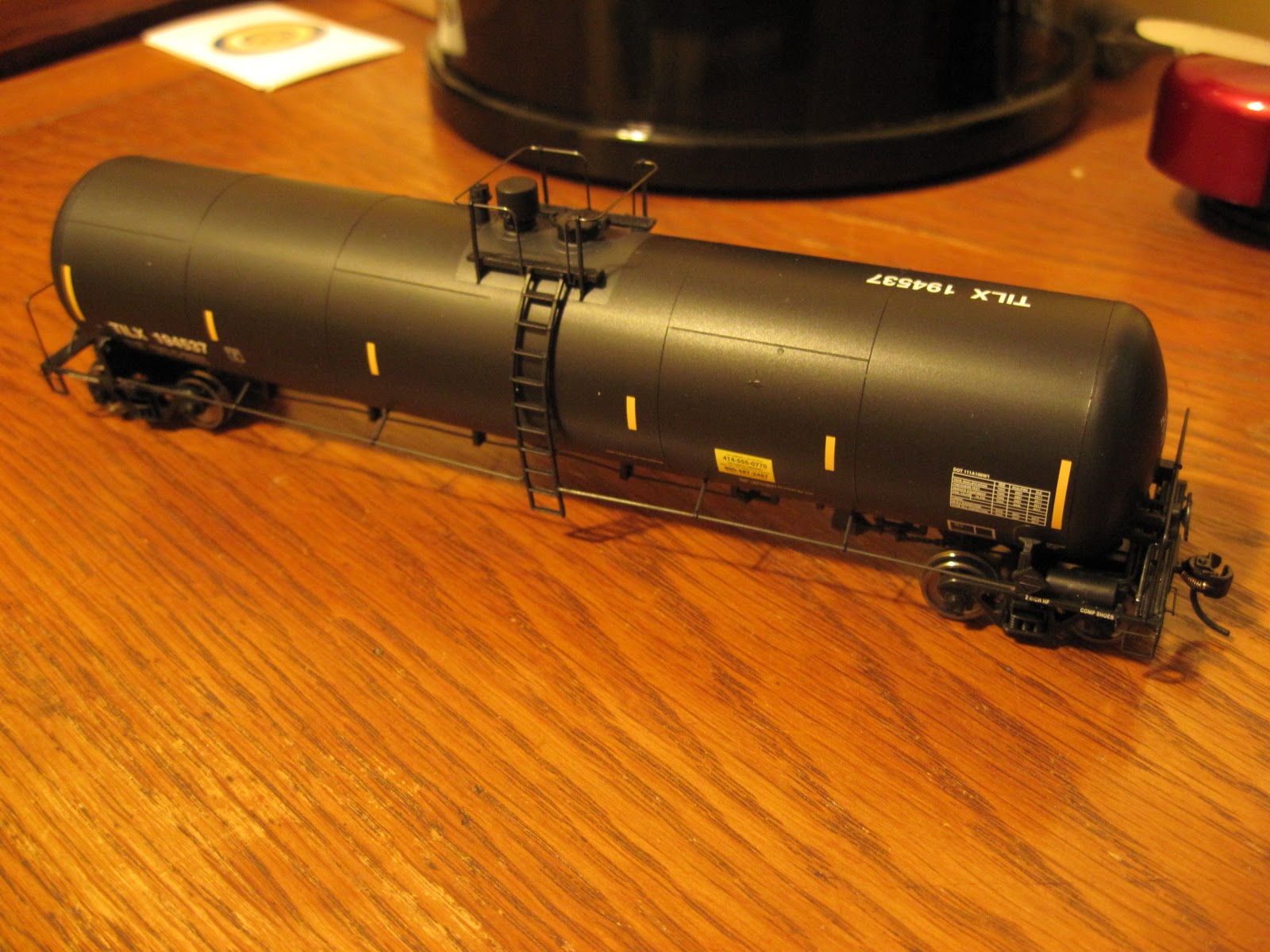
I recently bought my first tank car, a Walthers Platinum Line model of a Trinity 30,145 gallon tank car, commonly marketed as an ethanol car because that is one of the most common products these cars carry.  However, they are not strictly for ethanol use, and can be seen all over the country carrying all sorts of different chemicals.  I don't really know enough about tank cars and what they carry to say much more than that, so instead I'll review the car.  The road number that I bought is no longer available, but the model hasn't changed since then.

Appearance:
The car features an accurate paint scheme with clean paint and crisp lines.  All the tiny lettering can be read.  The model includes the reporting mark and number on the top of the car at the B end, just like the real thing.  The walkways appear to be etched metal and are see-through.  The bolt details on the roof hatch and the weld lines on the car body are present.  The brake rigging and other underbody details are all present.  The car has yellow conspicuity markings.


Operation:
The car comes with Proto-Max knuckle couplers and metal wheels.  The car weighs in at 4.41 ounces, a bit shy of the NMRA recommended 4.875 ounces.  I'm not sure how you could add weight to a tank car, but if you are running a unit train of these cars and they are all the same weight, then it shouldn't be a problem.

There is one letdown with this car.  All tank cars have placards that tell you what chemical is inside the car.  You may have seen these on chemical trucks on the road as well.  They are small, diamond shaped, and they have a number and a color.  The number corresponds to a certain chemical, and the color refers to how hazardous it is.  It also usually has a picture or two describing why the chemical is hazardous.  On the model, these placards are there and they are blank.  That is good, but the model doesn't come with any decals to put on the placard.  Highball Graphics has a decal set with three different placards available, but there are more chemicals than that.  I may be blowing this out of proportion a bit, but I just don't like the idea of delivering empty tank cars to the factories on my layout!

Except for the placards, I like this model.  I would buy more in the future to build up my tank car fleet.  I have several industries in mind that need tank cars, and so far this one car represents my entire tank car fleet.

Manufacturer: Walthers
Price: $39.98
Available Road Names: North American Ethanol (NAEX), Global Ethanol (TILX), Renewable Products Marketing Group (NATX), Abengoa Bioenergy (GATX), Midwest Ethanol Transport (MWTX), Trinity Industries Leasing (TILX), Undecorated

Monday, November 14, 2011

Product Review: Walthers 2 Bedroom Buffet/Lounge

I recently purchased an HO scale model of a Buffet Lounge car once found on the Pennsylvania Railroad's Broadway Limited, made by Walthers.  For the last several years, Walthers has made models specific to one historically significant passenger train, and this year, they have created models of the cars for the Broadway Limited.  The Broadway Limited once operated daily between Union Station, in Chicago, and Pennsylvania Station, in New York.  It was a luxury train, with all first class accommodations, and a fast schedule with only limited stops.  The train was a direct competitor to the 20th Century Limited, of the New York Central System, and was one of dozens of trains connecting New York and Chicago.  Being a first class train, there were no coaches found in the consist.  The train had several different types of sleeping accommodations, as well as dining and lounge cars for passengers to eat, drink, and socialize as they rushed towards their destination.  The model I purchased represents a car built by Pullman Standard, specifically for the Pennsylvania Railroad to use on their Broadway Limited, which is a combination of two bedrooms, a lounge area, and a small buffet, where drinks and light snacks would be served to passengers in the lounge.

Exterior:
This car is painted in the tuscan red, used on many of the passenger cars, freight cars, and locomotives of the Pennsylvania's fleet.  It features gold pinstripes, and gold lettering.  The paint on the model is clear and crisp, with sharp lines, and no bleed over between colors.  All the lettering is crisp and clear, and the model generally represents the typical high quality of Walthers products.  A feature which is relatively new on Walthers passenger cars is painted window sashes.  On this model, as well as other cars in the Broadway Limited set, the window sashes have been painted a metallic silver color, for the metal sashes, or black, for the rubber sashes, depending on what type of window would have been found on the prototype.  While it is a small, relatively minor detail, it actually does quite a lot for the model, and makes it look a little sharper.

The car features proper under body details, all of which are separately applied.  The under body equipment is all painted black.  The car includes metal wheels, and metal truck side frames, which are designed to pick up electricity from the tracks.  A lighting kit can be purchased separately and added to the car for a lighted interior.  The car also features working diaphragms, and Proto MAX magnetic knuckle couplers.  Additionally, all the grab bars on the car come factory applied and painted.  The car comes with a decal sheet, so the modeler can choose the name and road number to be applied.  Instructions packaged with the car include a diagram for placing the number and name decals.

Interior:
As with all Walthers passenger cars, this car features an interior.  The interior is molded in a plain, beige plastic.  While most of the windows are small, the interior can be seen through the window.  The modeler could paint the interior if the beige was particularly problematic, although I have not found it to be distracting from the overall quality of the model.  The interior is accessed by removing the roof panel, which snaps into place.  While the model comes unlighted, all the electrical contacts are in place to add a lighting kit, also manufactured by Walthers.  Adding some people to the lounge area, inside the car, would also add to the overall appearance, especially if the model is in a place where it can be easily viewed.

Operation:
The car operates well right out of the box, although it does take a bit of effort to pull the thing.  This is pretty typical of Walthers passenger cars.  I have found that applying a very small amount of graphite to the ends of the axles helps the car roll more freely, without completely insulating the wheels from the interior electrical contacts.  The car is long, the prototype being 85 feet, and so it is limited in its turning ability.  I was able to pull the car around a curve as tight as a 21 inch radius, although the car looked rather silly on such a tight turn.  Walthers recommends a minimum radius of 24 inches, which would work better operationally, even if it still looks a little tight.  Overall the car comes ready to operate.

I am happy that I bought this model.  I had been thinking about it for quite some time, as the Broadway Limited was a very famous train at one time, and is quite significant historically.  Additionally, I have a small family connection to the train.  My great grandfather, who I did meet, though do not remember, was a regular passenger on the Broadway Limited.  He lived near New York, and work took him to both Washington and Chicago on many occasions.  His preferred way of getting to either place was the Pennsylvania Railroad, and he took the Broadway Limited to Chicago, and back many times, riding behind steam locomotives, and later diesels.  I imagine that on some of his trips, he sat in the very lounge this car represents, socializing with some of the other passengers, over some evening cocktails.

Manufacturer: Walthers
Retail Price: $69.98
Available Paint Schemes (Model Numbers): Pennsylvania (932-9680), Undecorated (932-9618)

Monday, October 24, 2011

Product Review: Walthers NSC 3-Unit Well Car

Today I am reviewing an intermodal car from Walthers, the NSC 3-unit well car. This is by no means a new product, I have had mine for about 2 years now, but given the demand for intermodal models, I thought it would be appropriate. As a general rule, James and I never review a model that is out of production, and these are still being made. I don't think the road numbers I have are still available, but the car type is.

The real cars are quite new, and are able to carry 53' containers on the bottom of the well. 53' containers are currently the maximum length allowed on the US roads, so these are some of the longest intermodal platforms on the tracks. Unlike most intermodal cars, which have two platforms sharing a single truck, these cars have two trucks per platform with each platform connected by a drawbar. When I was roaming the rails this past July, I noticed these cars on virtually every stack train I saw.


These models are part of Walthers Gold Line series and come packed with all the regular features. As per the prototype, the three platforms are connected by drawbars rather than sharing a truck. The paint job is correct, and all the lettering is visible and legible. The cars include white visibility striping on the top sill, just like the prototype. There is a brake wheel on each end, and each platform is labeled "A", "C", and "B" like on the real thing. There are virtually no grab irons on the car, so they are all factory applied.


The cars come equipped with Proto-Max knuckle couplers, which I replaced with Kadee #58s when I bought the cars, although now I would put Sergent Engineering couplers on the cars. The drawbars go into identical pockets as the couplers, so make sure you have the platforms in the correct order. I do not like this setup, because you have to unscrew the coupler pockets to take the car off the track and put it back in the box. If you have a big enough layout that you leave your rolling stock on the layout all the time, this shouldn't be a problem. The cars are die cast and have no problems staying on the track when they are empty. Despite the die cast body, the empty car weighs in at a mere 4.23 ounces per platform, far below the NMRA recommended 6.125 ounces. I did not weigh the car with containers, but that would make it heavier.

If you are modeling modern day intermodal trains, this excellent model from Walthers will fit right into your fleet. It will look good hauling containers across your layout, and will do so reliably. I have two models of this car, and I am glad I spent the money on them.

Manufacturer: Walthers
Price: $54.98
Available road names: TTX Company

Monday, August 29, 2011

Product Review: Walthers Excursion Skytop Lounge

I recently purchased an HO scale Skytop Lounge, made by Walthers, and I thought I would talk about that today.  This model has been available for some time, and represents a unique and famous lounge observation car which was once operated by the Milwaukee Road, on their Hiawatha trains.  Several of these classic passenger cars still exist today, in various states of repair, but one, the Cedar Rapids is in operating condition and can periodically be found on the rear end of Amtrak passenger trains.

Over the years, the Milwaukee Road had a few different paint schemes for these cars.  Their first paint scheme was the Milwaukee's famous orange and red paint scheme.  Several years later, when the railroad was struggling financially, they found it was cheaper to paint their cars in Union Pacific's famous yellow.  Eventually the entire fleet, including the Skytop Lounge cars, were all repainted yellow.  This was the last paint scheme the Milwaukee had for them.  Several years after that, Amtrak took over passenger operations nationwide and the Skytop lounges were retired.  Some were sold to private ownership and some were scrapped.  The model I purchased represents one currently in service, in which it received another paint scheme, which was a variation of the original orange and red scheme used by the Milwaukee Road.  The prototype of this car sits at the St. Paul, MN, Amtrak station when it is not being used.

Exterior:
This model has the typical features of Walthers passenger cars.  The paint scheme is accurate and the lines are crisp.  It even features the small numbering to identify it as an Amtrak certified private rail car.  The model also features prototypical accurate trucks and a working diaphragm.  The model comes with Proto MAX couplers, which Walthers uses on a lot of their models.  Also included with the model are all the grab bars for the model.  They are installed by the user, and come in a little plastic bag behind the model.  I prefer to replace the couplers, although at the writing of this I have not had a chance to do so yet.  Eventually this car will get AAR type H couplers, by Sergent Engineering.

The trucks feature prototypical metal side frames which allow the car to pick up electricity, which is then routed to the interior for lighting.  Also, in the lighting department, there is a clear lens where the marker light should sit.  Disassembling the car reveals a small space where a red light could be placed to serve as a marker.  The electricity comes through two metal plates under the floor, running the length of the car, and a marker light could potentially be connected to those.  (If you are interested in this project, check out www.miniatronics.com for some lighting solutions.)  The under body of the car features typical equipment found under passenger cars for electrical systems, climate control, and braking.  Having never carefully examined the prototype, I cannot say if they are an exact match, although they certainly are convincing enough.

Interior:
Walthers passenger cars typically features a complete interior, and this car is not an exception.  The interior is accurate in the placement of seating and other features, although, as usual, Walthers uses a plain beige plastic molded parts.  The level of detail is satisfactory, although taking the time to paint the interior would significantly improve the appearance.  It is easy to see inside this car, because, as a lounge car, it features some large windows, especially at the rear.  An accurate interior color scheme would really do a lot for the car.  The interior does even features the details in the bathrooms.

As previously mentioned, the trucks are designed to pick up electricity from the rails.  That is then routed to the interior of the car.  On the door end of the car, there are two metal posts hidden in one bulkhead.  Walthers manufactures interior lighting kits that fit on the metal posts, and then light the car up.  The lighting kit has to be purchased separately.  Installing a lighting kit is a simple matter of removing the roof, and dropping the lighting kit right in.  While the roof is off, you might consider adding people too.

Operation:
The car operates well right out of the box.  It is a good idea to periodically lubricate the axle ends.  Made sure to use a conductive lube so that any interior lighting will still operate.  Walthers recommends operating this car on a minimum of 24 inch radius curves, although I have found it operates well enough on curves as small as 21 inches.  Because of its length, the car looks pretty goofy going around a curve with a radius even as small as 24 inches.

Suggested Uses:
If you model Amtrak later than the mid 1990's, this car would make a great private car to add to your Amtrak trains.  Additionally, it can be used with a full length dome car, also produced by Walthers, in a matching paint scheme.  Both of these cars can often be seen operating on excursions and at the rear of Amtrak trains on special trips.

Overall, I am satisfied with this car.  It is a classic railroad car and represents a piece of history preserved for us to enjoy today.  It is a very unique car, and it is nice that someone produces a model of this car.

Manufacturer: Walthers
Retail Price: $69.98, Excursion scheme $74.98*
Available Paint Schemes (Model Numbers): Milwaukee Orange (932-9206), Milwaukee Yellow (932-9261), Excursion (932-9263), Undecorated (932-9260, 932-9262)
Scale: HO

Monday, August 15, 2011

Product Review: Walthers Trinity RD-4 Coal Hopper

I was going to write this review last week because the coal hoppers I ordered were supposed to be in by then, but they hadn't come in, so I wrote about my plans for them. So of course, right after I hit "Publish", the package came. I ran upstairs, got the package, opened it up, looked over my new toys, and set them up on the layout. I bought four 6-packs, so I have 24 cars. 12 of them are TILX and 12 of them are NCUX.

The prototype for these cars were built in the 1990s to haul coal. They are hoppers, so they have hopper gates on the bottom, but they are also equipped with rotary couplers because rotary dumps have become increasingly popular at power plants, making these cars very versatile. Sized at plate F, these cars are huge. They are seen all over the country, especially in the famed Powder River Basin in Wyoming, an enormous coal producing area of the country.

These cars are part of Walthers Gold Line series, and so they come packed with all the goodies you'd expect. The aluminum paint on them shines like real aluminum. All the rivet details and warning signs and car info is all there. The detail parts are separately applied, including the etched-metal walkways on the ends of the cars. The car features a fully detailed underbody and interior. Walthers makes coal loads designed to fit these cars so you can model a loaded or an empty train.

These cars feature Proto-Max metal knuckle couplers. While they work well, they are huge, and I think they should be replaced with Kadee #58s or Sergent Engineering type F couplers. The cars also feature metal wheels mounted in plastic trucks. The wheels do not roll as well as they could, so if you want to model a unit train, it would be wise to lubricate all the wheelsets. The cars weigh in at 4.25 ounces, which is exactly what NMRA practice 20.1 says they should weigh. I don't know how much the Walthers coal load would affect the weight, but I suspect it would be minimal.

However, these cars do have one minor drawback. They are not packed well, and some parts fell off the cars I bought. Some cars were missing wheelsets, and most were missing some of the interior bracing. I was able to find all the wheelsets and all but one of the bracing pieces. I need to email Walthers about that, but in the past they have been good about supplying spare parts. Some of the bracing worked its way out of where they belong, but not out of the car, so they were bent. However, they are made of a soft, flexible plastic and were easy to put back in place. They were still slightly bent at first, but after a few days they straightened out. None of the cars were permanently damaged, they just required a little bit of work at first.

Overall, I think these cars were a great buy. I personally think Walthers asks too much for them, but it is not hard to find them for a lower price. They have been in production for a few years now and have been a very popular model so they are not hard to find anywhere. I think they will look great hauling coal to a power plant on my layout!

Manufacturer: Walthers Gold Line
Price: $119.98 (six-pack)
Available road names: Union Pacific (CMO reporting marks), NCUX, TILX

Monday, May 23, 2011

Product Review: Walthers B60b Baggage-Express Car

Today I am going to review a Walthers car I bought the other day, a B60b baggage-express car. The B60b was a Pennsylvania Railroad (PRR) design, and the fleet was built at the railroad's extensive shop facility in Altoona, PA. Most went to the PRR, although Norfolk & Western bought some and Long Island Railroad (LIRR) also had a small collection. After the big merger, the PRR cars were painted into Penn Central Green, and were retired sometime during that time period. Although they were a unique Pennsylvania design, they were part of the Railway Express Agency (REA) pool and carried express shipments all over North America and could be seen off the PRR system. They were classified as "Messenger" and "Non-Messenger" versions; if a person had to accompany a certain shipment, a Messenger type car was used, and it had a small seating area and bathroom for the person to ride in. Messenger type cars could be identified by a gold star above the car number.

Cosmetics:
My model is a non-messenger version in Long Island Railroad colors, specifically MTA's "Dashing Dan" paint scheme. The car comes without a number, but includes a decal sheet with car numbers available. Ten numbers are available for LIRR, numbers 7715-7724. I numbered my car 7723. The decal film slid off the paper very easily, and fell right into place with minimal adjustment required. All the lettering, including the decals, is crisp and clean. The Dashing Dan logos can be read under magnification. The paint scheme is a simple dark gray, and it matches the dark gray on the real car. According to the drawings, the messenger version cars come equipped with a full interior, but being a baggage car I see no point to this, although it is a nice touch. The rivet details show up very nicely. The undercarriage is mostly complete, all the major components are in place but things like brake piping and other small details are missing.

The doors and undercarriage details are separately applied, all the other details are molded in place except the grab irons. The grab irons are modeler-installed. However, because of the many different car styles over the years, there are different grab irons for different paint schemes. Starter holes are provided for all the grab irons, regardless of what model the car is. I haven't yet installed the grab irons, but studying the drawings to find where they go is difficult, because in many places only one grab iron goes where there are starter holes for three, and it is confusing as to which starter holes are the ones I actually need to use.

Operation:
The car is equipped with working diaphragms, metal wheels, and Proto-Max knuckle couplers. A set of hornhook couplers is provided in the box. The car weighs in at 5.22 ounces, almost exactly at the NMRA recommended 5.25 ounces. Since it is only 60 scale feet long, it can be run on tighter curves than the typical Walthers limit of 22" radius. The paperwork does not say what that limit is, but I would guess it could go around an 18" radius curve.

Overall, I think this car was a good purchase. I am pleased with the level of detail. I especially liked how easy it was to decal the car, in the past Walthers decals were more of a pain to use. I think this car will look great at the head end of any passenger train.

Walthers B60b Baggage-Express Car
Walthers Product Number 932-5873
Long Island Railroad (LIRR), ten roadnumbers available
MSRP $44.98

Monday, May 9, 2011

Product Review: Walthers Heavy Duty Flat Car

Today I am reviewing a 4 truck, 8 axle depressed center flat car by Walthers Gold Line. The product is available as single cars or two packs in five different paint schemes. Mine is a single car, Trailer Train QTTX 130556. In the real world, these cars are used to move big and heavy loads. When something big needs to be moved, the railroad is the only practical way to do it. Having 8 axles on the car helps to spread the weight on the rails. Taller loads may present a problem for vertical clearances, so some cars, like the one I bought, have a depressed center so the load sits lower in the car. This also helps with loading and unloading because the cargo doesn't need to be raised as high to get it on the car. However, because the car is so low, the braking system does not fit under the car and is instead placed on platforms at either end of the car.

Cosmetics:
This car is detailed well. Both brake platforms have safety treads and include the proper brake details, minus piping. There are hitches on the deck to securely mount whatever cargo the car is carrying. Ladders are molded into the car body. Lettering is crisp and clear and all of it can be read. The paint is smooth, but paint lines are not as well defined as they could be. The car is mostly yellow, but the reporting marks are on a black background which does not have a perfectly clear line from the yellow. The deck is gray with two white areas, and the same problem exists there. The car comes with brake wheels, brake wheel stands, and grab irons that must be installed by the modeler. The brake wheel apparatus is molded in appropriate colors, however the grab irons are bare metal.

Operation:
The car is equipped with metal wheelsets and Proto Max knuckle couplers, and a set of hornhook couplers is included in the box. The car body is die cast metal, making it heavy even when it is empty. It weighs in at 7.34 ounces, quite a bit heavier than the NMRA recommended 6.25 ounces. However, in the real world this car is often run as its own train, so the extra weight would not matter if you are following this practice on the model.

Overall, I think this is a great model. I installed the brake wheels with ease, but I have not installed the grab irons yet. It is missing brake piping, so between that and adding a load and weathering the car, it should be a fun and simple superdetailing project. I am confident this car will look great hauling heavy loads on any layout.

Walthers Gold Line 81' 4-Truck Depressed Center Flat Car
Walthers Product Number 932-5620
QTTX (Trailer Train) 130556
MSRP $37.98