Showing posts with label Pennsylvania Railroad (PRR). Show all posts

Tuesday, November 5, 2013

Raymond Loewy

Raymond Loewy was an industrial designer who would be celebrating his 120th birthday if he were still alive today. While he was not a railroad man, we have chosen to talk about him because his industrial design work did have an influence in the railroad industry.

Loewy was born in France on November 5, 1893, and he was educated at the University of Paris. Most of his design work however was in the United States. In the railroad industry, he had a close relationship with the Pennsylvania Railroad, beginning in 1937. His best known railroad designs were for their passenger locomotives. He is most often connected to the GG1 electric locomotive, although it should be noted that he did not actually design the locomotive. He suggested that the locomotive body  be welded, to improve the overall appearance, and he designed the pinstripe paint scheme that many of them wore, highlighting the shape and contours of the locomotive.

PRR K4 Pacific #3768
Image from Wikipedia.
Loewy did design a number of locomotives for the Pennsylvania Railroad. In 1938, one of his earliest locomotive designs was a streamlined shroud for K4 steam locomotive #3768. For some time, this locomotive pulled the Broadway Limited. Like most steam locomotives that wore streamlined shrouds, the metal casing covered many of the mechanical components of the locomotive, making access for maintenance and repairs difficult. Eventually the railroad determined that the shroud proved to be too much trouble, and it was removed from the locomotive.

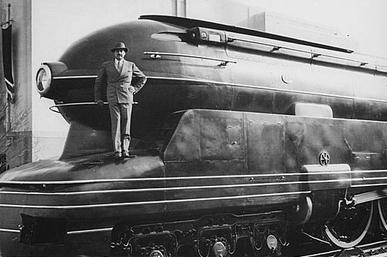
Loewy poses on the S1 Class locomotive.
Image from Wikipedia
In 1939, the Pennsylvania Railroad completed the experimental S1 class locomotive. Only one locomotive was produced, and it too featured a streamlined shroud, designed by Loewy. The S1 was originally intended to replace the Pennsylvania's fleet of aging K4 locomotives. The mechanical aspects of the locomotive were designed as a joint effort between the Pennsylvania Railroad, Lima Locomotive Works, American Locomotive Works, and Baldwin Locomotive Works. The Pennsylvania Railroad had hoped it would have the same performance and success as their GG1 locomotives. In the end however, it proved to be too big. It was the longest rigid frame steam locomotive ever built, and it had trouble negotiating some of the curves on the PRR. There were also problems with wheelslip and clearances. The locomotive was scrapped in 1949, and the railroad began to focus more on the T1 class steam locomotives.

A T1 class locomotive at the Baldwin plant, prior to
delivery to the PRR.
Image from Wikipedia.
In 1942, the Pennsylvania Railroad introduced its last steam locomotive, the T1 class. The T1 class locomotives were designed to be fast passenger locomotives. While very impressive locomotives technologically, they proved to be difficult to maintain. They were designed to operate at speeds up to 100 mph, although high speeds cause excessive wear and tear on valves, resulting in higher maintenance costs. They were so powerful that if the engineer was not careful, violent wheelslip could occur even at 100 mph. The T1 class was said to be "free steaming" locomotives, meaning the boiler was capable of producing more steam than the locomotive consumed at any throttle setting. The streamlined shell of the T1 class locomotives became known as a "Sharknose," and was designed by Loewy. The shroud on the T1 class left more of the running gear exposed, and allowed slightly better maintenance access than streamlining had on earlier locomotives.

After the T1 class locomotives, the Pennsylvania Railroad began to shift its focus to diesel, and eventually all passenger trains were pulled by diesel locomotives. Loewy redesigned many of the railroad's Baldwin diesels, and gave them a "sharknose" appearance similar to that of the T1 class steam locomotives. Besides locomotives, Loewy also did other design work for the Pennsylvania Railroad, which included marketing materials, passenger car interiors, and several station.

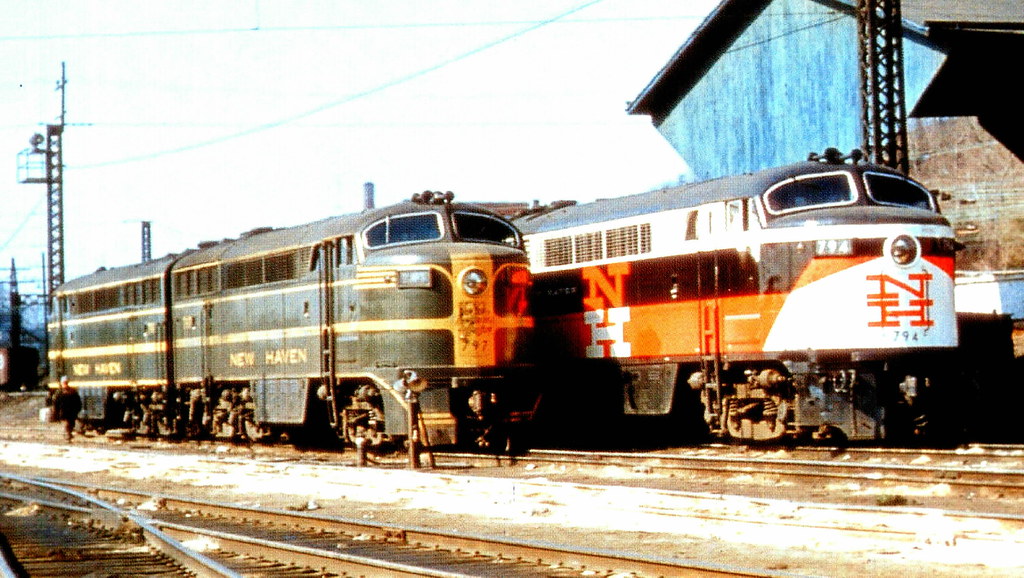
New Haven C-Liner locomotives.
Image from Flikr user torinodave72
Outside of the Pennsylvania Railroad, Loewy did design work for other railroads and other locomotive builders. In the late 1940's, Loewy worked with Fairbanks-Morse in the design of some of their new diesel locomotives, including the "Erie-built," the "C-Liner," and several others. In 1949, he also designed the Norfolk & Western Railway's new Roanoke, VA, station, which is now the home of the O. Winston Link Museum.

The railroad industry made up only a small portion of Loewy's work. Within the transportation industry, he also did extensive design work for Studebaker, designing a new corporate logo and some of the elements of their automobiles. He also designed the TWA logo in 1959 and the interior of Air France's Concorde in 1975. NASA's Skylab station was also a Loewy design. Outside the transportation industry, he also did work for Macy's, Saks, Sears-Roebuck, and many other firms. He also redesigned the Coca-Cola bottle and later designed their first steel soda cans. The Air Force One livery and the Coast Guard's "racing stripe" service mark were also Loewy designs. For a full list of his designs, please visit http://en.wikipedia.org/wiki/Raymond_Loewy#Loewy_designs.

Image from Google
Google has honored the work of Raymond Loewy with the Google Doodle on the left. It is designed to resembles Loewy's K4 class locomotive design, using the locomotive wheels to spell out Google.

Monday, November 14, 2011

Product Review: Walthers 2 Bedroom Buffet/Lounge

I recently purchased an HO scale model of a Buffet Lounge car once found on the Pennsylvania Railroad's Broadway Limited, made by Walthers.  For the last several years, Walthers has made models specific to one historically significant passenger train, and this year, they have created models of the cars for the Broadway Limited.  The Broadway Limited once operated daily between Union Station, in Chicago, and Pennsylvania Station, in New York.  It was a luxury train, with all first class accommodations, and a fast schedule with only limited stops.  The train was a direct competitor to the 20th Century Limited, of the New York Central System, and was one of dozens of trains connecting New York and Chicago.  Being a first class train, there were no coaches found in the consist.  The train had several different types of sleeping accommodations, as well as dining and lounge cars for passengers to eat, drink, and socialize as they rushed towards their destination.  The model I purchased represents a car built by Pullman Standard, specifically for the Pennsylvania Railroad to use on their Broadway Limited, which is a combination of two bedrooms, a lounge area, and a small buffet, where drinks and light snacks would be served to passengers in the lounge.

Exterior:
This car is painted in the tuscan red, used on many of the passenger cars, freight cars, and locomotives of the Pennsylvania's fleet.  It features gold pinstripes, and gold lettering.  The paint on the model is clear and crisp, with sharp lines, and no bleed over between colors.  All the lettering is crisp and clear, and the model generally represents the typical high quality of Walthers products.  A feature which is relatively new on Walthers passenger cars is painted window sashes.  On this model, as well as other cars in the Broadway Limited set, the window sashes have been painted a metallic silver color, for the metal sashes, or black, for the rubber sashes, depending on what type of window would have been found on the prototype.  While it is a small, relatively minor detail, it actually does quite a lot for the model, and makes it look a little sharper.
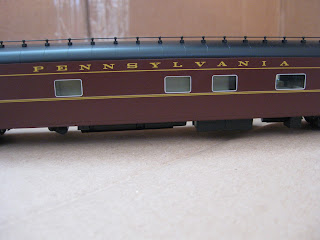
The car features proper under body details, all of which are separately applied.  The under body equipment is all painted black.  The car includes metal wheels, and metal truck side frames, which are designed to pick up electricity from the tracks.  A lighting kit can be purchased separately and added to the car for a lighted interior.  The car also features working diaphragms, and Proto MAX magnetic knuckle couplers.  Additionally, all the grab bars on the car come factory applied and painted.  The car comes with a decal sheet, so the modeler can choose the name and road number to be applied.  Instructions packaged with the car include a diagram for placing the number and name decals.

Interior:
As with all Walthers passenger cars, this car features an interior.  The interior is molded in a plain, beige plastic.  While most of the windows are small, the interior can be seen through the window.  The modeler could paint the interior if the beige was particularly problematic, although I have not found it to be distracting from the overall quality of the model.  The interior is accessed by removing the roof panel, which snaps into place.  While the model comes unlighted, all the electrical contacts are in place to add a lighting kit, also manufactured by Walthers.  Adding some people to the lounge area, inside the car, would also add to the overall appearance, especially if the model is in a place where it can be easily viewed.

Operation:
The car operates well right out of the box, although it does take a bit of effort to pull the thing.  This is pretty typical of Walthers passenger cars.  I have found that applying a very small amount of graphite to the ends of the axles helps the car roll more freely, without completely insulating the wheels from the interior electrical contacts.  The car is long, the prototype being 85 feet, and so it is limited in its turning ability.  I was able to pull the car around a curve as tight as a 21 inch radius, although the car looked rather silly on such a tight turn.  Walthers recommends a minimum radius of 24 inches, which would work better operationally, even if it still looks a little tight.  Overall the car comes ready to operate.

I am happy that I bought this model.  I had been thinking about it for quite some time, as the Broadway Limited was a very famous train at one time, and is quite significant historically.  Additionally, I have a small family connection to the train.  My great grandfather, who I did meet, though do not remember, was a regular passenger on the Broadway Limited.  He lived near New York, and work took him to both Washington and Chicago on many occasions.  His preferred way of getting to either place was the Pennsylvania Railroad, and he took the Broadway Limited to Chicago, and back many times, riding behind steam locomotives, and later diesels.  I imagine that on some of his trips, he sat in the very lounge this car represents, socializing with some of the other passengers, over some evening cocktails.

Manufacturer: Walthers
Retail Price: $69.98
Available Paint Schemes (Model Numbers): Pennsylvania (932-9680), Undecorated (932-9618)