Showing posts with label Great Northern Railway (GN). Show all posts

Friday, August 24, 2012

Photo of the Week: Drawbridge

This week, I finally visited something I have heard about for months.  East of Fairview, MT, just over the border in North Dakota, there is an old railroad drawbridge and tunnel.  They are no longer used for the railroad, and are open to the public to walk over and through.  The line they are on was once part of a project by the Great Northern to build a second main line, to the south of their existing one, which would connect New Rockford, ND, to Lewistown, MT.  This was known as the Montana Eastern Railroad, a wholly owned subsidy of the Great Northern.  This parallel line would serve the farms in the area that were currently out of reach of their existing line, across the northern part of North Dakota and Montana.  The Montana Eastern Railroad was never completed because of the economic downturn that came with the start of World War I, although the line was and still is used in parts throughout Montana and North Dakota, for local train service.

The Fairview Lift Bridge is located about four miles east of Fairview, MT.  It crosses the Yellowstone River.  Today, no ship traffic uses the Yellowstone River, but when the bridge was built, in 1913, the Yellowstone River was considered a navigable waterway, and regulations stated that bridges over navigable waterways must be at least 80 feet above average water level.  Since all commercial river traffic ended on the Yellowstone River in 1913, the only time the bridge was ever raised was at the end of construction, to test the lift mechanism.  The bridge is 1,320 feet long and comprised of several steel truss spans.  There is a sister bridge located in Snowden, MT, which is still used by rail traffic.  Because of light rail traffic, the bridge was also used to accommodate highway traffic until 1956.  Planks were laid on the ties, between and on either side of the rails, and gates were installed on either end to keep traffic off when a train was approaching.  A "Leverman" was employed to communicate with the railroad and operate the gates as necessary.  Vehicles using the bridge were charged a toll by the Great Northern Railway.  At its peak, the line handled one passenger train per day, and a few freight trains a week.


The bridge was built in 1913, at a cost of $500,000.  The towers are 108 feet tall, and the lift span weighs over one million pounds.  The span is s counter weighted to assist in lifting.  Because the counterweights so closely match the span weight, it only took a small, three cylinder, kerosene engine to raise and lower the bridge.  The lift span is nearly 300 feet long and is connected to the counterweights by 32 two inch thick steel cables, with eight at each corner and 16 per counterweight.  All the lifting mechanisms are still in place, with the exception of the kerosene engine.

Just east of the Fairview Lift Bridge is the Cartwright Tunnel, which is the only tunnel in the state of North Dakota.  The tunnel is 1,458 feet long, and was built in 1912 and 1913.  The tunnel was primarily excavated by hand, though horse drawn scrapers and blasting powders were used to build the approaches.  The tunnel walls and ceiling are lined with timber, and the floor is braced with heavy timbers to prevent the walls from pushing into the former track area.

Wednesday, March 7, 2012

Prototype Railroading: Familiarization Trips

Because trains operated considerably differently than highway vehicles, and therefore require a considerable knowledge of the tracks ahead, an engineer cannot simply get on a train and run it over a stretch of track he has never seen, even if he has the card allowing him to run the train.  Since engineers usually stay primarily at the same terminal, usually this is not an issue.  In Glendive, for several years, engineers have either operated on the Dickinson Sub, west of Dickinson, or on the Forsyth Sub, east of Forsyth.  Since those were the only two lines we ran out of Glendive, all the engineers were pretty well familiar with those stretches of track.  Recently, however, we have had a little change.

Besides the Forsyth and Dickinson subdivisions, there are two other railroad lines out of Glendive.  The Circle Sub runs west, towards Circle, and is the remainder of the former Northern Pacific Redwater Branch, which once went to Brockway.  From Glendive to Circle, the line has a 10mph speed limit, and has not been used in years.  I think the railroad keeps it to store cars, and just in case oil or coal starts to be produced out near Circle.  The other line out of Glendive is the Sidney Branch, which was leased to and operated by the Yellowstone Valley Railroad (YSVR) for several years.  In January, the lease ran out, and BNSF took the line back from the YSVR.  The line runs north to Sidney, and then on to Snowden, where it connects to the Hi-Line.  Many years ago the Northern Pacific owned and operated the line as far as Sidney, while the Great Northern owned it between Sidney and Snowden.  In the last few years, as the oil industry has grown in the area, the amount of traffic on the Sidney Branch has picked up considerably, and BNSF anticipates it will continue to grow.

The Yellowstone Valley Railroad leased the Sidney Branch from the BNSF for several years, seven is what I am told.  Because of that, BNSF crews working in Glendive really had no reason to go north on that branch.  Since it had been so long since anyone in Glendive had operated on the line, and since there were quite a few engineers that had never been up the line, it was decided that everyone would need to be familiarized on it.  This only applied to engineers, so Conductors were allowed to go up there without having ever seen the branch before.  Over the last couple of months, when a train has been called for the Sidney line, typically a qualified engineer will be called, and a second engineer will be called to familiarize.  The idea is that the familiarizing engineer will operate the train, under the direction and supervision of the qualified engineer.  After a round trip to Sidney, and engineer is qualified to operate on the line.  Right now, the speed limit goes back and forth a few times between 10mph and 25mph, and there are no signals on the line.  Last time I went up there with a familiarizing engineer, he said it was a pretty easy line to run, just because it is a slow line, and there is only one siding between Sidney and Glendive.

Engineers are the only people required to familiarize on a line, because they are the only ones authorized to operate the train.  Conductors can go on unfamiliar territory, and basically get to wing it!  At this point, I have made a few trips up the Sidney Branch, and it is not a difficult line to work on.  But the first time I went up there, I felt completely lost.  First of all, I never go to Sidney, even on my time off, so I was not real familiar with the area anyway.  Also, I had never worked in dark territory (territory with no signals), and there are a few small differences when compared to track warrant control with signals.  There is a little extra paperwork, where the Conductor has to record the position of every switch operated, and sign off that they were left in the position instructed by the dispatcher.  Whenever a track warrant is cleared with the dispatcher, the Conductor has to let the dispatcher know that the position of switch form is up to date and that all the switches are lined and locked as he or she instructed.  On my first trip up there, no one told me ahead of time that I had to do that, or have that paperwork.  Fortunately, I had an engineer that had worked in dark territory before, and helped me out a lot.  And by sheer dumb luck, I happened to have a whole pile of the position of switch forms in my grip already!  On that first trip, we were to pick up a train at Crane, which is where the only siding between Glendive and Sidney is located.  Since it is dark territory, all the switches are hand operated.  The train was in the siding, which meant that someone had to line the switch before the train could go anywhere.  Once the switch was lined for the siding, the train could pull out, but then the switch had to be lined back for main track movement.  We had a brakeman on that trip, so he got to line the switch, and the crew van driver stuck around to give him a ride back to the engines after he lined it back behind the train.  It's a little trickier without a brakeman, which was the case on my next trip.  The rest of the trip to Glendive was pretty uneventful.  Going 10mph for miles at a time is really not very exciting!  It was interesting to see the line though, and see some different scenery.

On my next trip up the Sidney Branch, we actually made a round trip.  We first took a whole lot of empty tank cars to Oneok, which is an oil loading facility just south of the yard in Sidney.  We were supposed to be meeting a train there and returning to Glendive with it, but we ended up meeting them at Crane, which is five miles to the south.  We put all the tank cars where they needed to be at Oneok, and then a van met us and took s to Crane, where the previous crew had left the train.  The YSVR had brought it down there from the yard in Sidney, which is about as far as they operate on the line anymore.  This time, we did not have a brakeman.  The train was on the siding at Crane, as expected.  They YSVR had either neglected to air test the train, or had neglected to leave us any indication that they had.  In any event, since we had no indication that an air test had been done, we had to do one.  I had the van drop me off near the last car of the train, and then we began the air test.  The engineer set the brakes, and I walked up to the front of the train, about 4,500 feet away, inspecting each car along the way, and inspecting the brakes on each car, to make sure they had set up properly.  When I got to the front of the train, I lined the switch and the engineer pulled the train out of the siding.  As it rolled slowly by I inspected each car to make sure the brakes had released properly.  With the air test complete, and the train out of the siding, I lined the switch back to the main.  Our warrant actually allowed us on the main track between switches at Crane.  Ideally the dispatcher would have given us permission to pick up a crew member, which means that no one has to watch the shove, and the train could have backed up to pick me up.  However the dispatcher had only given us permission to make a reverse movement, which meant someone had to protect the shove as the train backed up.  There was a crossing near the south switch, so I watched the shove back, and met the van where it had left me to do the brake test.  Once the engines were near that crossing, I hopped in the van and got a ride around to the front of the train.  It sure beat walking!  All of this work, especially during my first trip, made me think that Conductors really ought to get some sort of familiarization as well though.  My engineers on both of those trips really made my life a lot easier, because both of them had been up the line more than I had, and had more experience working in dark territory.  On both trips, I learned a lot of new information, and went to places I had not even seen pictures of before.  Several people had tried to explain exactly how things were laid out at these locations, and their explanations helped a lot, but everything made a lot more sense when I was there, looking at what my engineers were explaining.

Now that I have been up the Sidney line a few times, I actually like the run.  It is a nice change from the constant runs to Forsyth, and at the end of the day, we go home, which is always nice.  The trip is slow, and running at 10mph can get to be a bit boring, but the work is more interesting and it's a nice change of scenery.  Currently there is no Sidney pool job, so all the jobs on the Sidney line are called off the extra board, which means a little bit of dumb luck is what gets you on one of those trains (off away from one, depending on your perspective.), but they keep talking on and off about establishing a pool to shuttle trains up north.  Personally, I think they ought to forget the shuttle idea and just run some local trains, but the railroad will probably try to avoid locals if they can, because the local crews get a higher rate of pay, making them more expensive to the railroad.

In other news, I got a little surprise the other day.  I was standing around in the depot, waiting for the crew office to decide what to do with me.  They had called my engineer and me for a grain train, which was outside of the area we can work in, as Glendive crews.  They thought about sending us home, but eventually decided to have us go get some engines off a work train in Terry.  While I was standing around the depot, waiting for the phone to ring, one of the engineers surprised me.  He made a comment about something I had written on here.  I think I was more surprised that anyone at work would read this than anything else!  I hardly knew what to say, because I just had not expected it.  I have wondered to myself on occasion, if other railroaders have ever found this, and I guess I have my answer now!

Thursday, September 8, 2011

History of the Empire Builder

On Tuesday, we talked about Amtrak's Empire Builder. Today, we are going to talk about how that train came to be, which takes us back to the late 1800's, long before anyone had ever thought of Amtrak. The Great Northern Railway was created by tycoon James J. Hill from the St. Paul and Pacific Railway, and several other railroads he owned at the time. The railroad was headquartered in St. Paul, and James Hill had a dream of connecting that city with the Pacific Ocean. His dream was realized on January 6, 1893, in Scenic, WA, when the countries northernmost transcontinental railroad was completed.

James J. Hill, circa 1890.
Image from Wikipedia.
James Hill became known for keeping the work on the railroad going, even against obstacles. His goal was the shortest, straightest, and flattest route possible to the Pacific Ocean. He had no interest in developing Rocky Mountain scenery, he just wanted to develop a railroad to the Pacific. He did a lot of the route planning himself, and even rode the proposed routes on horseback. If an area the railroad was expanding to did not have enough industry, Hill would buy out a company and bring the industry in, just to generate rail traffic and produce business for the line. He let nothing stop him, and he refused Federal money, and only accepted a few land grants. The Great Northern was the only transcontinental railroad built without any Federal financial support. Because of Hill's attitude and ruthless expansion, he became known as the Empire Builder. Hill died in 1916, and never saw the launch of the train named for him, the Empire Builder.

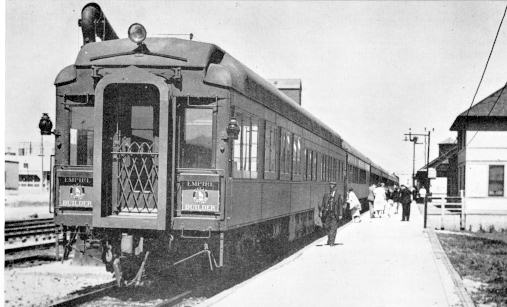
The Empire Builder Solarium observation car, idles in
Shelby, MT. Photo from www.gngoat.com.
On June 11, 1929, the Great Northern decided to launch a new premier train, and they chose to name it the Empire Builder, in honor of James Hill. The train displaced the Oriental Limited as their premier train, and it operated between Chicago and Portland and Seattle, using Chicago, Burlington, and Quincy trackage between Chicago and Minneapolis. The train was a 14 car train, pulled by a 4-8-4 steam locomotive. For World War 2, the service was altered to accommodate the higher demand for the railroad. After the war, in 1947, the train was re-equipped for the first time.

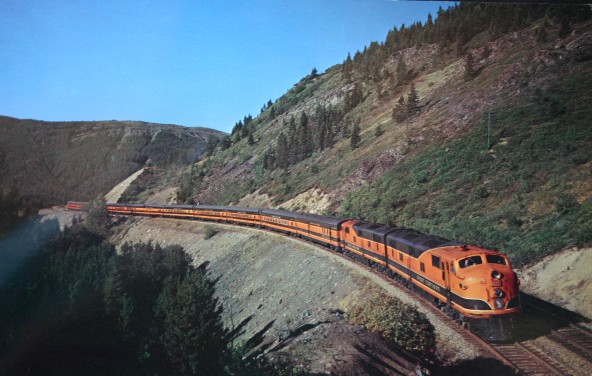
The 1947 Empire Builder, near Glacier
Park, MT. Photo from www.gngoat.org
In 1947, the Great Northern gave a new look to the Empire Builder. It was re-equipped with new, streamlined passenger cars, and the steam locomotive was replaced with a pair of shiny new diesel locomotives. This is when unveiled its famous orange and green paint scheme, which became a trademark of the Great Northern. The diesels and cars were all painted to match, and they really stood out in the new Empire Builder paint scheme. The new diesels were streamlined to match the new passenger cars. Diesel was still new. Premier trains got diesels first, and the steam locomotives kept pulling the less well known trains and the freight trains. In addition to being new power, diesels were a status symbol for the railroads.

The Empire Builder, after the 1955 addition of the dome
care. Photo from www.greatnorthernempire.net.
In 1951, the Empire Builder was re-equipped once again. A new set of diesels was assigned to the train, and in 1955, dome cars were added to the passenger cars. The Empire Builder boasted more seats under domes than any other train. Several coach dome cars were added, and one full length dome car was added for the First Class passengers. The train featured food service in three cars, including the dining car, the full length dome, and the coffee lounge car, better known as the Ranch car. The Ranch car featured a western themed decor, with a variety of options for dining, from light snacks to entire meals. There was bar seating, table seating, and lounge seating. The full service dining car served three meals per day, all cooked to order. In the full length dome, First Class passengers could order food and drinks while enjoying the view of the scenery under a large, glass dome. Attendants were happy to deliver food to any sleeping car accommodations or coach seats as well.


Drawing of the interior if the Ranch car, taken from a Great Northern
publication entitled, "The Ranch."
The entire train had a western theme in the artwork. Many of the cars were decorated with northwestern Indian artwork. Some, like the Ranch car, had a western, ranch theme. With the hide seats and wooden partitions, the ranch car was supposed to make passengers experience the areas of North Dakota and Montana that they were travelling through, and looking at outside the windows. The dome cars gave passengers some spectacular views as they traveled along the Mississippi River, through the Rocky Mountains, over Stevens Pass, and through the Columbia River Gorge.

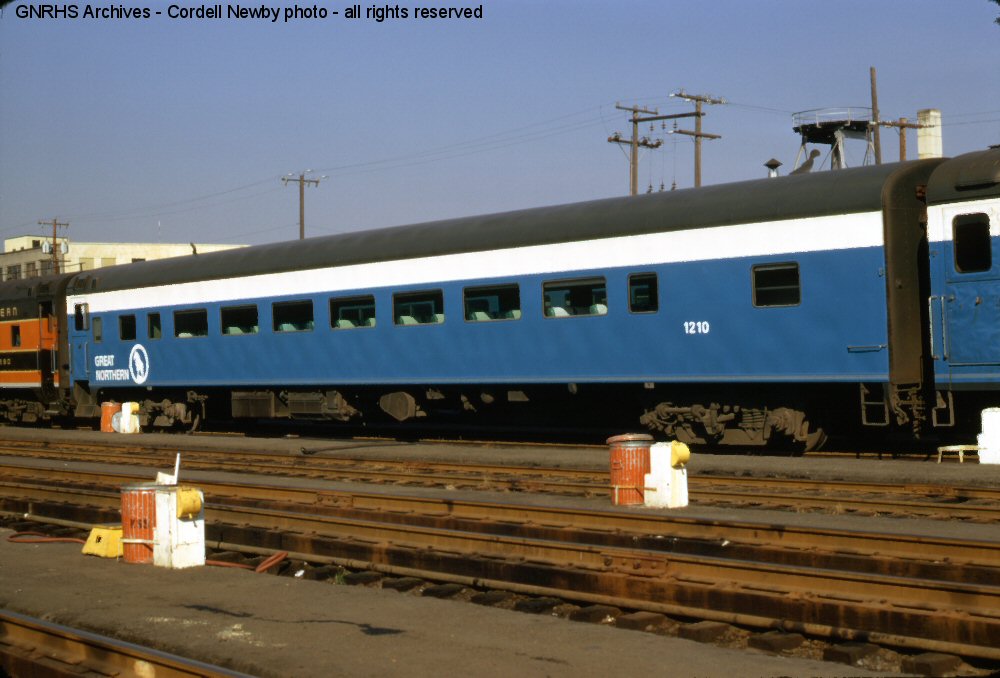
An Empire Builder coach in the "Big Sky Blue" paint
scheme. Photo from GN Historical Society archives.
Train travel during this time was often viewed differently than it is today. Many people have heard the phrase, "Getting there is half the fun." Railroads went to great lengths to ensure that the trip would be as much a part of the experience as the destination. Rail travel was stylish, and celebrities rode well known trains, because they wanted to be associated with that train, and all the style and luxury that went with it. The Empire Builder, in its day, was one of those trains.

In its later years, the Great Northern decided to change the company image a bit. Passenger trains, including the Empire Builder, were painted in what became known as the "Big Sky Blue" paint scheme. This lasted for a few years, until the Great Northern Railway ceased to exist.

A former Great Northern sleeping car, from the Empire
Builder
, in the Burlington Northern "Hockey Stick" paint
scheme. Photo from www.rrpicturearchive.net.
In 1970, just over a year before the creation of Amtrak, the Great Northern Railway merged with the Northern Pacific Railway, the Chicago Burlington & Quincy Railroad, and the Spokane, Portland, and Seattle Railway, to form the Burlington Northern Railroad. The Burlington Northern continued to run the passenger trains of all four of its predecessors for thirteen months, until Amtrak was created, on May 1, 1971, and took over most passenger operations nationwide. During the time Burlington Northern ran passenger trains, they were repainted again, to a paint scheme known as the hockey stick scheme. When Amtrak was created, on 1 May 1971, they took over all of the Burlington Northern passenger trains, including the Empire Builder. Since Amtrak took over, new equipment has been introduced, and the route has been changed a few different times. While they still run a train known as the Empire Builder, it has changed quite dramatically since it was the pride of the Great Northern.
Photo of the Empire Builder in Montana. Photo is from the rear cover of a Great Northern publication entitled, "Great Domes on Great Northern's Greatest Train." This booklet was published in 1955 when the GN introduced dome cars to the Empire Builder.

Saturday, June 25, 2011

Prototype Railroading: Detours

Occasionally, a rail line goes out of service for one reason or another, and when that happens, usually the important trains get detoured, and the low priority ones get cancelled, or they wait until the line reopens.  Lately this has led to an interesting situation in Montana.

During the spring this year, eastern Montana and North Dakota got a lot of rain.  That caused rivers to rise and trains to be rerouted due to flooding.  It led to mudslides that closed different sections of track for anywhere between a few hours and a few days.  The rivers are about 12 times their normal height, although at this point are not considered flooding anymore.  Western Montana has mountains, which still have snow on them.  Every year, in June, rivers rise as that snow all melts off.  So now we are in the predicament where the rivers are already very high, just a few feet below flooding, and the snow is finally melting, sending more water down the rivers.  On the former Northern Pacific, while the river is very high, we have not had any flooding issues yet.  On the Hi-Line, the former Great Northern, on the other hand, the tracks are under water in some places.  There is significant flooding in the Minot, ND, area.  Because of that flooding, the trains that normally operate on the Hi-Line have to go somewhere else.  The low priority ones are being delayed until the flooding stops.  BNSF estimates that the line will be flooded for 10 to 14 days.  It could be several more weeks until the line is back to full service, depending on the flood damage.

The higher priority trains operating on the Hi-Line cannot simply be cancelled, because customers are paying big money to have those trains arrive on time.  They will not arrive on time, but there is no sense delaying them upwards of a month.  Instead, they are all being rerouted on the former Northern Pacific, or right through the area I work.  Typically the Hi-Line has a lot of intermodal and vehicle trains, which we almost never see here.  We are on a coal route, so we mostly have coal trains.  When things are operating normally, we have exactly one intermodal train, which is usually only five to eight loads.  It goes to Billings.  Yesterday however, I was assigned to a train full of shiny, new Hondas, all bound for Albany, NY, Ayer, MA, and Wilmington, DE.  That train would normally have operated over the Hi-Line.

While we get some more unusual trains through this way when the Hi-Line is closed, it leads to some operational problems.  The Hi-Line is all controlled by Centralized Traffic Control, or CTC, it has high speed switches, and it is mostly two main tracks.  Trains are able to operate at a higher speed on the Hi-Line, and the line has a capacity for more trains and longer trains.  When all those trains come here, they have to operate slower, and fewer of them can operate at a time.  Because of this, dispatch has chosen to make the railroad an eastbound railroad.  We take a van or bus to Forsyth, and then we catch a train back to Glendive.  They can operate more trains if they are all going in the same direction.  They only run what westbound trains have to run, and for the crew that gets that, it is a very long day, because they meet dozens of eastbound trains.  Part of the reasoning behind this is that the trains that normally operate on the Hi-Line are longer than most of the sidings we have here.  When a train is 8,000 feet long, and only one siding every 150 miles can hold it, it really makes arranging meets difficult.  There is simply nowhere to put the train.  Having most of the trains going the same direction also makes that less of a problem.  The few westbound trains can meet the really long ones just about anywhere.

When the Hi-Line was closed, there was one high priority train that did not get detoured.  That was Amtrak's Empire Builder.  There were rumors that it would be detoured, but it just does not make sense.  The detours are effective from Spokane, WA, to Fargo, ND.  It could be shortened to Shelby, MT, on the west end, but that still would mean Amtrak would miss a lot of the normal stops, and be making stops nowhere near the regular ones.  Instead, Amtrak chose to run the train near the ends, with a gap in the middle, and no alternate transportation.  Even if Amtrak chose to detour on this route, the speed limit is lower, and the switches are mostly limited to 10 mph, so Amtrak would incur huge delays, again making it impractical.  So Amtrak will be canceled until water levels drop and the track gets inspected and repaired.  The important freight trains will continue to run, but on this line, the old Northern Pacific, and we will all spend less time in Forsyth as a result. I'm okay with that!

On a side note, here is a bit of trivia for you.  The Great Northern Railway was built by James J. Hill, who was known for being fiercely independent.  The rail line was built from Minneapolis to Seattle, and as a result of Mr. Hill's independence, it was the only western railroad completed with no federal subsidy.