Showing posts with label Stations. Show all posts

Saturday, March 30, 2013

Photo of the Week: Anchorage Depot

This week our (not so) weekly photo comes from Anchorage, AK. This is the Alaska Railroad depot, in Anchorage, still with a layer of snow on and around it.

The depot is a quiet place during the winter. Between October and May, the Alaska Railroad only runs a few passenger trains per month, one to Fairbanks and back each weekend, and one to Hurricane on the first Thursday of each month. By the middle of May however, the depot will be a busy place several times a day, with daily departures to Fairbanks, Seward, and Whittier. The passenger trains will get longer as tourist traffic increases in the spring. Freight traffic also picks up in warmer weather, and is beginning to pick up now. It will slow down again in the fall, just like passenger traffic does. The Alaska Railroad is the only railroad in the US that still carries both freight and passengers.


The depot itself was built during World War II, to help accommodate the increase in passenger traffic during the war. Interestingly, the Alaska Railroad carried more troops during the war than any other railroad in the US. The depot has been renovated and remodeled inside since its completion. In the last couple of years, a high level platform was added to meet ADA boarding requirements.

The locomotive that sits out front, ARR #1, is an old tank style steam locomotive, with an 0-4-0 wheel arrangement. The locomotive belonged to the US government and was built for use in the constriction of the Panama Canal. The canal was finished in 1914, and many of the newly surplussed locomotives and freight cars from that project were brought to Alaska, to build the "government railroad." The federal government owned and operated the Alaska Railroad until the 1980s, when the state of Alaska purchased the railroad. Since the state purchased it, the railroad has been operated for profit and pays all of its operating expenses without receiving a subsidy from the state.

Monday, March 4, 2013

Walthers City Station Project

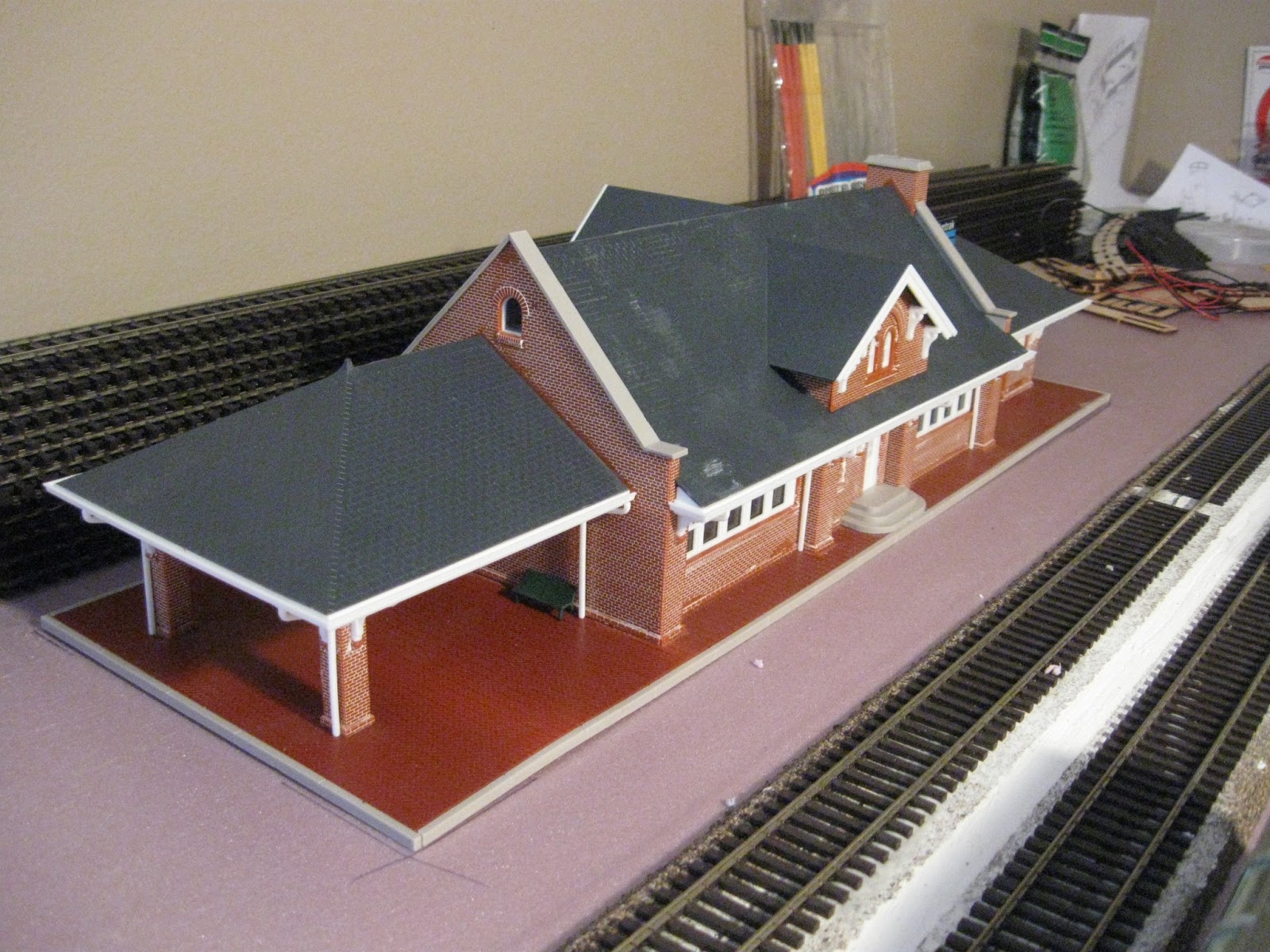
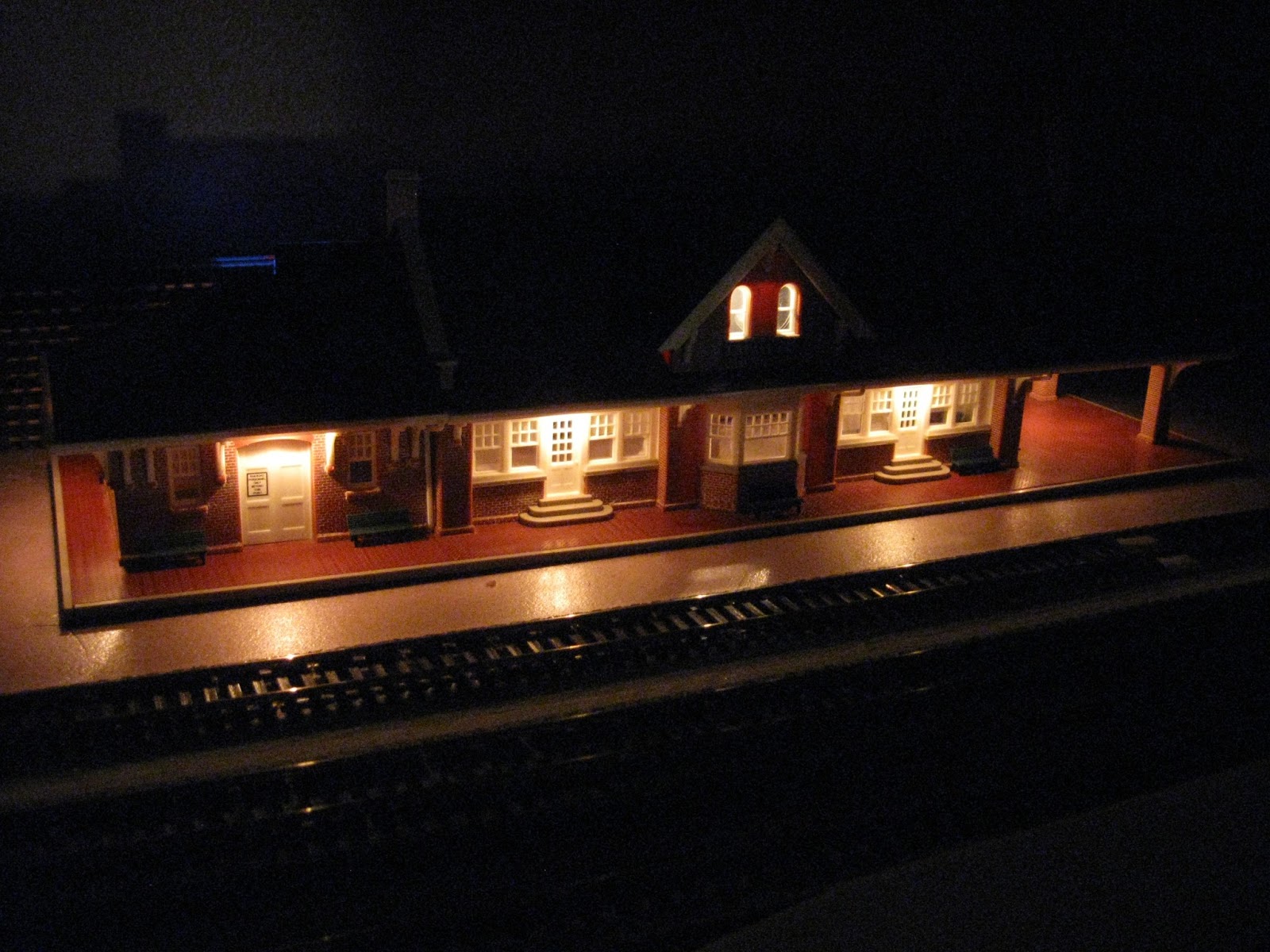
I recently (finally) completed Walthers' City Station, for my model railroad. It has had a few personal touches added to it as well. The most noticeable addition is interior and exterior lighting. I have also added some benches, and a neon Amtrak sign. Other than that, the kit is pretty much the same as it was designed to be built, out of the box.

I decided to add lighting when I first started building the model. When I first bought it, it was shipped to New Hampshire, and Steven, in a fit of ambition, decided to start on it. When he moved, he shipped what he had done out to me. At that point, he had added mortar to the brick walls and assembled the main walls. He had also installed most of the windows.

When I got it, I started planning where I wanted lights. This building has fairly small windows, which are difficult to see into, so I decided not to put a detailed interior in it. While I wanted light in the windows, I really wanted a nicely lit exterior, providing lighting for the outdoor waiting areas and the platform. I had quite a few miniature light bulbs on hand from a few other projects, and decided to use those. They operate on 12 volts, so I would not need to put in any resistors or other electronics. I decided there would need to be lights by every door, to light the steps, so people could get in and out safely. Additionally, I wanted lights under the portico, on one end of the depot, so that people waiting under there would have light. A few other lights under the overhang in the roof would balance everything out, and eliminate dark areas around the depot.

Once I decided where to put all the lights, I painted all the interior walls black, to help eliminate any light leaks. I then drilled holes for the bulbs, exactly the size of the bulbs. I then painted the holes black, to help reduce any glow in the plastic, around the light bulbs. I did not want lots of hanging lights, so the light bulbs would be embedded in the plastic to some degree, giving it more of a recessed lighting look. Before installing any light bulbs, I used a scrap piece of plastic from the kit, drilled a hole in it, and placed a light bulb in it and turned it on. I wanted to make sure the light bulbs would not melt the depot! I put the test light bulb on a higher than recommended voltage, and let it sit for several hours. While the plastic was warm, the heat from the light bulb did not seem to be enough to cause it to melt. With that confirmed, I began installing the light bulbs in the depot itself.

As I Installed the light bulbs, I tried to keep the wiring as neat and organized as possible. While it is difficult to actually see in the windows, I did not want wires hanging down in places they would cause shadows or would be easily seen. The interior would be lit, so even wires inside could cause noticeable shadows if they were in the wrong place. After I installed the exterior light bulbs, I put in all the inside ones. I did not want the depot to radiate light, I just wanted there to be enough inside to make it look used. I did not want dark windows on the building.

As I was finishing up installing the light bulbs, I decided I wanted to add a neon Amtrak sign. Miller Engineering (www.microstru.com) makes a fairly significant selection of simulated neon signs, for several model scales, including HO, N, and O. I found an Amtrak sign that was originally designed to be used as a sign hanging from a wall, over a sidewalk. I intended to put it on the roof, although I did not want one as big as their Amtrak billboard. I made a small cut in a wall next to where I wanted the sign, using a hobby knife. I tested the sign several times to make sure it would fit, as I was cutting the hole. The hole was the smallest thickness I could get away with and have the sign fit. I installed the wiring behind the wall, which is high enough up to hide it from view through the windows. Below the table top of the model railroad, I installed a converter module to power the sign, using power from my 12 volt accessory bus wire. I then ran the sign wires and all the light bulb wires to a 4-pin modular plug, like those used in phone lines.
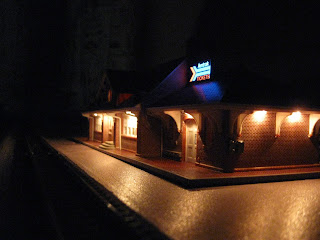
Beneath the layout, I ran some feeder wires from the accessory bus to the hole in the table top. Another set of feeder wires went to the sign module. Under the table, I wired the sign leads and the lighting leads to a 4-pin modular connector, similar to a phone jack. When I placed the depot on the table, all I had to do underneath the table was plug in the modular plug and connector, and turn on the light switch, and the depot lit up. I like using the modular connectors because they allow for quick, easy connections. I can remove the depot easily, for cleaning, and when the time comes to weather my track.

As an afterthought, I decided to add some blinds inside the windows, to help conceal the lack of an interior. I also found some green benches, and placed those around the outside of the depot. Additionally, I found an electric meter, and mounted that on an exterior wall. I still would like to add some support legs to the neon sign, but other than that, I am quite satisfied with the depot. I like how much light it gives off, and once there is a platform in place, it will be a nice centerpiece to the station area.





Friday, July 13, 2012

Photo of the Week: 7/13/2012

This week we feature Union Station, in Kansas City.  Union Station was built in 1914, in the heart of Kansas City, by twelve railroads that once provided passenger rail service to the area.  Originally, it had 20 tracks, and the main concourse, with its 100 foot ceiling, was designed to hold 10,000 people.  The building had shops, dining, shoe shine service, a barber, cigar shop, post office, spacious waiting rooms, and offices for several railroads.  Besides passengers, mail and express goods also came through Union Station.  The entire building had over 850,000 square feet of usable floor space, in over 900 rooms.  The building was huge, just as railroad stations were in many major cities all over the country.

As passenger rail service fell into decline in the 1960's and 1970's, Union Station began to see less passenger traffic.  Eventually, maintenance budgets were cut, and the station ultimately fell into disrepair.  Amtrak continued to use Union Station into the 1970's and early 1980's, for the Southwest Chief, but eventually the building was in such bad shape, that they were forced to leave Union Station and build an "Amshack" nearby to serve passengers.  In the 1990's however, the station was given a new life.  Starting in 1997, the station was completely renovated and cleaned, inside and out.  By the end of the project, over 10 million pounds of dirt and debris had been removed.  The roof was replaced with identical tiles, and the interior was completely restored.  The chandeliers, which are each 12 feet in diameter, contain a half mile of wiring, and require over 11,000 watts, were all carefully dismantled, then cleaned and restored, and reassembled.  The ceiling had to be mostly replaced because of water damage, but every detail was reconstructed in plaster, just as the original had been.  The company responsible for the ceiling had also restored the ceilings Grand Central Terminal and Windsor Castle.  The color of every part of the building, from paint to metal, stone, roof tiles, and plaster, was carefully and painstakingly matched by a process of carefully scraping away the dirt and grime, one layer at a time.  The entire restoration took approximately two years to complete.

Today, Union Station is a very attractive landmark, right in the middle of town.  Most of the passenger tracks are gone, only two remain.  There are six passenger trains per day that stop there, so it is still much quieter than it was in decades past.  However, the building sees many visitors every day, because there is once again fine dining, shops, exhibits, and events in the station.  The station plays host to a number of traveling exhibits as well as permanent ones.  There is a planetarium and science center there, as well as a model railroad, post office, several gift shops, and fire fighting museum.  In addition, during my visit, an exhibit of artifacts from the Titanic was also at the depot.  Of course, Amtrak once again has a presence in Union Station too, having returned in 2002.  The "Amshack" is nothing more than a small crew office now, and serves no function for passengers.

And finally, the photos!